
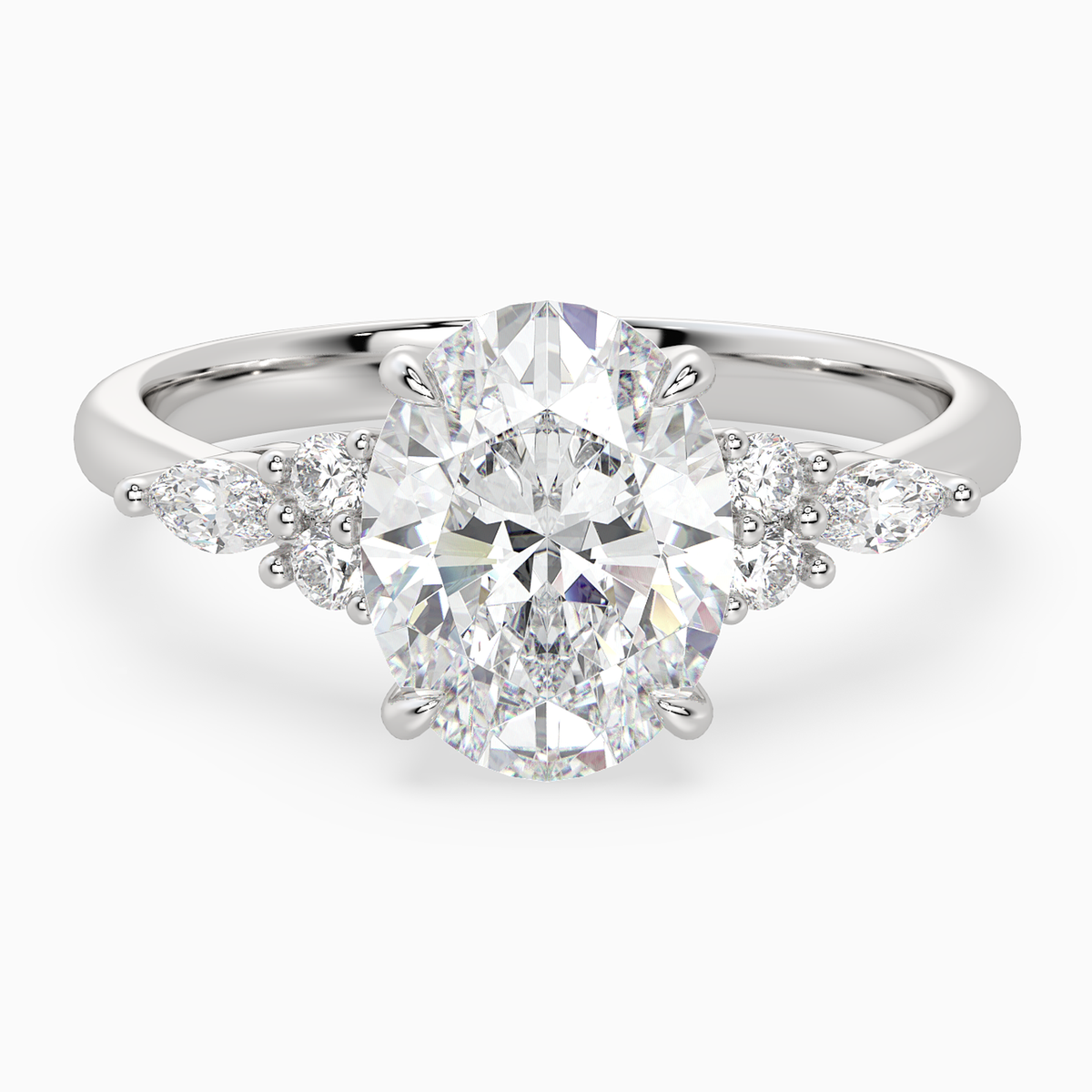


Diamond Clarity Guide
VVS vs VS Diamonds: Clarity, Value and What to Choose

VVS and VS are both high diamond clarity ranges, and both can look clean and brilliant in an engagement ring. The real question is not whether VVS is technically better. It is whether the upgrade will change what you see, how the ring wears, and how intelligently your budget is allocated.
This guide compares VVS vs VS diamonds in practical terms: what the grades mean, when the difference is visible, how clarity affects price, and when a lab-grown diamond buyer should prioritize VVS, VS1, or VS2.
The Short Answer
Choose VS clarity if you want an eye-clean diamond and prefer to keep more budget available for cut, carat weight, setting quality, or overall design. Choose VVS clarity if you value a more technically pure stone, are buying a larger diamond, are considering an open-facet shape, or simply want extra peace of mind.
- VS diamonds are often the stronger value choice when the stone is eye-clean.
- VVS diamonds have inclusions that are extremely difficult to locate under magnification.
- Most shoppers will not see a meaningful difference between a well-selected VS and VVS diamond in daily wear.
- Cut quality usually affects sparkle more than a move from VS to VVS.
- In lab-grown diamonds, a VVS upgrade can be reasonable when the price gap is modest and the rest of the specifications are already strong. Use our diamond clarity guide and 4Cs diamond guide for the broader decision framework.
What Diamond Clarity Means
Diamond clarity describes the presence of internal characteristics, called inclusions, and surface characteristics, called blemishes. A clarity grade is assigned after a grader examines the diamond under 10x magnification and considers the size, number, position, color, and visibility of those characteristics.
For engagement ring shoppers, clarity matters because obvious inclusions can affect appearance, transparency, or confidence in the stone. But clarity does not automatically equal beauty. A technically higher grade can still be less visually appealing if the cut is weak, the diamond is poorly proportioned, or the setting does not suit the stone.
VVS vs VS Diamonds at a Glance
| Factor | VVS Diamonds | VS Diamonds |
|---|---|---|
| Meaning | Very, very slightly included. | Very slightly included. |
| Subgrades | VVS1 and VVS2. | VS1 and VS2. |
| Under magnification | Inclusions are extremely difficult for a skilled grader to find at 10x. | Inclusions are easier to find at 10x but still usually minor. |
| To the naked eye | Usually eye-clean. | Often eye-clean when selected carefully. |
| Best for | Large diamonds, open-facet cuts, buyers who want technical purity. | Value-focused shoppers, brilliant cuts, most engagement ring styles. |
| Budget impact | Typically higher, though lab-grown pricing can narrow the gap. | Often leaves more room for cut, carat, setting, or design upgrades. |
What Is VVS Clarity?
VVS stands for very, very slightly included. Inclusions in this range are so minor that they are difficult to locate even under 10x magnification. VVS1 is generally cleaner than VVS2, but both grades sit high on the clarity scale.
A VVS diamond can be a smart choice when you want a stone with very limited internal characteristics, especially if the diamond is large enough for small details to matter more. It can also be appealing for step cuts such as emerald and Asscher diamonds, where broad, mirror-like facets reveal the body of the stone more clearly than a busy brilliant-cut facet pattern.
What Is VS Clarity?
VS stands for very slightly included. VS1 and VS2 diamonds have inclusions that are more noticeable under magnification than VVS inclusions, but many VS diamonds are still completely eye-clean in normal viewing conditions.
That eye-clean point is why VS clarity is so useful for engagement rings. If the inclusion is small, lightly colored, placed away from the table, or hidden by the setting structure, the visible result can be excellent. A shopper who chooses a strong VS diamond can often redirect budget toward a better cut, a larger center stone, or a more considered setting.

Can You See the Difference Between VVS and VS?
Most shoppers cannot see the difference between VVS and a well-selected VS diamond without magnification. In daily wear, the ring is viewed from changing angles, in changing light, and at a normal distance. A small inclusion that is visible on a grading plot may not be visible when the diamond is set and worn.
The exception is when a VS diamond is not truly eye-clean for its size, shape, or setting. A dark inclusion near the center table, an inclusion that reflects inside the stone, or a large inclusion in a step cut can be more noticeable. This is why clarity should be evaluated stone by stone, not only by the grade printed on a report.
The Eye-Clean Test
If you are deciding between VVS and VS, ask a practical question: can the inclusion be seen with the unaided eye from normal viewing distance? If the answer is no, a VS diamond may deliver the same visible beauty while preserving budget for specifications that influence the ring more directly.
When VVS Clarity Is Worth Considering
VVS is not always necessary, but there are situations where it makes sense. Consider VVS clarity when the diamond is larger, when the shape has broad open facets, or when the setting leaves the stone highly exposed. VVS can also be worthwhile when the price difference is modest and you already have the cut, color, carat weight, and setting where you want them.
VVS may be the better fit if:
- You are choosing an emerald, Asscher, or other step-cut diamond.
- You are buying a larger center stone and want more clarity confidence.
- You prefer a technically cleaner diamond even when the visual difference is subtle.
- You are building a minimal solitaire, tension-style, or open setting where the stone is highly visible.
- The lab-grown diamond price difference between VS and VVS is small enough to justify the upgrade.
When VS Clarity Is the Smarter Value
VS clarity is often the most balanced choice for brilliant-cut engagement rings, including round, oval, pear, cushion, radiant, and princess diamonds. These cuts use more facet activity, which helps make minor inclusions harder to notice in normal wear.
VS can also make sense when your goal is maximum visible beauty rather than maximum technical purity. A well-cut VS diamond with excellent proportions will usually look more compelling than a higher-clarity diamond with weaker light performance.
Cut Usually Matters More Than Clarity
Clarity protects the diamond from visible distractions. Cut determines how the diamond returns light. Once a diamond is eye-clean, moving higher in clarity often creates a smaller visible change than improving cut quality, proportions, symmetry, or overall stone selection.
For most buyers, the sequence should be: choose a strong cut first, confirm the diamond is eye-clean for its shape and size, then decide whether VVS adds enough confidence or meaning to justify the cost.
How to Choose Between VVS, VS1 and VS2
| Your priority | Best clarity direction | Why it works |
|---|---|---|
| Best visible value | Eye-clean VS1 or VS2 | You avoid paying for clarity you cannot see and keep budget flexible. |
| Technical purity | VVS1 or VVS2 | You gain a cleaner grading profile and more confidence under magnification. |
| Larger diamond | VS1, VVS2, or VVS1 | Inclusions become easier to notice as the diamond gets larger. |
| Step-cut diamond | VS1 or higher | Open facets make clarity more visible than in many brilliant cuts. |
| Budget for setting design | Eye-clean VS | The saved budget can improve the ring's structure, profile, or custom details. |
Burvonti's Practical View on Clarity
At Burvonti, clarity is treated as part of a complete diamond decision, not an isolated status label. The most useful diamond is the one whose specifications support the ring you actually want to wear: clean appearance, strong light performance, balanced proportions, and a setting built around the selected stone.
That may lead one buyer to a disciplined VS diamond and another to a VVS upgrade. Both can be correct when the decision is based on the actual stone, transparent specifications, and the final design rather than the grade alone.

Compare Clarity With the Full Ring in Mind
For a lab-grown diamond engagement ring, VVS vs VS should be considered alongside cut, color, carat weight, setting style, and the way the finished ring will be worn. The right choice is the one that makes the whole ring feel precise, intentional, and visually clear. Continue with What Are the 4Cs of Diamonds for the next comparison.
Explore engagement rings Ask BurvontiFrequently Asked Questions
Which is better, VVS or VS?
VVS is technically a higher clarity range, but VS can be the better value if the diamond is eye-clean. The better choice depends on the specific stone, shape, size, setting, and budget.
Are VS and VVS diamonds the same?
No. VVS diamonds have inclusions that are more difficult to find under 10x magnification, while VS diamonds have inclusions that are somewhat easier to locate. Both can still look clean to the naked eye.
Can you see the difference between VVS and VS?
Usually not in normal viewing conditions if the VS diamond is well selected and eye-clean. The difference is more likely to matter in larger stones, step cuts, or diamonds with inclusions near the center.
Is VS1 or VS2 better?
VS1 is generally cleaner than VS2, but a good VS2 can still be eye-clean. For value, inspect the actual inclusion type and location instead of relying only on the subgrade.
Does higher clarity make a diamond sparkle more?
Not necessarily. Cut quality, proportions, and light performance usually have a larger effect on sparkle. Higher clarity helps when inclusions are visible or interfere with transparency.
Is VVS worth it for lab-grown diamonds?
It can be worth it when the price difference is modest, the stone is large, the cut has open facets, or you value technical purity. If a VS diamond is eye-clean and well cut, it may be the more efficient choice. Continue with Are Lab-Grown Diamonds Worth It for the next comparison.