
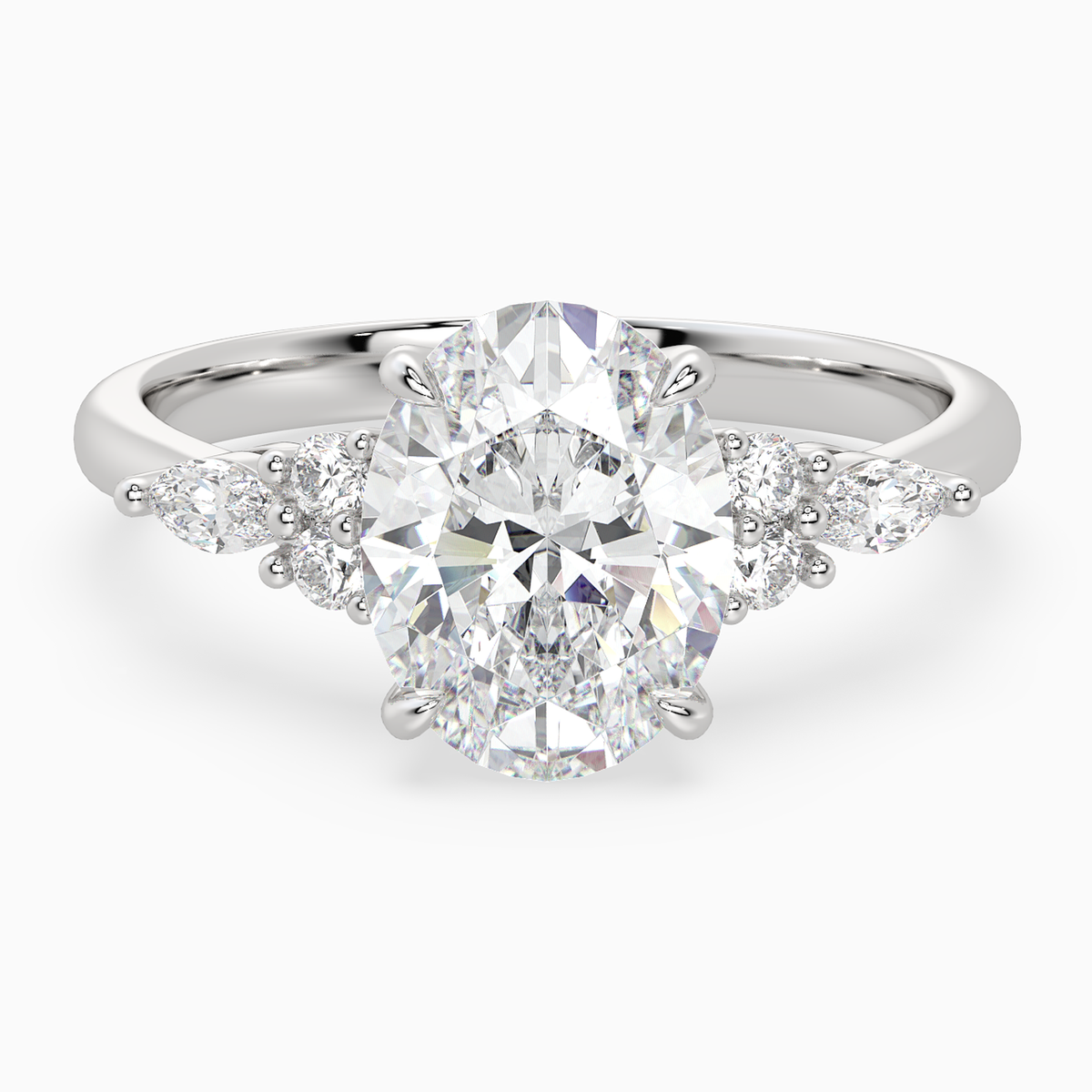


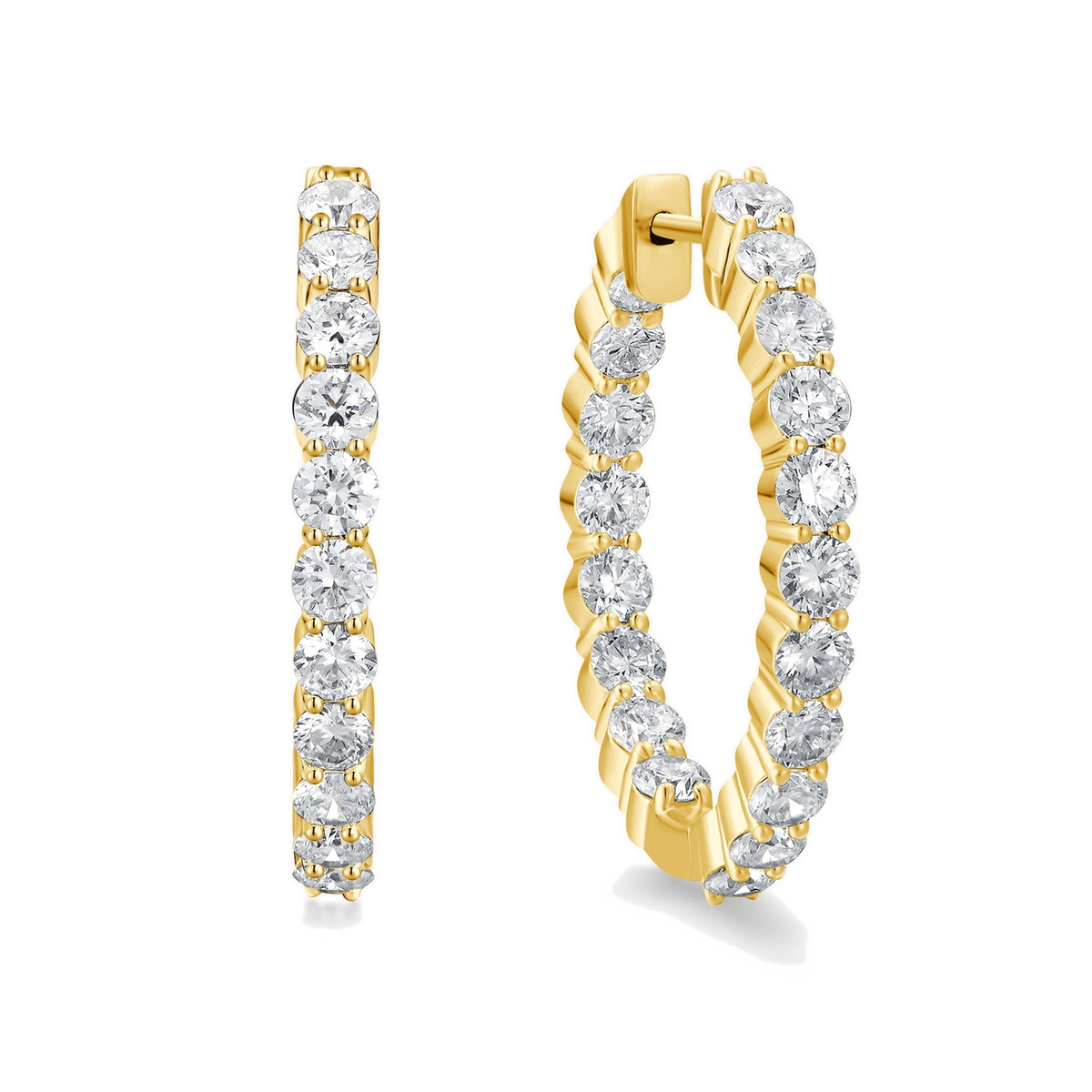
Lab-Grown Diamond Hoop Earrings
A circle drawn in proportion to the ear. Explore diamond hoops through diameter, visible arc, setting rhythm and the mechanics of closure.




- Free Express Shipping
- Free Resizing
- 60-Day Free Returns
- Lifetime Warranty
Lab-Grown Diamond Hoop Earrings: The Architecture of an Arc
A hoop begins with a line that turns around the ear. Its character comes from how closely that arc follows the lobe, how much diameter it occupies, where diamonds appear from the front, and how the circle opens and closes. Burvonti’s current Collection moves from compact shared-prong huggies to graduated open and inside-out hoops, while a wider group uses the huggie as the precise attachment for a suspended diamond.
That range makes structure more useful than a simple choice between small and large. A close hoop can carry a distinct diamond rhythm; a larger arc can remain visually spare. A drop-huggie combines two readings at once—the circle establishes the point of connection, while the element below it introduces shape and movement. Each should be compared through its complete architecture.
Huggie, Hoop, and the Space Between
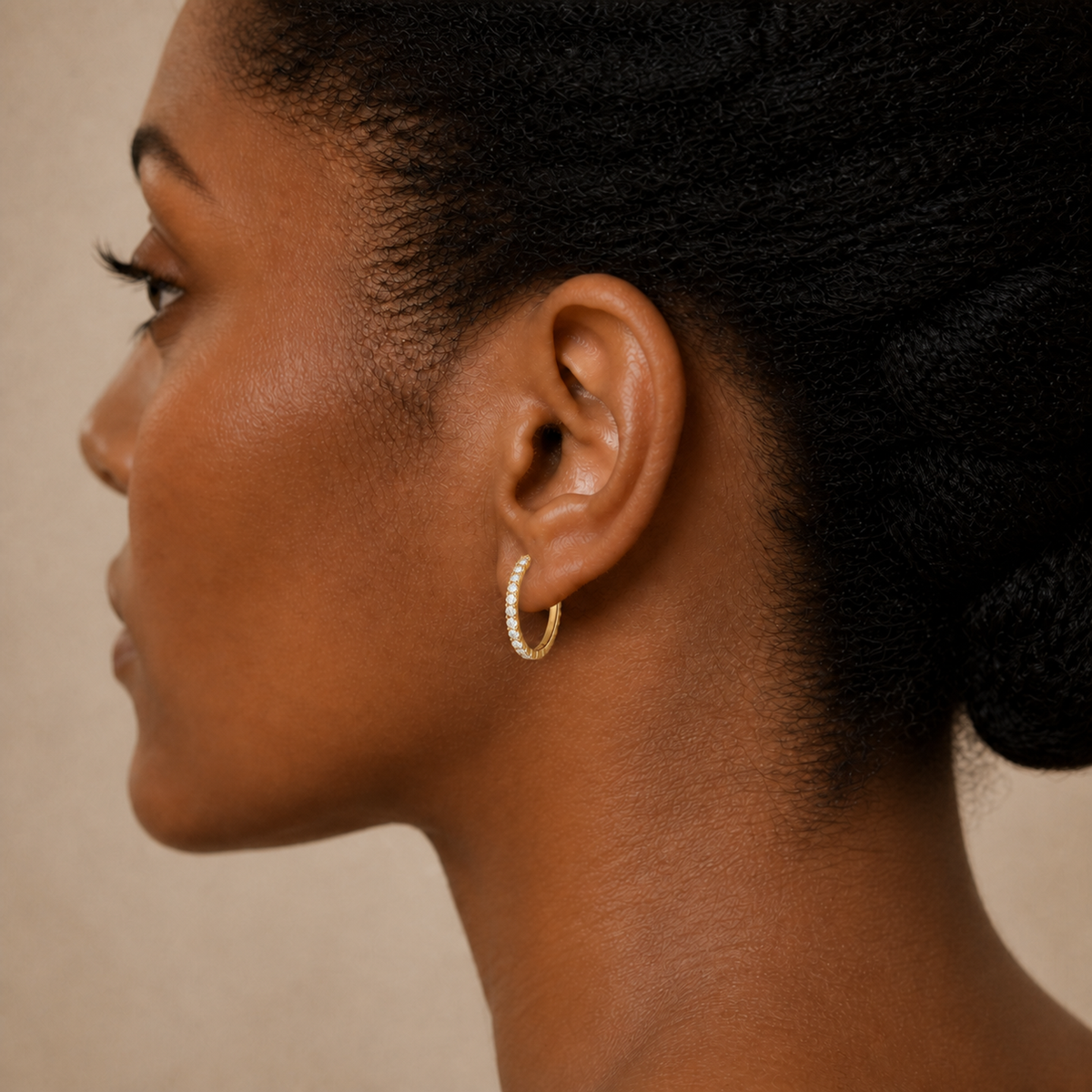
A huggie usually describes a compact hoop that sits close to the lobe. A standard hoop may create more air between metal and ear, but the names do not establish one universal diameter. Piercing position, lobe depth, outer diameter, inner opening, metal width, and setting projection all influence whether a design reads as closely fitted or more open on the wearer.
Burvonti’s current drop-huggie families use a published 12.50 mm outer diameter. That is a useful product fact, not a promise of identical clearance on every ear. Compare the measurement with front, side, and worn-scale imagery when available. A millimeter value describes the piece; anatomy and piercing placement determine the relationship.
Where Diamonds Meet the Arc
Diamond placement changes which part of a hoop remains visible. A shared-prong huggie creates a close sequence along the outer face. A graduated open hoop builds scale along an incomplete curve. An inside-out design places diamonds on surfaces intended to remain visible across the front exterior and inner rear of the hoop. The name should still be verified against product imagery rather than treated as a fixed coverage formula.
The current drop-huggie designs add ten possible center shapes beneath a diamond-accented or metal-led arc, including prong, bezel, halo, luxe, and solitaire interpretations. Here the hoop is not background hardware: its diameter, diamond rhythm, and connection point determine how the suspended form begins.
Diameter, Width, and Profile Create Presence
Diameter determines the scale of the arc, but width and profile determine how much visual weight that arc carries. A narrow diamond line can feel precise at a wider radius; a compact huggie can appear stronger when metal or settings broaden its face. Projection also matters, especially when a hoop is worn beside another earring or close to hair, eyewear, and clothing.
Face shape is not a rule for selecting hoop size. Proportion is better judged through the wearer’s features, hairstyle, piercing position, other jewelry, and desired amount of negative space. The goal is not to correct a face but to decide how the arc should relate to it.
Closure Is Part of the Geometry
Most current Burvonti drop-huggie products identify a hinge opening with a one-notch post that snaps closed. The three hoop-specific structures use either a secure lock back with double-notched post or a lever back. These facts describe distinct mechanisms; none makes loss impossible or establishes universal ease of use.
A closure should engage as its product instructions describe, meet the ear without undue pressure, and preserve the intended line when closed. Check hinges, posts, notches, levers, and backs for changes over time. If alignment, resistance, or engagement changes, stop wearing the pair until it can be inspected.
Read Carat Weight Through Distribution
Total carat weight describes the combined diamond weight covered by the product specification, commonly across both earrings. It does not reveal diameter, the number of diamonds, individual stone size, or how much of the arc is covered. Center Stone Total Carat Weight on a drop-huggie also needs to be read separately from diamonds set into its hoop or halo.
Compare where the weight is placed. A repeated row distributes light along a curve; graduation changes rhythm; one suspended center creates a focal point below it. Equal combined weights can therefore produce very different arcs, spacing, and face-up presence. Dimensions and diamond count are necessary companions to the carat figure.
Compose Around One Clear Arc
A hoop can act as the main line of an ear composition or as the quiet framework for a suspended shape. With multiple piercings, compare diameter, projection, post and backing clearance, and whether neighboring pieces touch as the head moves. Repetition can come from one shared metal, diamond shape, or setting rhythm without requiring every earring to match.
The current Collection is represented in 14K White, Yellow, and Rose Gold. White gold can reduce visible contrast around a diamond line; yellow or rose gold can make the metal arc more explicit. The result also depends on setting coverage, surface finish, skin context, and surrounding pieces, so metal should be judged within the complete composition.
A Measured Circle, Finished by Human Judgment
Burvonti pairs responsibly sourced lab-grown diamonds with hoop structures considered from open profile to closed position. Laboratory-grown diamonds are diamonds rather than simulants, while any grading document should be read only for the stone it identifies. One report does not automatically describe a full pair or every diamond placed along an arc.
Custom possibilities may refine diameter, width, metal, diamond pattern, suspended shape, or closure where technically feasible. Store hoops so posts, hinges, and diamonds do not abrade one another; avoid forcing the circle or bending an open profile. Use a gentle cleaning method suited to the complete mechanism and arrange inspection after impact or any change in closure.
Frequently Asked Questions
What is the difference between a huggie and a hoop earring?
A huggie usually describes a compact hoop worn close to the lobe, while hoop is the broader structural category. Exact fit depends on inner and outer diameter, width, piercing position, lobe anatomy, and profile rather than the name alone.
What types of hoop earrings are in the current Burvonti Collection?
The current public Collection includes shared-prong huggies, a graduated open hoop, an inside-out hoop, and five drop-huggie families across ten center shapes.
What is an inside-out diamond hoop?
It places diamonds on hoop surfaces intended to remain visible from the front, commonly the outer front and inner rear. Confirm the exact coverage, direction, and closure through the individual product imagery and specifications.
Are drop-huggies considered hoop earrings or drop earrings?
They combine both structures. The compact hoop establishes the attachment and closure, while the suspended element creates a drop. Burvonti includes these hybrids in both relevant Collections so customers can approach them through either decision.
What diameter are Burvonti drop-huggie hoops?
Current public product details state a 12.50 mm outer diameter for the 50 drop-huggie products. This should not be extended to the three other hoop structures or future products without a new readback.
How do I choose a hoop diameter?
Compare outer and inner diameter, lobe clearance, metal width, setting projection, piercing position, hairstyle, neighboring jewelry, and desired negative space. Face shape alone does not determine one correct size.
Will a huggie fit closely on every ear?
No. The same diameter can sit differently according to piercing position, lobe depth, anatomy, width, post path, and setting profile. Confirm measurements and use worn-scale views when available.
Which diamond shapes are represented in Burvonti drop-huggie hoops?
The current public families represent Asscher, Cushion, Emerald, Heart, Marquise, Oval, Pear, Princess, Radiant, and Round centers, subject to live product availability.
How do prong, bezel, halo, and solitaire drop-hoops differ?
They change the boundary and scale of the suspended center. Prongs leave more perimeter open, a bezel adds a continuous metal edge, a halo broadens the composition, and a solitaire keeps the visual hierarchy centered on one principal shape.
What closures are used on current Burvonti hoop earrings?
The drop-huggies identify hinge openings with snapping one-notch posts. Current hoop-specific designs identify either a secure lock back with double-notched post or a lever back. Confirm the exact product.
Does an audible click mean a hoop can never open or be lost?
No. A click may indicate that a mechanism engaged, but retention still depends on alignment, condition, correct use, pulling, impact, and maintenance. Inspect the closure before wear.
Are hinge closures durable enough for daily wear?
Durability cannot be guaranteed Collection-wide. Suitability depends on hinge design, material, execution, frequency, impact, pulling, and care. Arrange inspection if resistance, alignment, or engagement changes.
What does total carat weight mean for diamond hoops?
It generally combines the diamond weight covered by the stated specification across the pair. It does not state hoop diameter, individual diamond size, number of diamonds, or coverage without additional details.
How should I compare carat weight on a drop-huggie?
Read Center Stone Total Carat Weight separately from hoop or halo accents when the product distinguishes them. Confirm what the option includes before comparing it with an all-over diamond hoop.
Can hoop earrings be worn with multiple piercings?
Yes when diameter, projection, post and backing clearance, and movement suit the wearer’s anatomy. Check that adjacent pieces do not press or abrade one another.
Which metals are represented in the current Hoop Collection?
The current public Collection is represented in 14K White, Yellow, and Rose Gold. Exact alloy, finish, rhodium plating, sensitivity considerations, and alternative-metal feasibility remain product-specific.
How should I store and clean diamond hoops?
Store each hoop without pressure on its arc, post, hinge, or diamonds. Use a gentle cleaning method suited to the full setting and closure, avoid abrasive products and harsh chemicals, and do not force articulated parts.
Can Burvonti diamond hoops be customized?
Custom possibilities may include diameter, width, metal, diamond pattern, suspended center, or closure when structurally feasible. Fit, documentation, price, and timing require individual confirmation.