
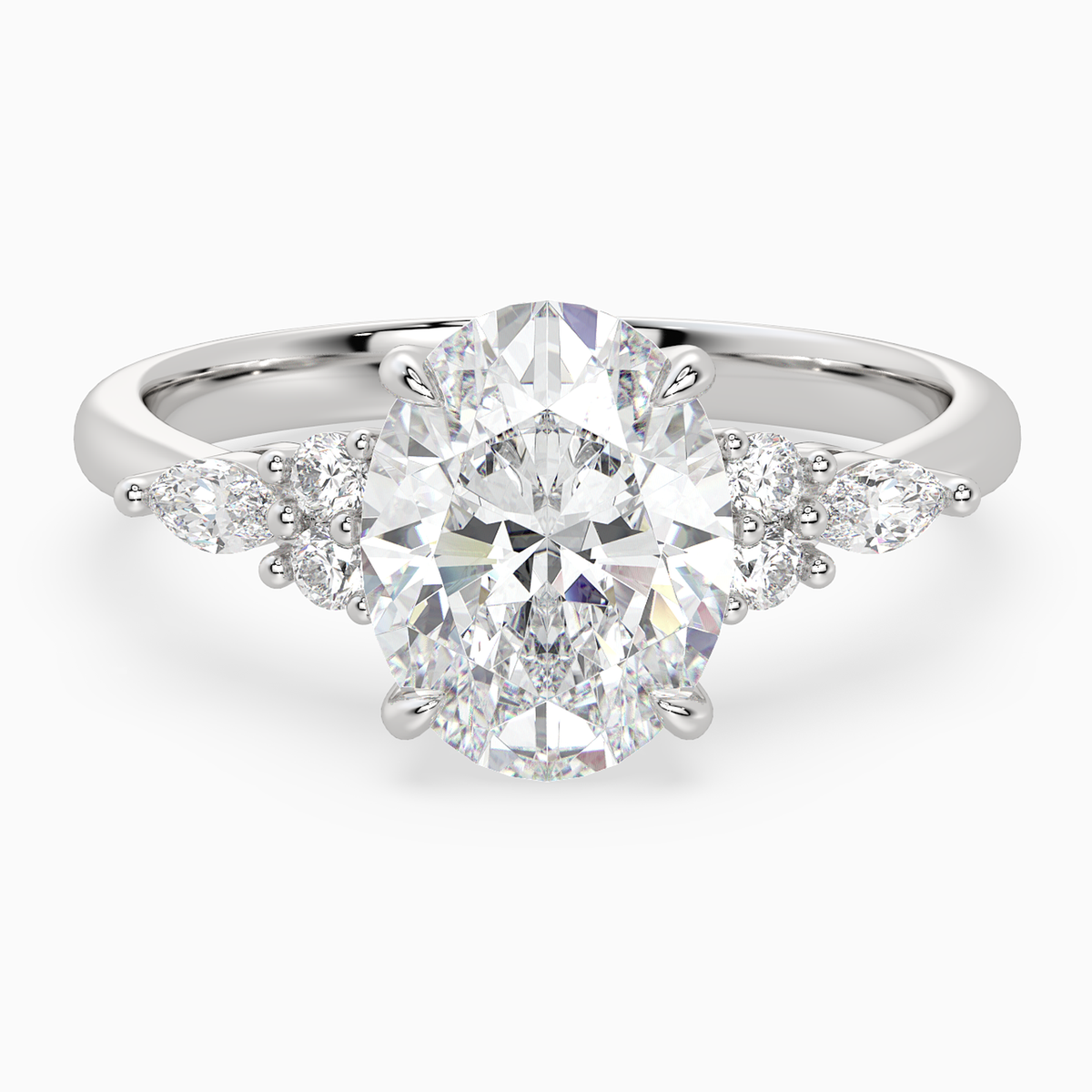


The 4Cs of diamonds are cut, color, clarity and carat weight. Together, they describe how a diamond looks, how it performs in light, how rare it is and how its price is determined. If you are comparing diamonds for an engagement ring or fine jewelry piece, the 4Cs give you a shared language for evaluating quality beyond first impressions.
The important thing to know is that the 4Cs are not a contest to find the highest grade in every category. A beautiful diamond is usually the result of balance. Some grades are easy to see with the naked eye, while others may matter more on paper than in daily wear. Learning how each C works helps you choose a diamond with intention, using your budget where it makes the biggest visual difference.
For lab-grown diamonds, the same 4Cs apply. A lab-grown diamond is graded for cut, color, clarity and carat weight just as a mined diamond is. The difference is origin, not the grading language.
Compare lab-grown diamonds by the 4Cs
Quick Answer: The 4Cs at a Glance
Cut
Controls how well the diamond returns light and often has the greatest effect on beauty.
Color
Describes how colorless or warm a white diamond appears in its setting. Use our diamond color guide for the broader decision framework.
Clarity
Evaluates inclusions and blemishes, with eye-clean appearance as the practical goal. Use our diamond clarity guide for the broader decision framework.
Carat
Measures diamond weight and influences visual presence, rarity and price.

If you only remember one rule, start with cut. A well-cut diamond can appear brighter, livelier and more beautiful than a diamond with higher color or clarity grades but weaker proportions.
Why the 4Cs Matter When Buying a Diamond
Before standardized diamond grading became widely used, buyers often had to rely on subjective descriptions. The 4Cs created a clearer framework. Whether a diamond is viewed in New York, Los Angeles or online, cut, color, clarity and carat weight make it easier to compare one stone with another.
Grading reports from respected laboratories such as GIA, IGI or GCAL document these characteristics. A report does not tell the whole story of beauty, but it gives you essential specifications: measurements, proportions, color grade, clarity grade, carat weight and other details that help you compare diamonds more confidently.
For shoppers, the 4Cs answer practical questions:
- Will the diamond sparkle well?
- Will it look white in the chosen setting?
- Are inclusions visible without magnification?
- Does the carat weight create the presence you want?
- Is the price aligned with the visible quality?
The best diamond is not always the one with the highest grades. It is the one where the grades work together for your eye, your setting and your budget.
Cut: The C That Most Affects Sparkle
Cut describes how well a diamond has been shaped and finished. It includes proportions, symmetry and polish. For round brilliant diamonds, cut grades usually range from Excellent to Poor on many grading reports.
Cut is often the most important of the 4Cs because it controls how light moves through the diamond. A well-cut diamond reflects more light back to the eye, creating:
- Brilliance: white light return
- Fire: flashes of rainbow color
- Scintillation: the contrast and sparkle seen as the diamond moves
Two diamonds can have the same carat weight, color and clarity, yet look very different if one is better cut. A poorly cut diamond may look dull or smaller than its weight suggests because light leaks through the sides or bottom instead of returning upward.

What to Look for in Cut
For round brilliant diamonds, an Excellent or Ideal cut grade is usually a strong starting point. Beyond the grade, pay attention to visual performance. The diamond should look bright across the face, not just around the edges or in one lighting condition.
Fancy shapes such as oval, emerald, cushion, radiant, pear and marquise diamonds may not always receive a simple cut grade in the same way round diamonds do. For these shapes, proportions, symmetry, bow-tie effect, facet pattern and personal preference become especially important.
At Burvonti, cut should be treated as a design decision, not only a line item on a certificate. The diamond and setting need to work together so the stone's light performance is supported by the final ring.
Color: How White or Warm a Diamond Appears
Diamond color refers to the presence or absence of body color in a white diamond. Most grading scales for white diamonds run from D to Z:
- D-F: colorless
- G-J: near colorless
- K-M: faint color
- N-Z: increasingly noticeable warmth
Colorless diamonds are rare and usually more expensive. Near-colorless diamonds, especially G, H, I and sometimes J, can offer excellent value because they often appear white to the naked eye once set in jewelry.
The setting metal changes how color is perceived. Platinum and white gold tend to make warmth easier to notice, especially from the side. Yellow gold and rose gold can make near-colorless diamonds feel harmonious because the metal already has warmth. Continue with Do Lab-Grown Diamonds Turn Yellow for the next comparison.

Best Value Color Range
For many engagement rings, G-H offers a strong balance of white appearance and value. I-J can also be attractive in yellow gold, rose gold or certain vintage-inspired designs. If you want an icy, highly colorless look in a platinum solitaire, D-F may be worth considering.
Color is partly technical and partly aesthetic. Some shoppers love a crisp white diamond. Others prefer a slightly warmer stone because it feels softer against yellow or rose gold.
Clarity: What Inclusions Mean in Real Life
Clarity describes the internal and surface characteristics of a diamond. Internal characteristics are often called inclusions, while surface characteristics are called blemishes. Common examples include crystals, feathers, clouds, needles and pinpoints.
Clarity grades generally move from Flawless to Included:
- FL: Flawless
- IF: Internally Flawless
- VVS1-VVS2: Very, Very Slightly Included
- VS1-VS2: Very Slightly Included
- SI1-SI2: Slightly Included
- I1-I3: Included
The most useful clarity question is not "Is this diamond technically perfect?" It is "Does this diamond look clean to the naked eye?"
Many VS1, VS2 and even carefully selected SI1 diamonds can appear eye-clean, meaning inclusions are not visible in normal viewing conditions. Higher clarity grades may be desirable for collectors, large stones or step-cut shapes, but they are not always necessary for everyday beauty.

Why Placement Matters
The location of an inclusion can matter more than the grade alone. An inclusion under the center table may be easier to notice than one near the edge. In some cases, a prong can help cover a small feature near the girdle. In other cases, a dark crystal in the center may be distracting even if the overall clarity grade sounds acceptable.
Diamond shape also matters. Emerald and Asscher cuts have large, open facets that make inclusions easier to see, so VS2 or higher is often a safer range. Round brilliant, oval, cushion and radiant cuts can hide small inclusions better because their facet patterns create more visual movement.
Explore diamond clarity in more detail
Carat: Size, Presence and Price
Carat is a measure of weight, not size. One carat equals 200 milligrams. Because different diamond shapes distribute weight differently, two one-carat diamonds can look different in size when viewed from above.
To keep the two terms separate, continue with our carat vs. karat guide.
Carat weight strongly affects price because larger diamonds are rarer. Prices also tend to jump around popular milestones such as 1.00 ct, 1.50 ct, 2.00 ct and 3.00 ct. Choosing a diamond just below a milestone, such as 0.90 ct instead of 1.00 ct, can sometimes offer a similar visual size at a better value.

Carat and Shape
Elongated shapes such as oval, pear, marquise and emerald can appear larger than round diamonds of the same carat weight because they spread across the finger differently. A well-proportioned oval or marquise may create more finger coverage, while a round brilliant may offer more classic symmetry and light performance.
The right carat weight depends on hand proportions, setting style, lifestyle and preference. A delicate solitaire may make a one-carat diamond feel refined and balanced. A halo or three-stone design can increase presence without relying only on center-stone weight.
How the 4Cs Work Together
The 4Cs are connected. Changing one C often changes how the others appear.
Cut and Color
A strong cut can make a diamond appear brighter and more lively, which can help a near-colorless stone face up beautifully. A weaker cut may make body color more noticeable because the diamond returns less light.
For round brilliant diamonds, you may be able to choose G-H color with an excellent cut and still achieve a crisp, bright look. For step cuts like emerald and Asscher, color can be more visible, so some shoppers prefer a higher color grade.
Cut and Clarity
Brilliant-cut diamonds often hide small inclusions better because their facet patterns create movement and sparkle. Step cuts have broader, quieter flashes of light, so clarity characteristics are easier to see.
This is why an SI1 round brilliant may look clean, while an SI1 emerald cut may show inclusions more readily. Shape, cut style and inclusion placement should be judged together.
Carat and Clarity
As diamond size increases, inclusions can become easier to see. A VS2 clarity grade that looks perfectly clean in a smaller stone may need closer review in a larger diamond. Bigger diamonds also show more surface area, so the placement and type of inclusion become more important.
Carat and Cut
Carat weight alone does not guarantee visual presence. A poorly proportioned diamond can carry weight in the depth, making it look smaller from the top. A well-cut diamond usually looks brighter and often more visually balanced.
This is one reason cut deserves priority. It protects both beauty and perceived size.
Best 4C Combinations by Buyer Priority
| Buyer Priority | Recommended 4C Strategy | Why It Works |
|---|---|---|
| Maximum sparkle | Prioritize Excellent or Ideal cut, then balance color and clarity. | Cut has the strongest effect on light return and visual life. |
| Best value | Excellent cut, G-H color, VS2-SI1 clarity if eye-clean. | This keeps visible beauty high without overpaying for grades that may not be noticeable. |
| Icy white look | D-F color, strong cut, clarity based on eye-clean appearance. | Best for platinum or white gold settings where color is more visible. |
| Larger visual size | Consider elongated shapes and just-below milestone carat weights. | Shape and spread can create presence without only increasing carat weight. |
| Emerald or Asscher cut | Consider higher clarity and color than you might choose for a round brilliant. | Step cuts reveal inclusions and color more openly. |
Compare Lab-Grown Diamonds by the 4Cs
Review cut, color, clarity and carat weight side by side, then choose the balance that fits your setting, budget and eye.
Compare lab-grown diamondsHow the 4Cs Apply to Lab-Grown Diamonds
Lab-grown diamonds are real diamonds with the same crystal structure and optical properties as mined diamonds. They are evaluated by the same core quality factors: cut, color, clarity and carat weight.
For shoppers, this means the 4Cs remain essential. A lab-grown diamond still needs strong light performance. It still has a color grade. It still may have inclusions. It still varies in carat weight and visual spread.
The advantage is that lab-grown diamonds can often allow more flexibility in budget. Many buyers can choose a larger carat weight or higher quality combination than they might consider in a mined diamond at the same budget. Even so, the smartest approach is not automatically choosing the largest stone. It is choosing the most balanced diamond for the ring you want to build.
Explore lab-grown diamond options
How to Read a Diamond Grading Report
A diamond grading report documents the qualities of a specific stone. Before buying, review these details:
- Carat weight: the exact weight of the diamond.
- Measurements: length, width and depth, which influence visible size.
- Shape and cutting style: round brilliant, oval, emerald, cushion and other shapes.
- Color grade: where the diamond falls on the color scale.
- Clarity grade: the clarity category and, often, a plot or comments.
- Cut grade: usually available for round brilliant diamonds.
- Polish and symmetry: finishing details that support visual performance.
- Fluorescence: how the diamond reacts to ultraviolet light.
- Report number: the unique identification for the grading report.
A grading report gives you the language of comparison. Seeing the diamond, or reviewing high-quality imagery and video, gives you the final aesthetic judgment.

Build the Ring Around the Diamond You Choose
The 4Cs help you compare diamonds with clarity. Burvonti brings that clarity into the final ring, pairing transparent specifications with a setting made around the selected stone.
Start a custom ring designChoose a Diamond With Intention
The 4Cs of diamonds help you move from uncertainty to a more precise decision. Cut affects sparkle. Color affects the diamond's white or warm appearance. Clarity affects how clean the stone looks. Carat affects weight, presence and price.
The strongest choice is rarely about chasing perfection in every category. It is about knowing which grades matter for the way the diamond will actually be seen, worn and set.
Burvonti's approach begins with transparent specifications and ends with a ring built around the chosen diamond. The stone, setting and proportions should be considered together, then made with intention rather than pulled from a generic inventory path.
Whether you are comparing lab-grown diamonds, designing an engagement ring or refining a custom setting, the 4Cs give you the foundation. From there, the final decision belongs to your eye, your priorities and the meaning the ring needs to carry.
Explore lab-grown diamond engagement rings Explore engagement rings when you are ready to compare available designs.
Frequently Asked Questions
What are the 4Cs of diamonds?
The 4Cs of diamonds are cut, color, clarity and carat weight. They are the main quality factors used to describe a diamond's light performance, appearance, rarity and value.
Which of the 4Cs is most important?
Cut is usually the most important C because it has the greatest effect on sparkle and brilliance. A well-cut diamond can look brighter and more beautiful than a diamond with higher color or clarity grades but weaker proportions.
What is a good 4C combination for value?
For many shoppers, an Excellent or Ideal cut with G-H color and VS2-SI1 clarity can offer strong value, as long as the diamond is eye-clean and visually bright. The best combination depends on shape, setting and personal preference.
Do lab-grown diamonds use the same 4Cs?
Yes. Lab-grown diamonds are graded for cut, color, clarity and carat weight using the same diamond quality language. Their origin is different, but the 4Cs still determine appearance and value.
Is a higher carat diamond always better?
No. Carat measures weight, not beauty. A smaller, well-cut diamond can look brighter and more balanced than a larger diamond with poor proportions. Shape and setting also affect how large a diamond appears.
What clarity grade should I choose?
Choose a clarity grade that looks clean to the naked eye. VS1 and VS2 are safe choices for many diamonds, while some SI1 diamonds can offer excellent value if inclusions are not visible in normal viewing conditions. Continue with VVS vs VS Diamonds for the next comparison.