
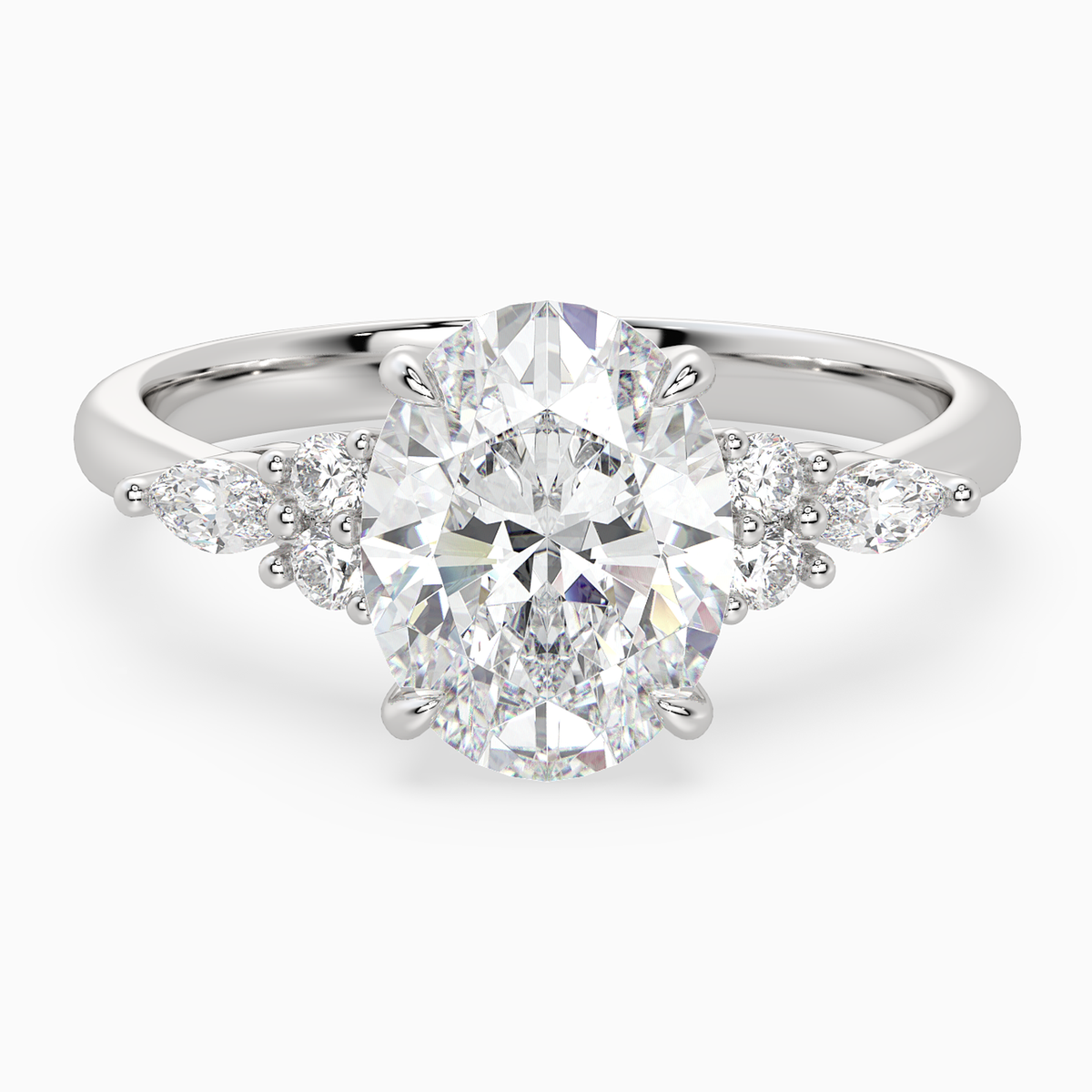


Princess Diamond Engagement Rings
Four points, held in tension. Princess centers bring brilliant light to a precise square, with settings resolved around every corner.


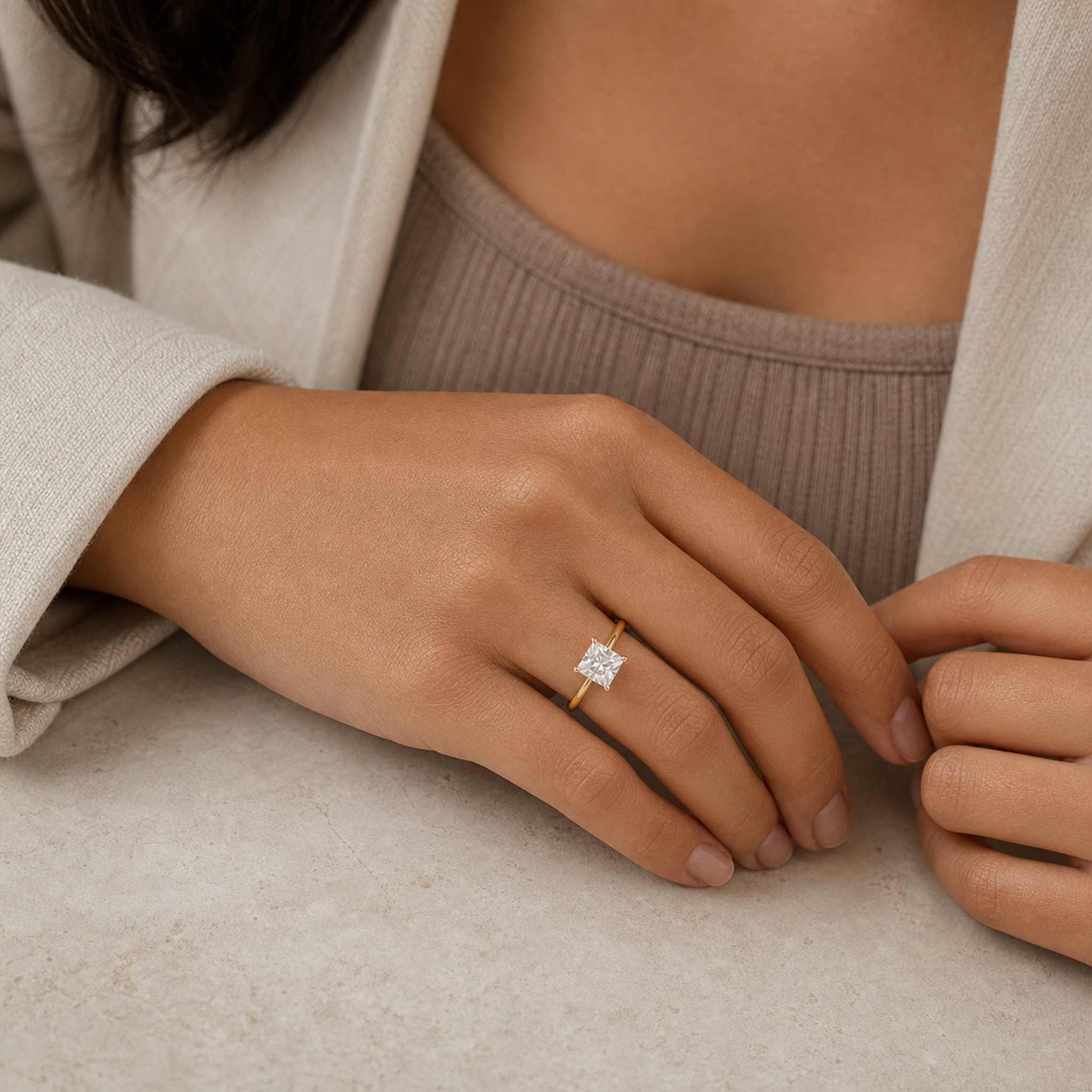


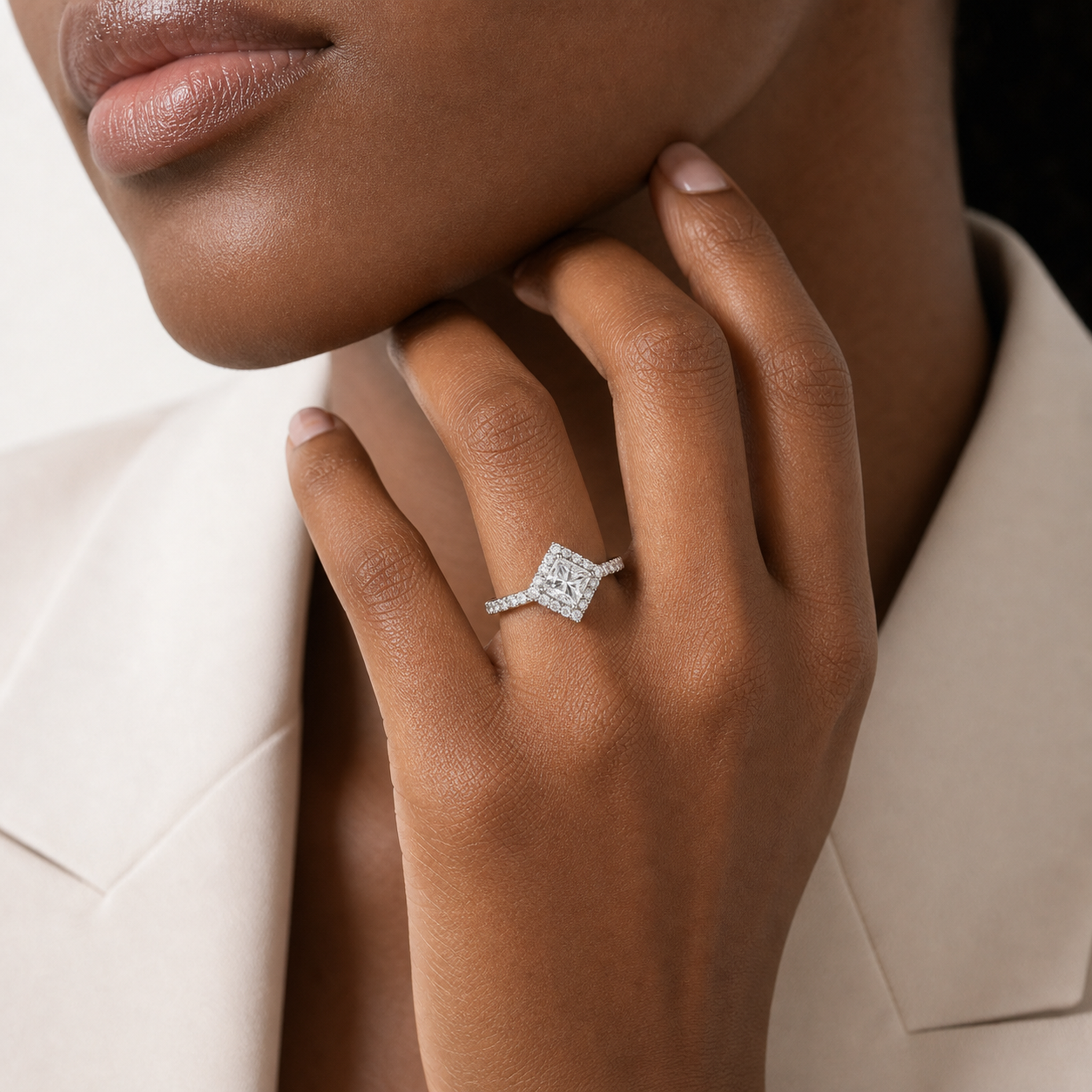


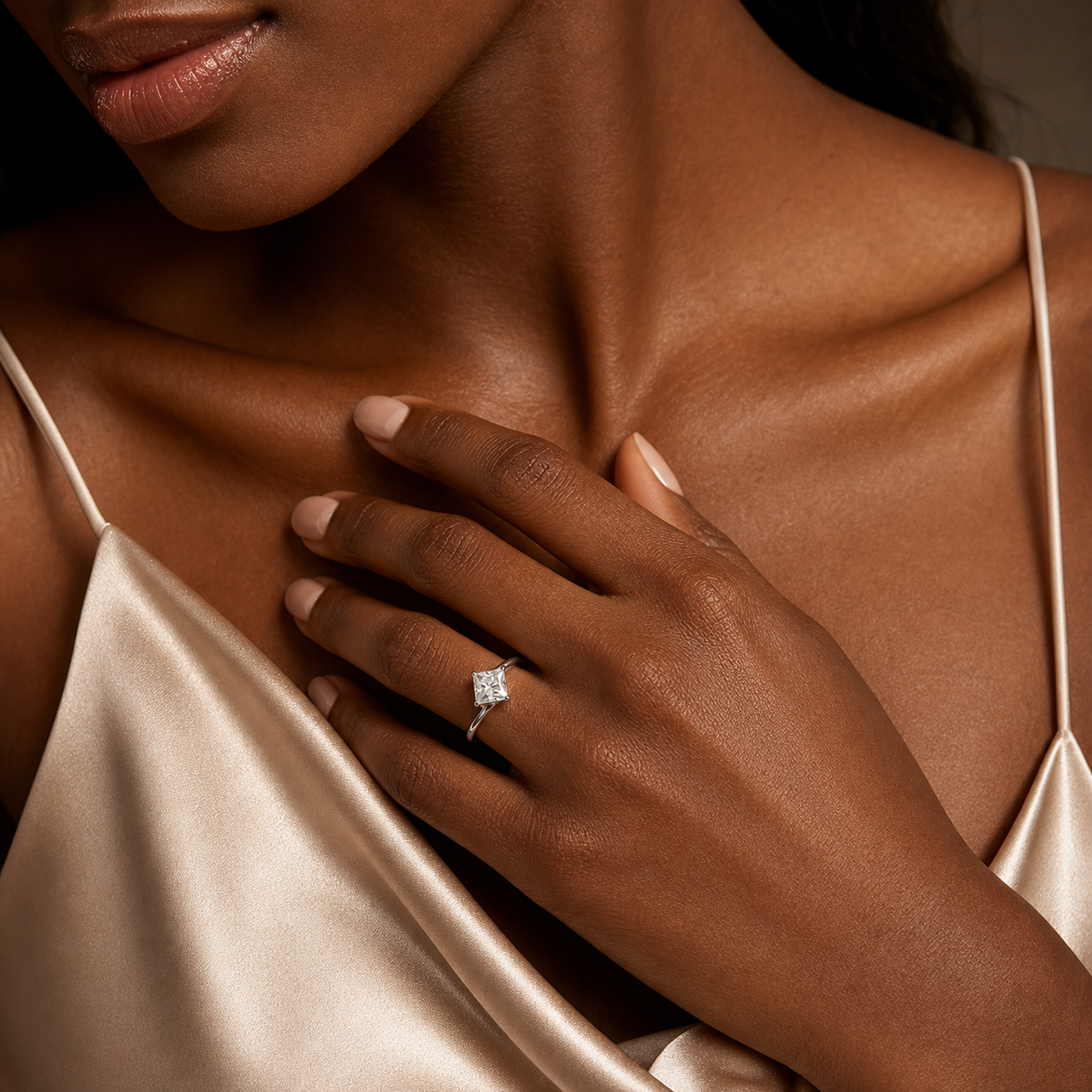


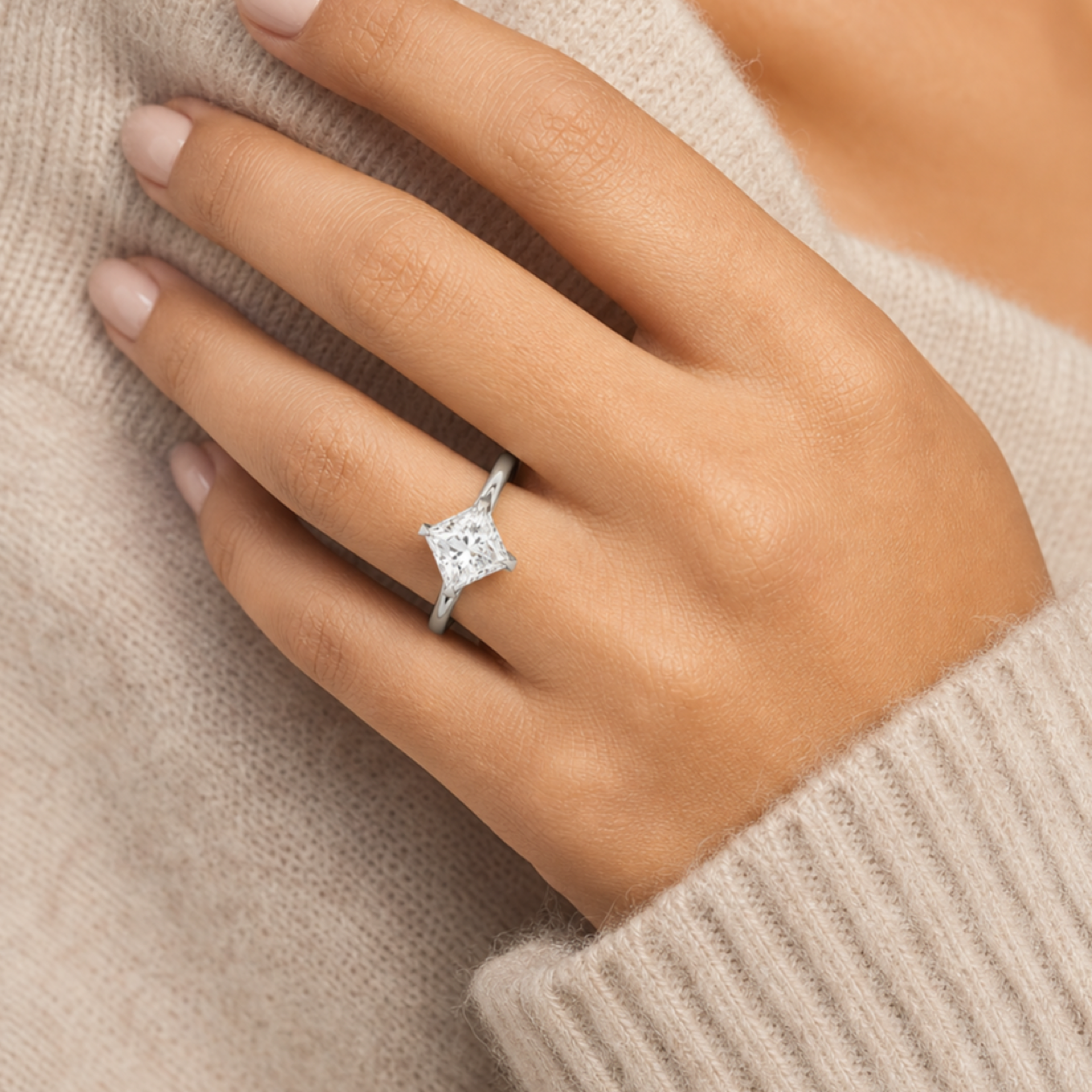


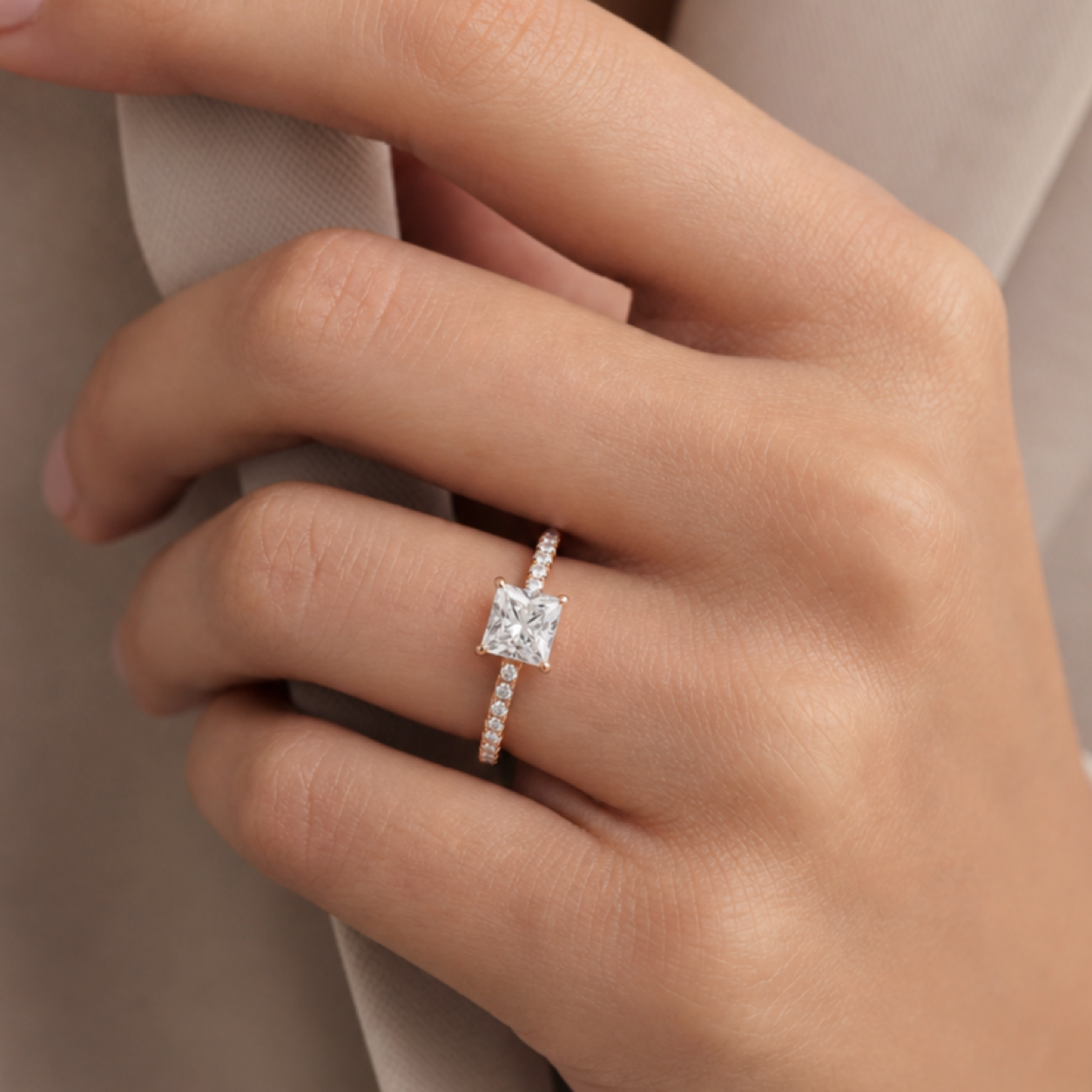
Princess Diamond Engagement Rings: A Square Held at Four Points
A princess-cut diamond carries brilliant-style light into a square or subtly rectangular outline. Four straight sides meet at four pointed corners, giving the center a precise perimeter and a clear diagonal tension. The geometry is immediate, but the light inside it is not uniform: modified-brilliant facet arrangements can create broad flashes, fine scintillation, directional contrast, or a mixture of all three.
Burvonti’s current princess collection is deliberately concentrated. Its five public designs center on Solitaire, Hidden Halo, Kite Halo, pavé, and bypass architecture rather than presenting every possible setting as already available. Each design answers the four corners differently—through open space, a second perimeter, a crossing band line, or detail placed below the face-up square.
Square Is an Outline; Princess Is Also a Cutting Style
Princess is a trade name for a square or rectangular modified-brilliant diamond. That distinction matters. Asscher diamonds may share a square footprint but use step facets and cropped corners; square Radiants use brilliant-style faceting within a cut-cornered frame; Cushions soften their corners and sides. The princess is defined by the relationship between its brilliant internal pattern and its four pointed ends.
Length-to-width ratio helps determine whether a center will be described as square or rectangular. GIA guidance uses 1.05:1 as the upper boundary for the square designation, but this is a naming threshold, not a promise of beauty. Side equality, corner alignment, facet symmetry, central alignment, and the way the outline enters the setting still require individual judgment.
Facet Arrangement Changes the Scale of Light
Princess facet counts and pavilion arrangements vary. Some centers show larger, more legible flashes; others break light into finer regions or create a stronger cross, chevron, or directional pattern. This variation is part of the cut, not an error to be hidden behind a universal maximum-sparkle claim. Compare how brightness, fire, contrast, and scintillation distribute from the center toward all four corners.
Princess diamonds are fancy shapes and do not currently receive an overall GIA cut grade. Polish and symmetry grades, measurements, color, clarity, and the plotted characteristics remain useful documentation, but they cannot fully predict face-up appearance. View the selected center at a normal distance and in motion, preferably under more than one ordinary lighting condition, and note whether dark or dull areas remain fixed.
Carat Weight Does Not Describe the Face-Up Square
Carat is weight. Many princess diamonds carry meaningful depth in their pavilion, so two centers of the same weight—or a princess and another square shape—may show different face-up dimensions. That does not make one proportion automatically inefficient. Compare length, width, depth, girdle, outline, and light pattern together rather than expecting weight to establish visible scale.
The ring changes perception once more. A fine band leaves more negative space around the square; a Kite Halo extends the diagonal emphasis; a Hidden Halo is read more strongly from the side; a bypass line introduces movement against the center’s symmetry. Burvonti calibrates the center, corner treatment, band width, and profile as a complete composition.
Every Pointed Corner Needs a Deliberate Answer
The four pointed corners are defining features and vulnerable areas. They can lie near diamond cleavage planes and may be more susceptible to chipping if exposed to a correctly placed impact. V-shaped corner prongs, split-prong arrangements, or a bezel are common protective approaches. Their presence supports the design; it does not create an absolute guarantee against damage.
Inspect corner alignment, girdle condition, and any clarity characteristics located near the points. Prong dimensions, coverage, seat, workmanship, wear, and maintenance also matter. Some princess cuts have no culet facet at the pavilion point, adding another reason for precise mounting and clearance below the stone. Protection should preserve the square’s definition without treating the corners as decoration.
A Concentrated Collection Can Still Offer Distinct Architecture
A Solitaire makes the square, corner supports, basket, and band proportion fully legible. Burvonti’s Estelle, Zinnia, and Cressida designs add Hidden Halo or pavé detail at different levels, allowing the face-up outline to remain clear while the profile gains another line of light. Amara sets the same geometric center against a bypass band, replacing strict axial calm with a controlled crossing movement.
Luna uses a Kite Halo, turning the princess center so its corners and surrounding frame read diagonally. This is not simply a larger-looking treatment; it changes the orientation and rhythm of the entire ring. Because the public assortment remains narrow, this page should describe the real available architectures precisely and use custom language only for feasible, individually confirmed variations.
Metal, Profile, and Wedding-Band Contact Complete the Geometry
White Gold can create cooler continuity among center, prongs, Halo, and pavé. Yellow Gold gives the square and its supports a warmer, more visible boundary. The current public collection is concentrated in these two metal colors; Rose Gold or other options should not be implied without product-level confirmation. Alloy, finish, care, and exact specifications remain part of the decision.
From the side, basket width, Hidden Halo, setting height, bypass shoulders, and any projecting corner support establish the contact line. Straight wedding bands may sit close, meet the setting, or leave space. A contour, chevron, open band, or intentional interval may answer other profiles. Straight sides on the center do not guarantee that the complete engagement ring will stack flush.
Precision Held Across Four Corners
Burvonti pairs responsibly sourced, independently graded lab-grown diamonds with settings resolved through proportion and human judgment. For a Princess, that means examining the equality of the sides, the alignment of the points, the balance of the internal pattern, and the support at each corner. The square should feel exact without becoming visually rigid.
Custom possibilities may refine center specifications, setting, corner-prong treatment, metal, Halo, band line, or engraving when structurally feasible. Use gentle care appropriate to the diamond, alloy, and construction; avoid abrasive products and harsh chemical exposure, and arrange inspection if a corner prong catches, the center moves, or the ring receives a significant impact. Availability, resize range, documentation, security, and band fit remain product-specific.
Frequently Asked Questions
What is a princess-cut diamond engagement ring?
It is an engagement ring centered on a square or rectangular modified-brilliant diamond with four pointed corners. Its straight-edged outline and brilliant-style facet arrangement create a different structure and light pattern from Asscher, Cushion, Radiant, or Round centers.
Is Princess the shape or the cutting style?
It describes both a square or rectangular outline and a modified-brilliant cutting style. Shape is the face-up perimeter; cutting style is the internal facet arrangement. Both must be considered when comparing Princess diamonds.
How is a princess cut different from an Asscher cut?
A Princess has pointed corners and modified-brilliant facets that produce a busier field of light. An Asscher has cropped corners and step facets arranged in concentric planes. Similar square footprints therefore create very different light and setting requirements.
How is a princess cut different from a radiant cut?
Princess diamonds usually have four sharp points; Radiants have cropped corners that create an eight-sided outline. Both can use modified-brilliant faceting, but their pavilion arrangements, contrast patterns, corner geometry, and setting responses can differ substantially.
What length-to-width ratio makes a princess diamond square?
GIA guidance uses a ratio no greater than 1.05:1 for the square designation. That is a naming boundary rather than an ideal-quality formula. Side equality, corner alignment, facet symmetry, face-up light, and setting response still matter.
Can a princess diamond be rectangular?
Yes. Princess diamonds can be square or rectangular. A rectangular outline introduces a clearer directional axis, while a near-square center feels more evenly distributed. Preference and setting architecture determine which relationship is appropriate.
Do all princess diamonds have the same number of facets?
No. Crown and pavilion facet arrangements can vary widely. Different constructions produce different balances of broad flashes, fine scintillation, contrast, and directional patterns, so facet count alone is not a quality grade.
Does GIA give princess diamonds an overall cut grade?
No. GIA currently assigns its regular overall cut grade only to eligible standard Round Brilliant diamonds. A Princess report still records shape and cutting style, measurements, polish, symmetry, color, clarity, fluorescence, and identifying characteristics.
How should I evaluate a princess diamond without an overall cut grade?
Use the independent report to compare documented characteristics, then view the center face-up and in motion. Look for aligned geometry, responsive light, balanced contrast, and no dark or dull area that remains dominant through ordinary changes in angle.
Does carat weight tell me how large a princess diamond will look?
Not by itself. Carat measures weight. Length, width, depth, girdle, pavilion construction, and weight distribution influence face-up size, while the band, Halo, prongs, and profile alter the center’s presence in the complete ring.
Are the corners of a princess diamond fragile?
The four points are more vulnerable to a correctly placed impact than rounded or cropped corners. Girdle condition, inclusions near a point, setting support, workmanship, wear, and maintenance all affect the exact risk.
Does a princess diamond need V-prongs?
V-shaped prongs are a common way to shield the four points, but split prongs or a carefully designed bezel can also support them. The correct treatment depends on the center’s dimensions, girdle, corner geometry, setting, and construction.
Is a bezel better than prongs for a princess center?
Neither is universally better. A bezel gives the square a continuous metal boundary and can cover the corners more fully; prongs leave more of the outline visible. Compare coverage, profile, maintenance, workmanship, and visual intent for the exact ring.
Which princess engagement ring styles are currently available at Burvonti?
The current public collection contains five designs concentrated in Solitaire, Hidden Halo, pavé, Kite Halo, and bypass architecture in 14K White or Yellow Gold. Confirm live product availability and the center specification for each design.
How does a Hidden Halo change a princess engagement ring?
A Hidden Halo places additional diamonds below the face-up perimeter, making side view, basket, and setting height more expressive while keeping the central square relatively clear from above. Exact visibility depends on the chosen profile.
What is a Kite Halo princess engagement ring?
It rotates or frames square geometry along a diagonal so the corners read as top, bottom, and side points. This changes the ring’s orientation and rhythm; it should not be treated only as a device for making the center appear larger.
Which metal works best with a princess diamond?
There is no universal best. White Gold can create cooler continuity among center and supports; Yellow Gold provides a warmer frame. Current Burvonti availability is concentrated in those two metal colors, and exact alloy, care, and specifications should be confirmed.
Will a princess engagement ring sit flush with a wedding band?
Not necessarily. Basket width, corner supports, Hidden Halo, setting height, and bypass shoulders determine the contact line. Straight, contour, chevron, open, or intentionally spaced pairings may suit different constructions.
How should I clean a princess diamond engagement ring?
Use a gentle method appropriate to its diamond, metal, and construction. Avoid abrasive cleaners and harsh chemicals, clean carefully around all four corner supports and beneath the center, and request inspection if a prong catches or the stone moves.
Can a Burvonti princess engagement ring be resized or customized?
Resize and custom possibilities depend on the design. Center specifications, corner treatment, metal, Halo, band line, or engraving may be adjustable when structurally feasible, but sizing range, security, documentation, current availability, and band fit must be confirmed individually.