
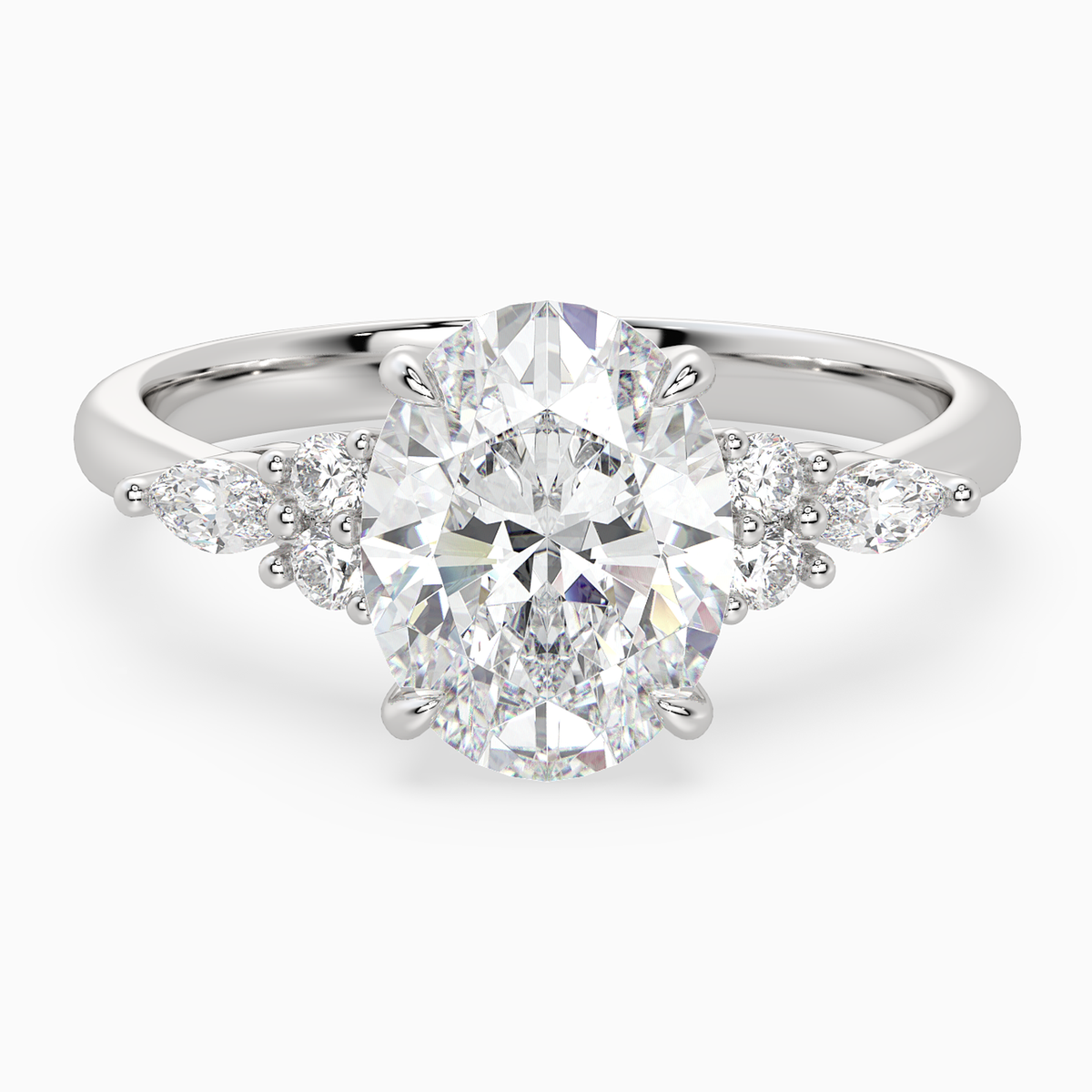


Flawless
No inclusions or blemishes are visible under 10x magnification. Rare, costly, and usually more technical than necessary for everyday jewelry.
Begin with a familiar route, explore a collection, or continue through a practical guide.


Learn how diamond clarity grades work, what inclusions and blemishes mean, and how to choose an eye-clean lab grown diamond without paying for perfection you cannot see.
Diamond clarity describes the tiny internal and surface characteristics that can appear inside a diamond. The practical goal is not always the highest grade. It is choosing a stone that looks clean to the eye, suits its shape and size, and leaves room in the budget for cut quality and design.
Diamond clarity is one of the four Cs of diamond grading. It measures how visible a diamond's internal inclusions and external blemishes are when examined by a trained grader under 10x magnification.
Inclusions are internal features, such as pinpoints, clouds, crystals, needles, or feather-like lines. Blemishes are surface features, such as scratches, polish lines, abrasions, or small nicks. Many are microscopic. What matters for a finished ring or piece of jewelry is whether those characteristics are visible to the naked eye, whether they affect durability, and whether they interrupt the diamond's light performance.
Lab grown diamonds use the same clarity scale as mined diamonds. They can still have growth characteristics, but the controlled growth environment often makes it possible to find strong clarity options at more accessible prices.
The clarity scale runs from Included to Flawless. Higher grades mean inclusions and blemishes are harder to find under magnification, but the visual difference between neighboring grades can be subtle once a diamond is set.

No inclusions or blemishes are visible under 10x magnification. Rare, costly, and usually more technical than necessary for everyday jewelry.
No internal inclusions are visible under 10x magnification, though tiny surface features may be present.
Inclusions are extremely difficult to find under magnification. These diamonds typically look exceptionally clean.
Small inclusions are visible under magnification but usually not to the naked eye. A strong value zone for many engagement rings.
Inclusions are easier to see under magnification and may be visible without it, depending on size, shape, placement, and cut quality.
Inclusions are obvious and may affect transparency, sparkle, or durability. These grades are generally approached with caution for fine jewelry.
Compare practical clarity ranges next: VVS vs VS Diamonds.
Clarity characteristics are not all equal. A small pinpoint near the edge of a brilliant-cut diamond may have little visual effect, while a dark crystal under the table can be easier to notice. Location, contrast, and the diamond's cut style matter as much as the grade name.

Inclusions are internal clarity characteristics that formed during diamond growth. In lab grown diamonds, they may come from the crystal growth process; in mined diamonds, they form over geological time.

Blemishes are external characteristics on the diamond's surface. Many are very small and tied to cutting, polishing, or ordinary wear over time.
Professional graders consider more than the number of inclusions. A single dark inclusion in the center can be more important than several tiny features near the edge.
Larger characteristics are easier to notice and more likely to affect the grade.
More features usually lower the grade, especially when they appear in clusters.
Features under the table are easier to see than those near the girdle or hidden by prongs.
Dark or reflective inclusions have higher contrast and can stand out more quickly.
Some characteristics are cosmetic; others may matter for durability in certain positions.
Different diamond shapes reveal inclusions differently. Step cuts have broad, open facets, while brilliant cuts use more facet patterning and sparkle to soften the appearance of small inclusions.
| Diamond Type | Why It Matters | Practical Clarity Direction |
|---|---|---|
| Round, Oval, Cushion, Radiant | Brilliant faceting helps hide many small inclusions. | VS2 or eye-clean SI1 can be excellent value; VS1+ for larger stones or extra peace of mind. |
| Emerald, Asscher, Baguette | Large step facets make internal features easier to see. | VS1 or better is often preferred, especially above 1.5 carats. |
| Pear, Marquise, Heart | Tips and points need careful inspection for durability and visibility. | Choose an eye-clean grade and inspect inclusion placement near pointed ends. |
| Under 1 Carat | Small inclusions are harder to see at everyday viewing distance. | Eye-clean SI1 or VS2 may offer a smart balance, depending on cut and placement. |
| 2 Carats and Above | More surface area can make inclusions easier to spot. | VS2+ is often a safer starting point; step cuts may benefit from VS1+. |
The best clarity grade is the one that supports the design, looks clean in real viewing conditions, and keeps your budget focused on the details you will notice every day.
Continue with the grading-report reading step: IGI-Certified Lab-Grown Diamonds.
For a Burvonti ring or fine jewelry piece, clarity should be evaluated alongside the full design: diamond shape, carat size, setting style, and the way the piece will be worn. We favor clear explanations, grading report review, and eye-clean selection over paying for a grade that may not change the look of the finished jewelry.
These internal link destinations are intentionally left blank for the hidden draft and can be connected when the final Burvonti URL map is ready.
Understand why cut quality shapes brilliance, fire, and everyday sparkle.
Learn how color grades appear across shapes, metals, and ring styles.
Compare grading, origin, value, and buying considerations for lab grown diamonds.
Diamond clarity is the grade that describes how visible a diamond's internal inclusions and external blemishes are under 10x magnification. The cleaner those characteristics are, the higher the clarity grade.
For many engagement rings, VS1, VS2, or an eye-clean SI1 offers a strong balance of beauty and value. Step-cut diamonds and larger center stones often benefit from higher clarity grades.
Yes. VS2 diamonds often look clean to the naked eye, especially in brilliant cuts such as round, oval, cushion, or radiant. Always check the inclusion location and contrast before choosing.
Many SI1 diamonds can be eye-clean, but it depends on the diamond's size, shape, cut quality, and inclusion placement. A dark inclusion under the table will be more visible than a small feature near the edge.
Lab grown diamonds are graded on the same clarity scale as mined diamonds. Because they are grown in controlled environments, high clarity options can be easier to find, but each diamond still needs individual review.
Severe inclusions can reduce transparency or light performance, but in eye-clean ranges sparkle is usually influenced more by cut quality than by clarity grade alone.
Emerald cuts have open step facets, so inclusions can be easier to see. VS1 or better is often a comfortable starting point, especially for larger emerald-cut diamonds.