
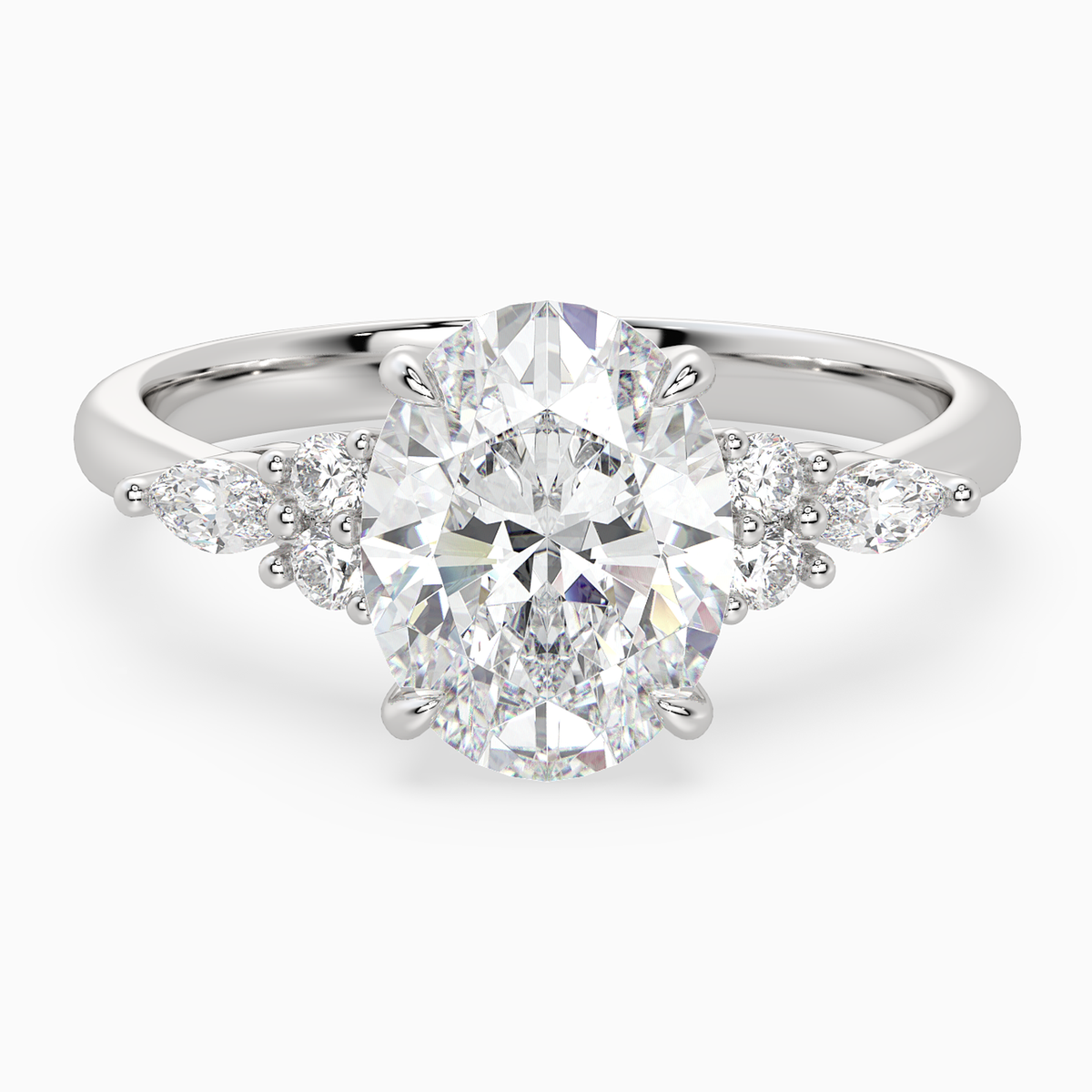


Marquise Diamond Engagement Rings
Two points, one measured axis. Marquise centers draw brilliant light through an elongated outline, framed for balance and presence.
























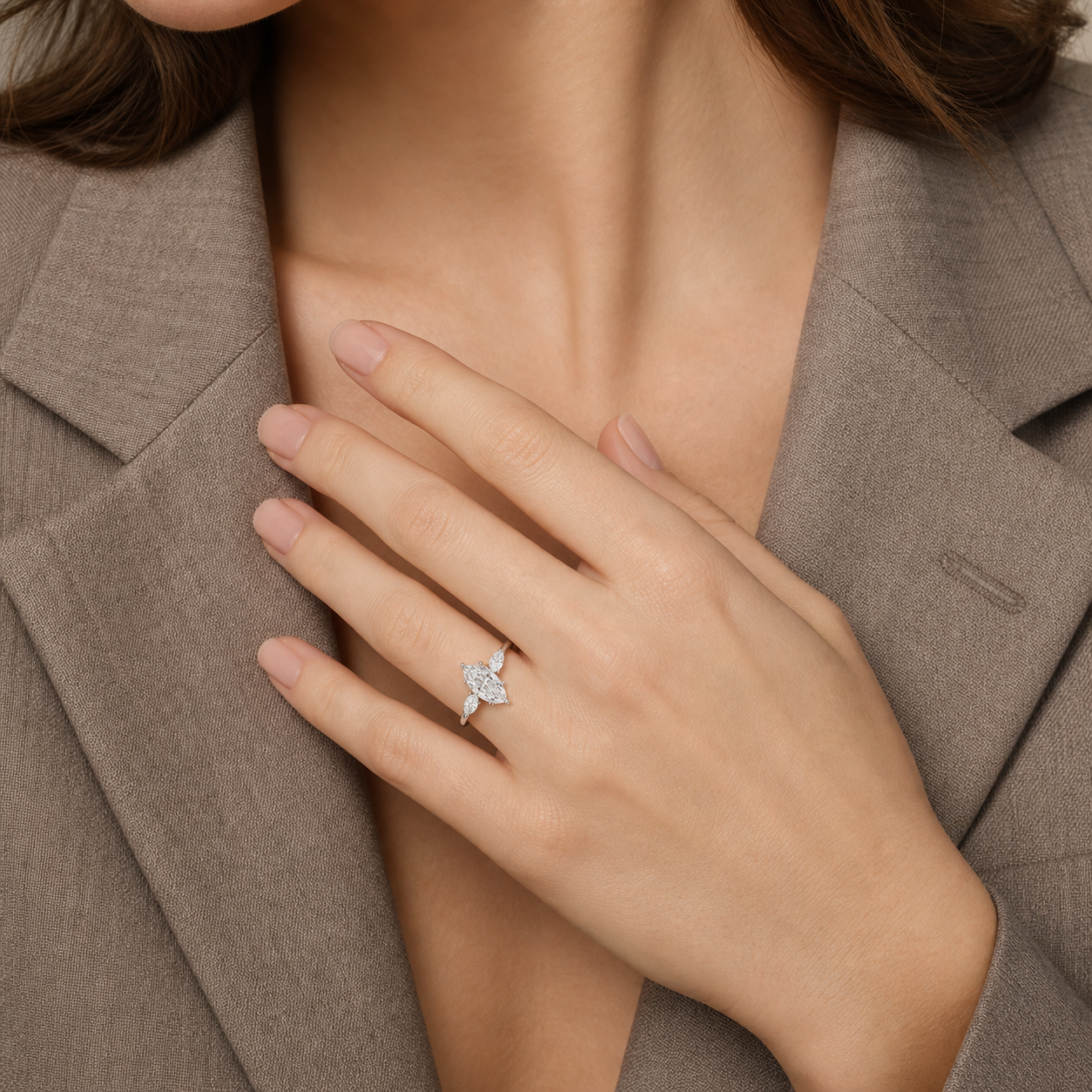
Marquise Diamond Engagement Rings: The Tension of a Fine Axis
A marquise diamond is drawn between two points. Its curved sides open around a central belly and return along a shared axis, creating an outline that feels poised between expansion and restraint. The trade also calls the shape a navette, but its visual value does not depend on a royal legend or a promise of drama. It lies in the precision of that double-ended line.
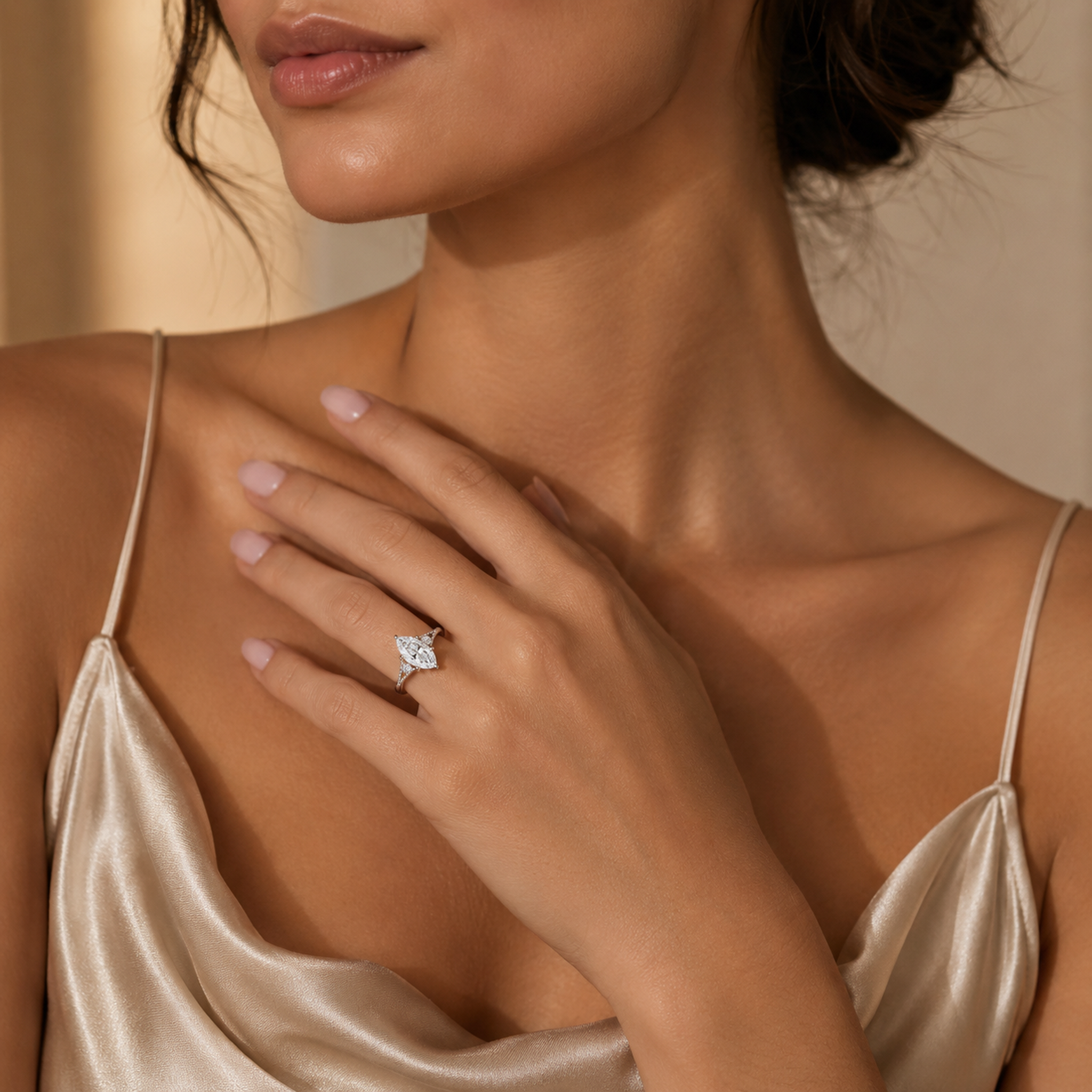
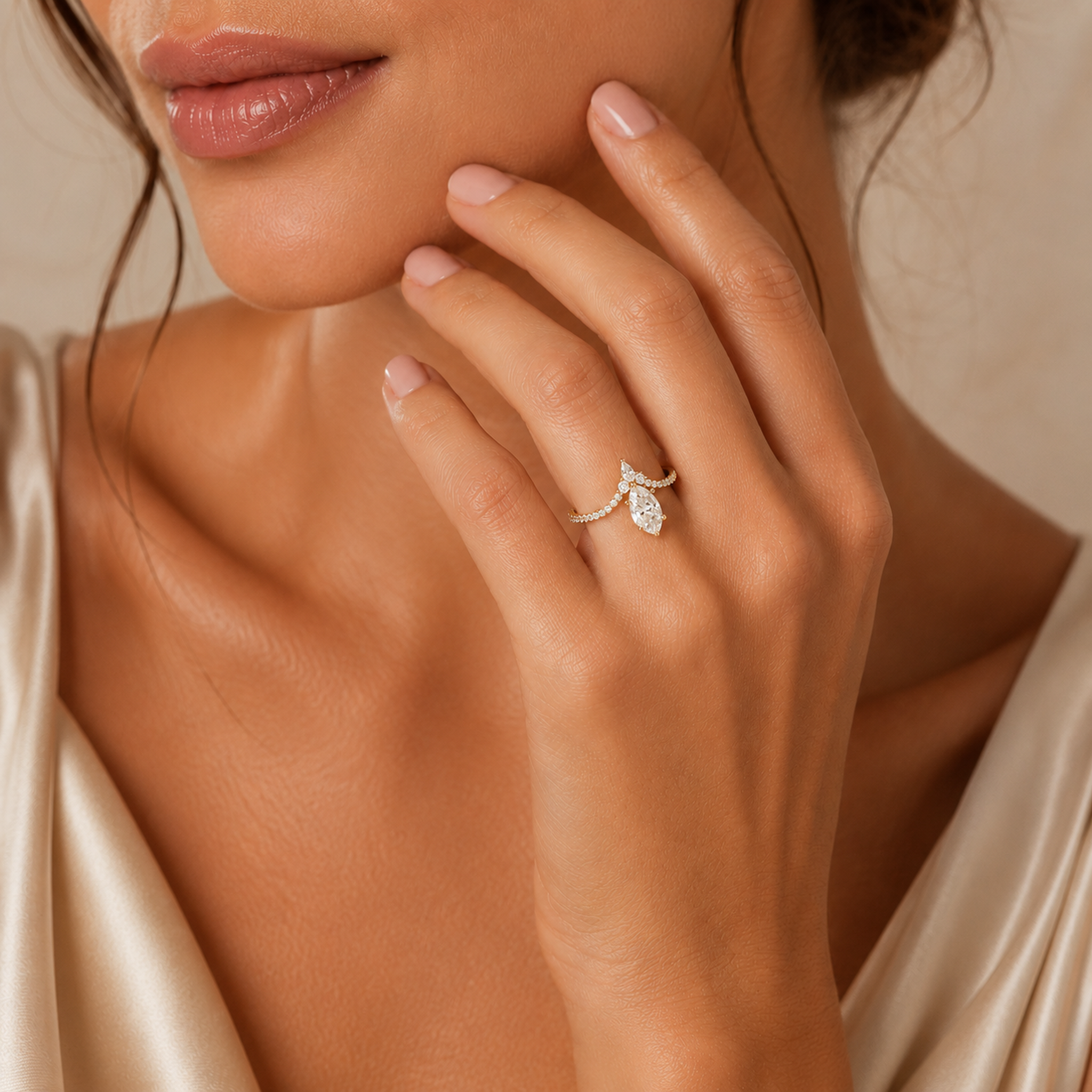
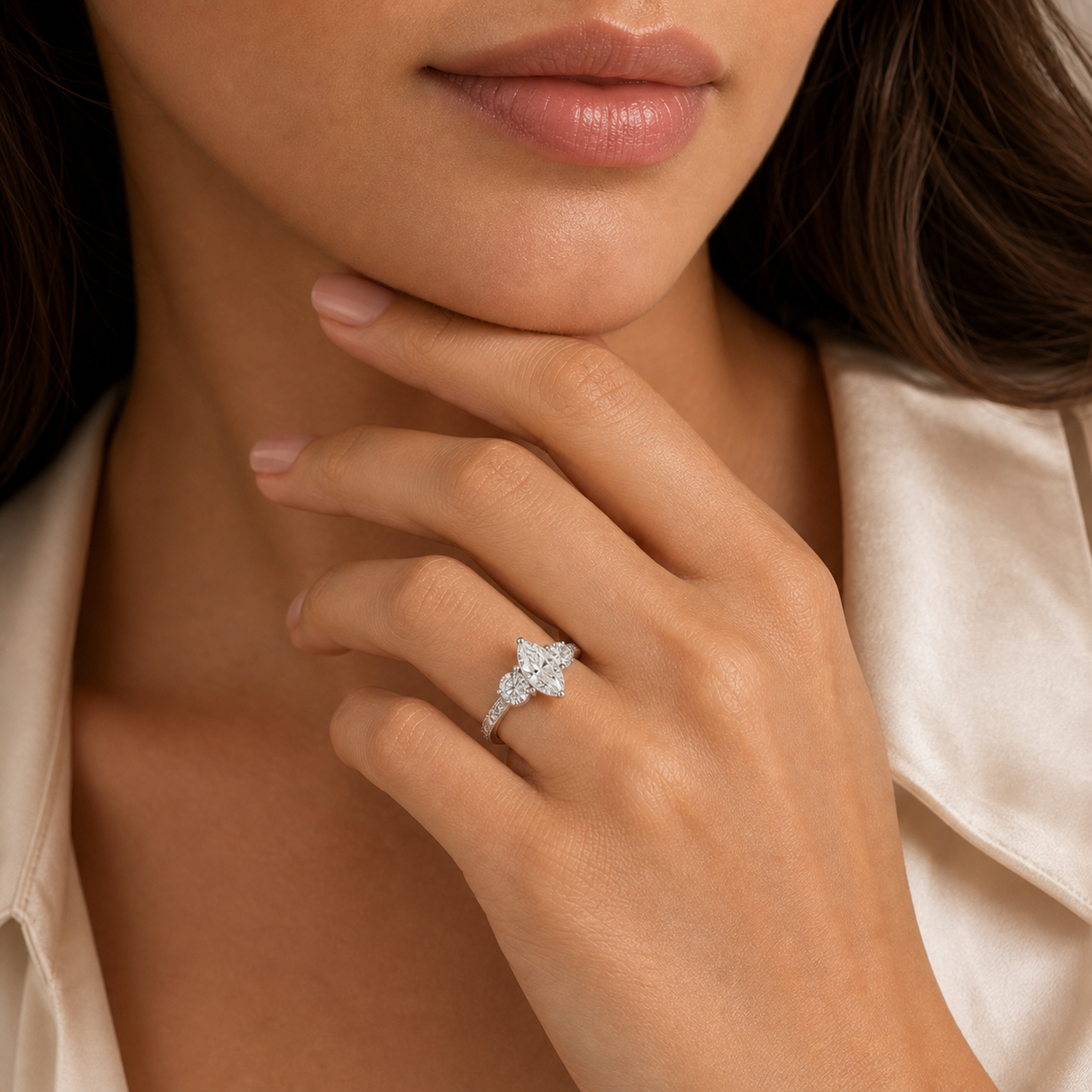
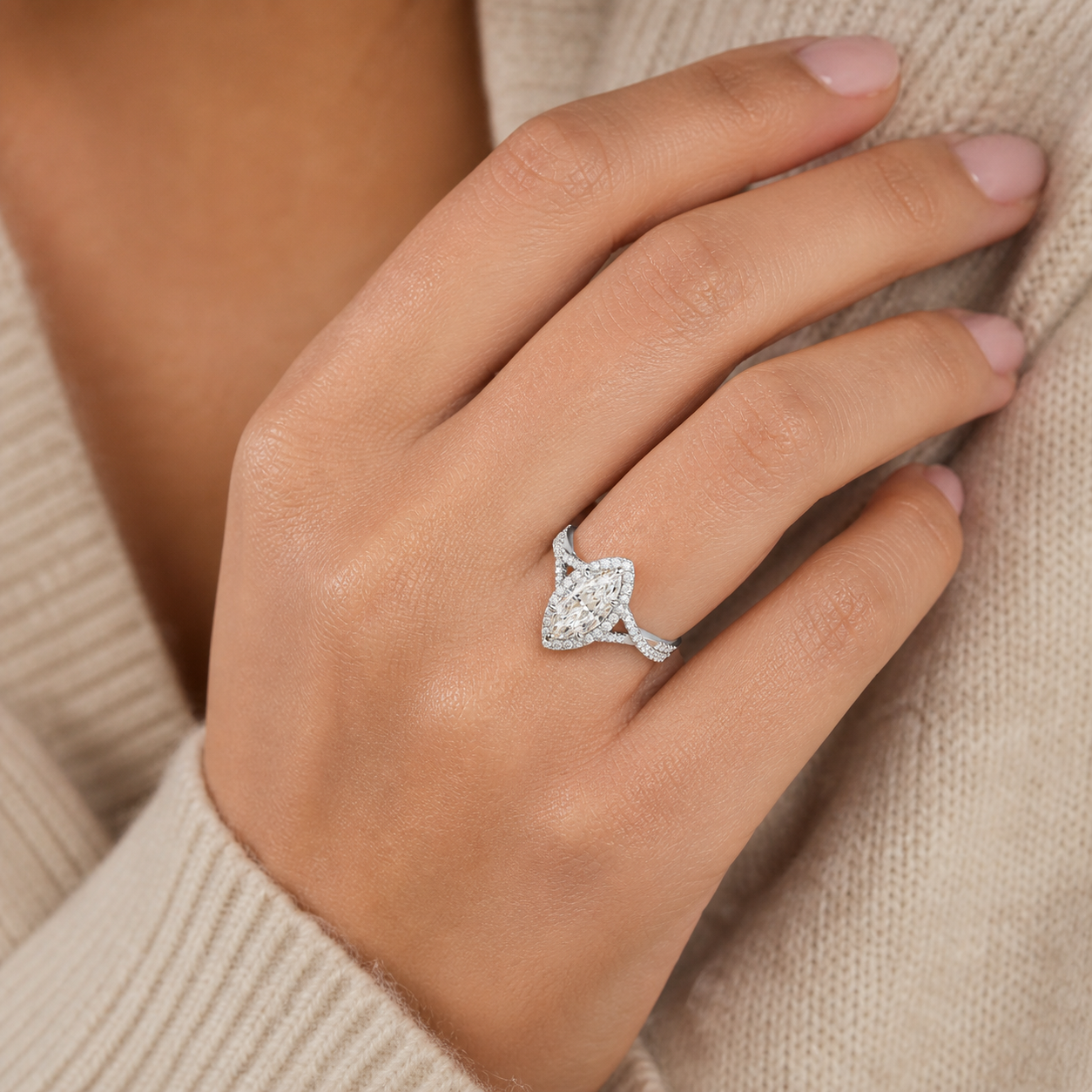
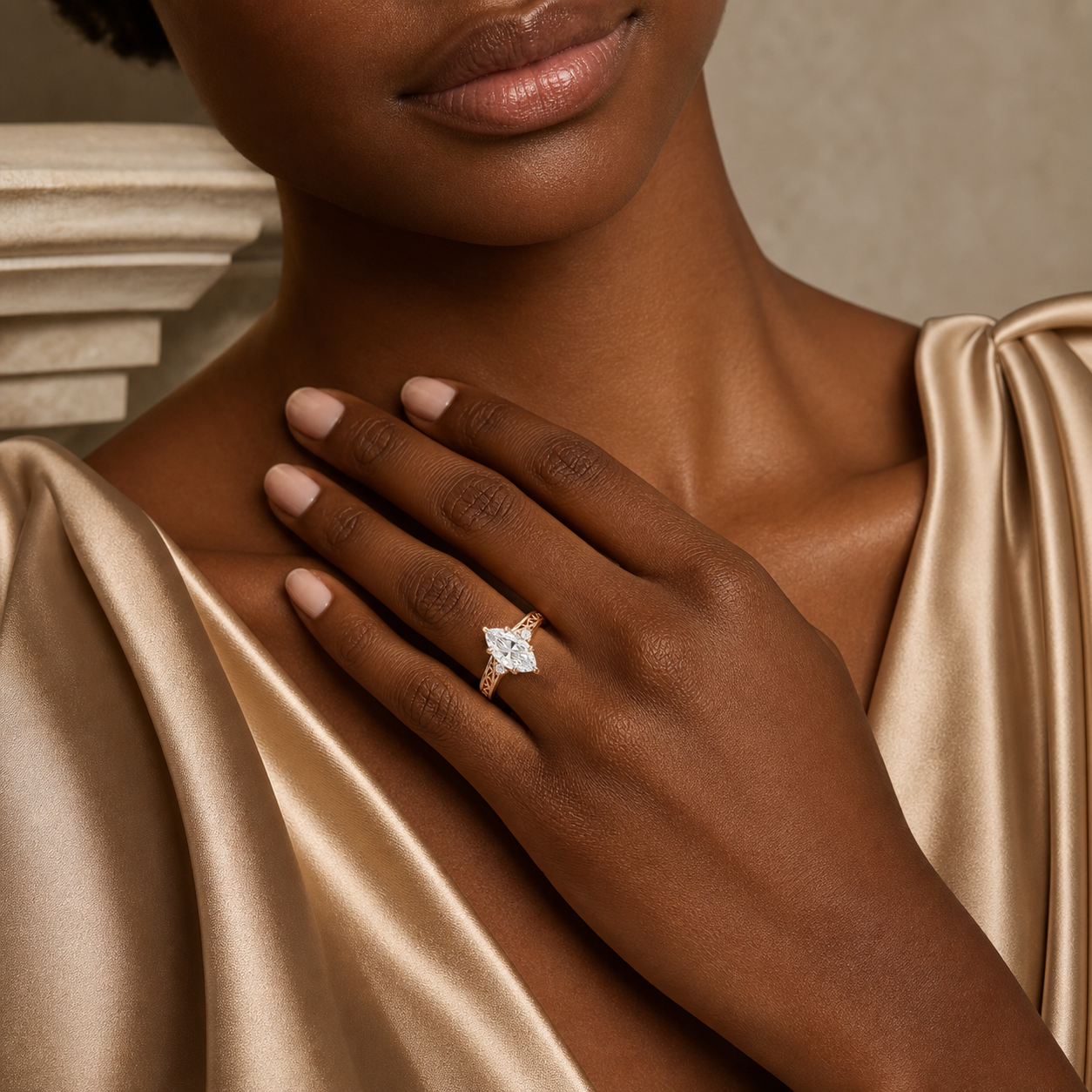
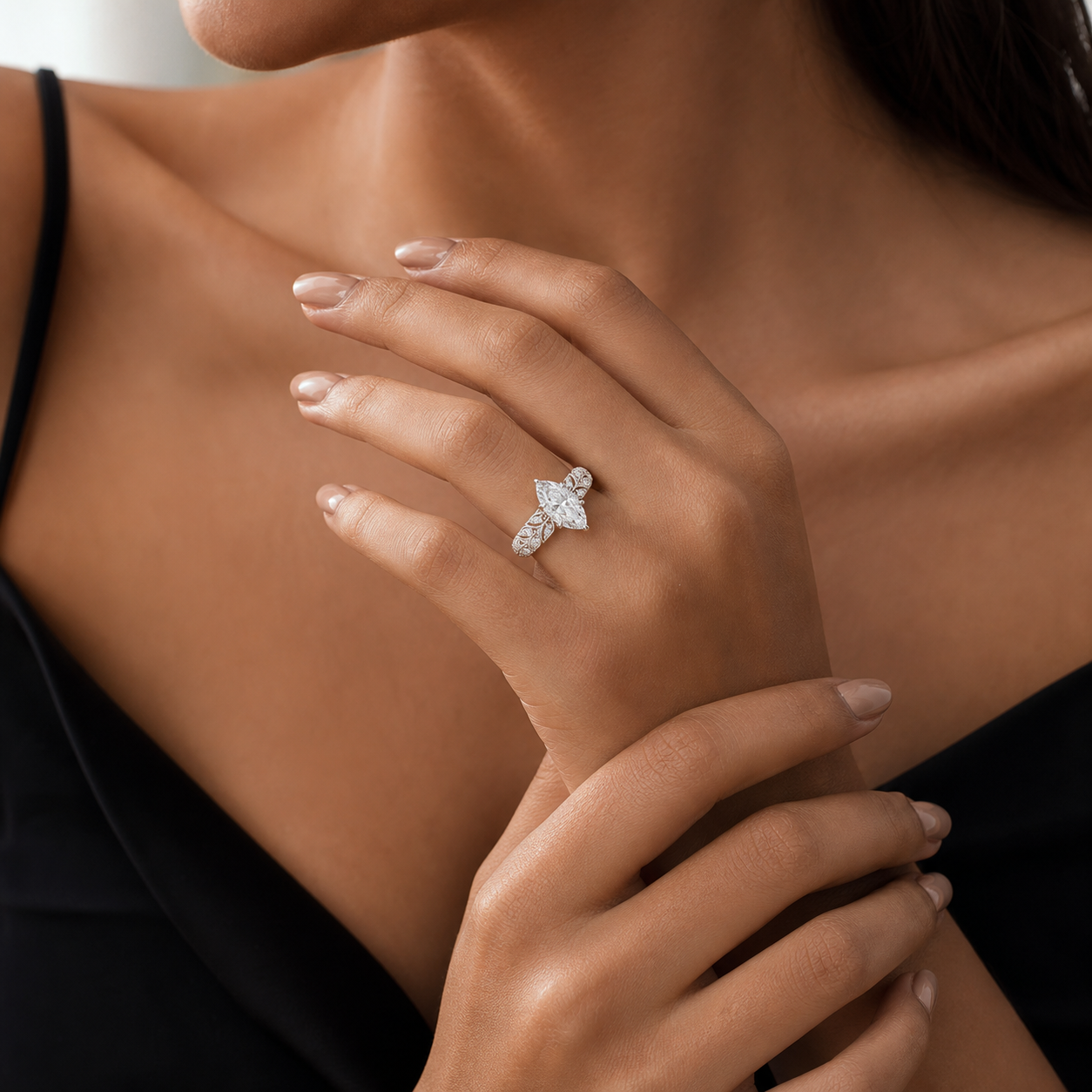
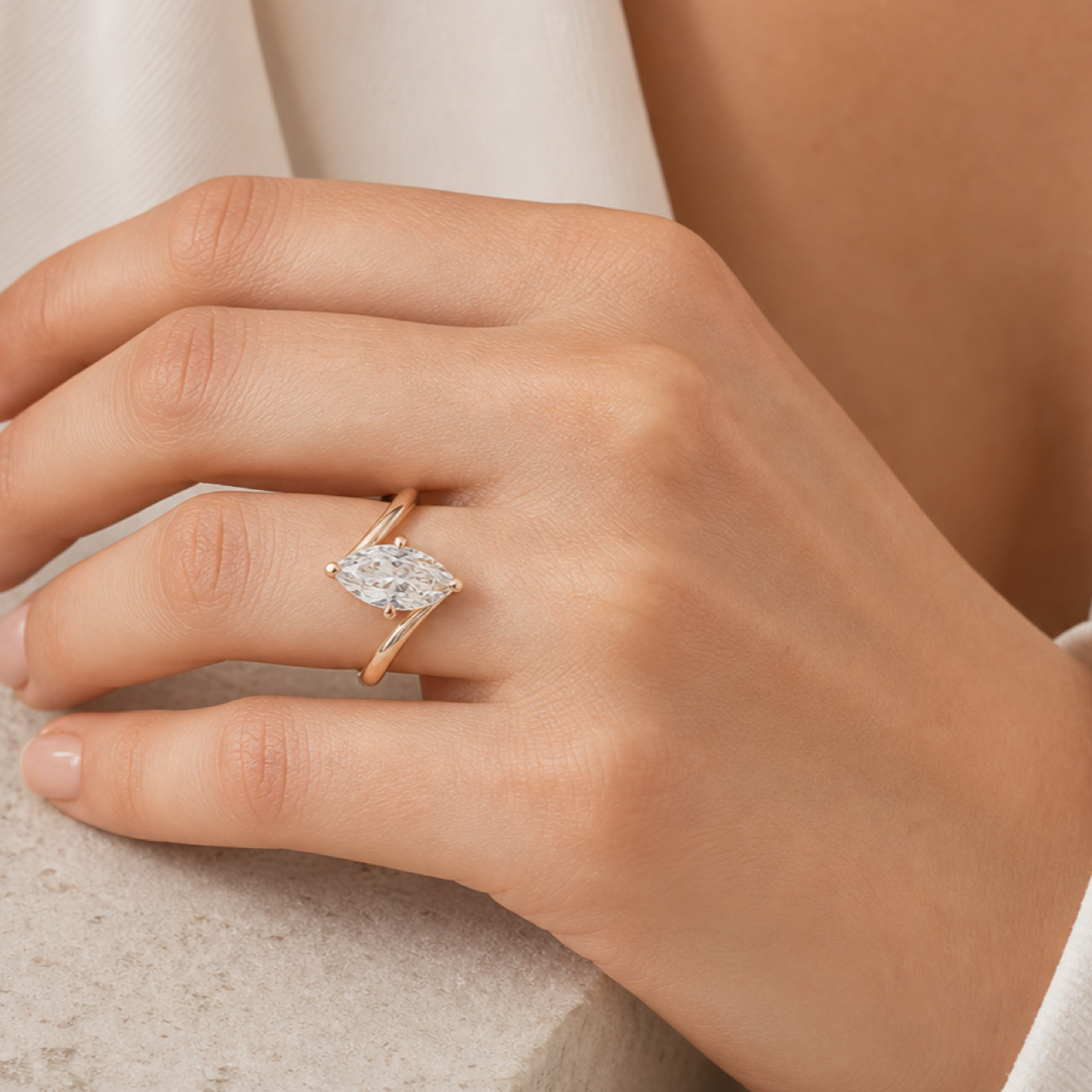
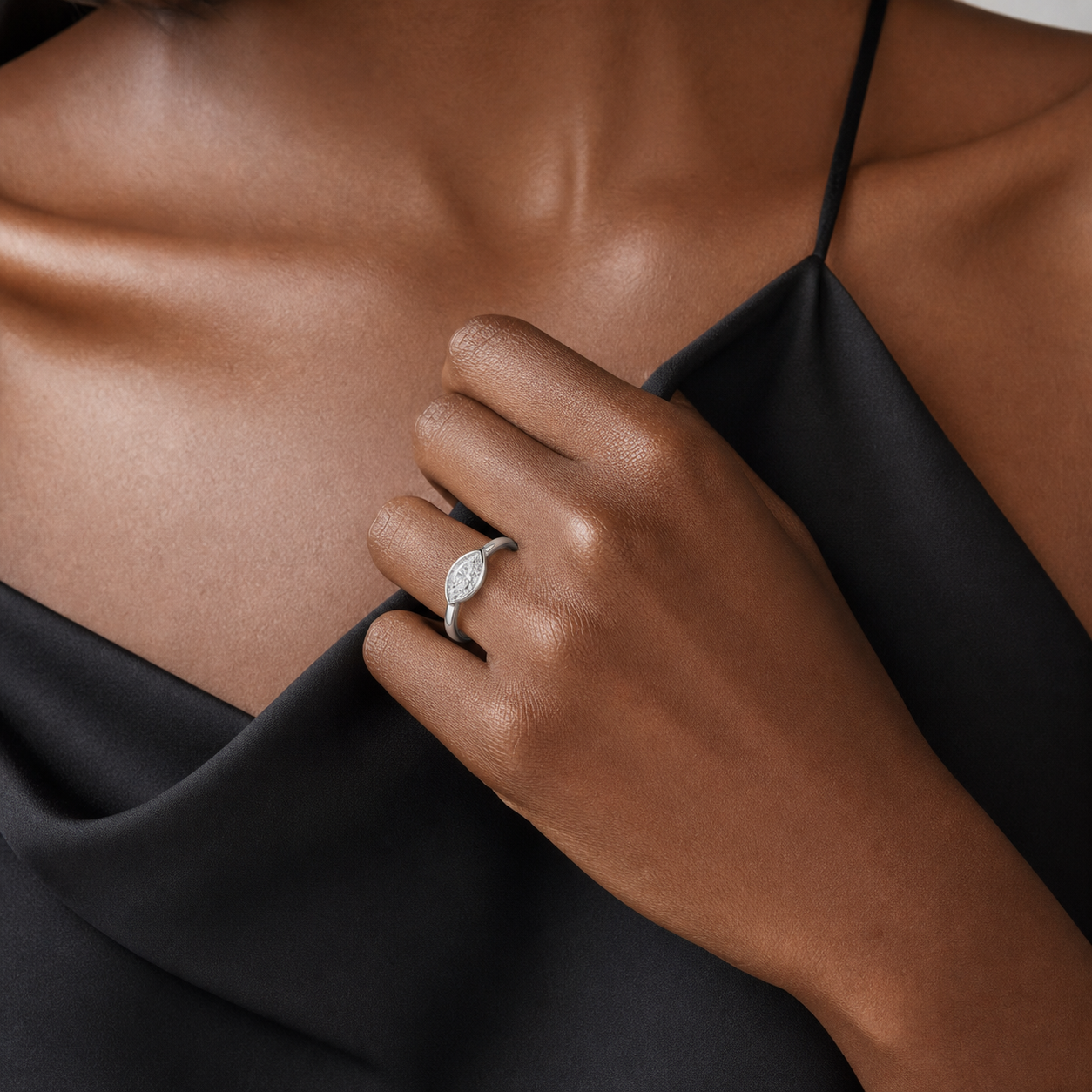
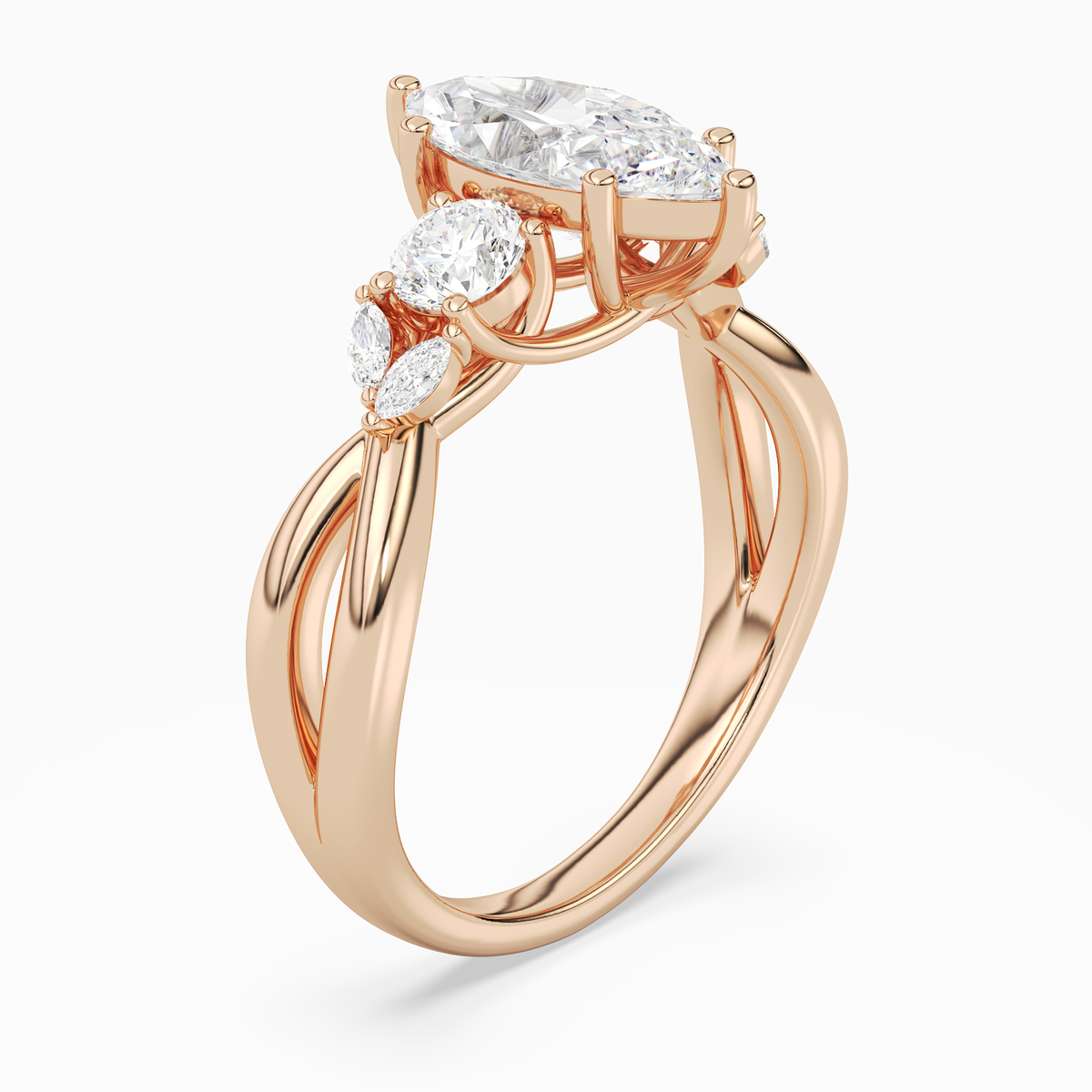
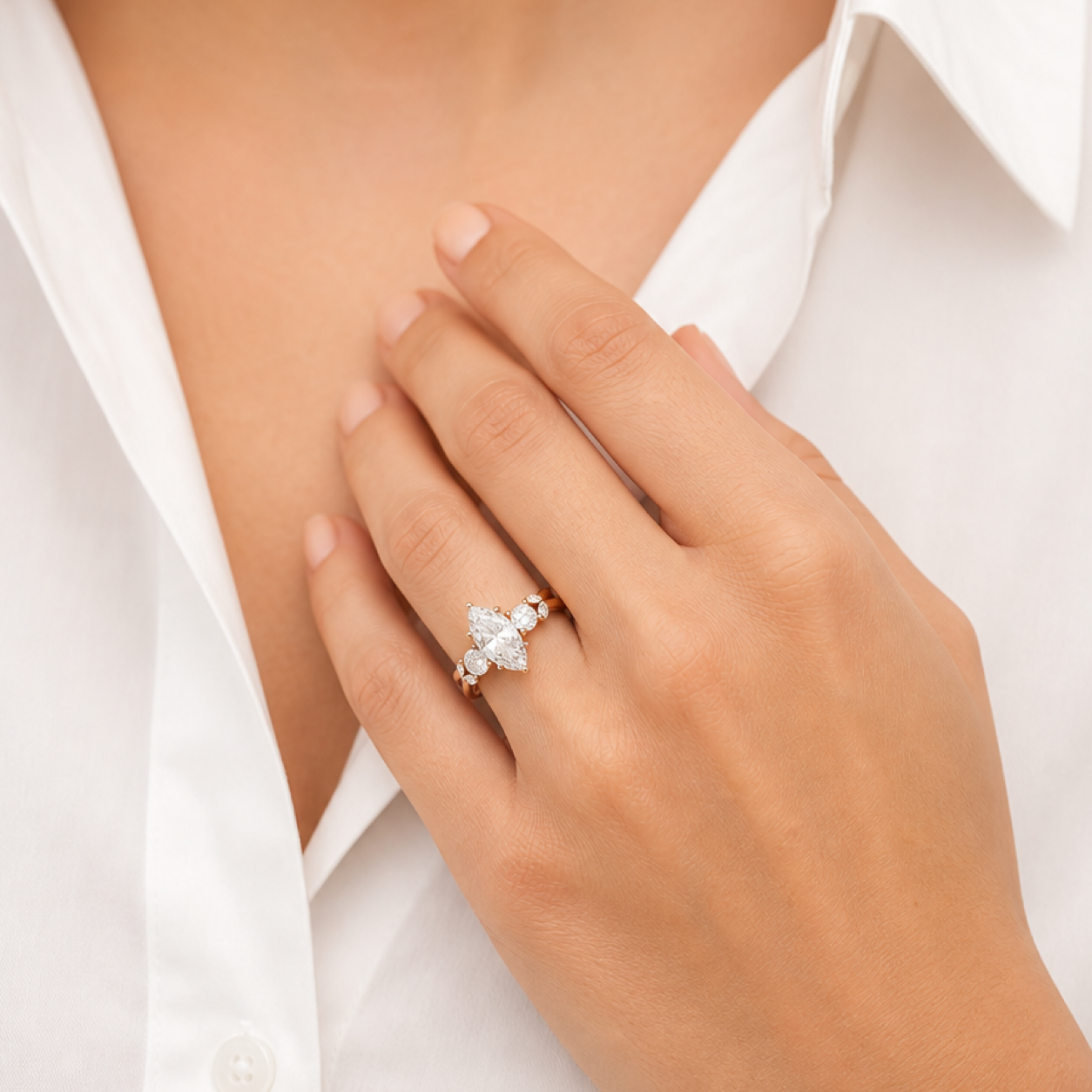
Burvonti’s marquise engagement rings bring the outline into Solitaire, Halo, Side Stone, Three Stone, bezel, bypass, vine, and more sculptural settings. Some preserve the long north–south direction; an East–West bezel turns the center across the finger. Accents can repeat its points, soften its transition, or build a wider composition around the axis.
Proportion Begins with an Axis, Then Expands into Shape
Length-to-width ratio describes whether a marquise reads fuller or more slender. It is not a complete cut grade and should not become a universal sweet spot. GIA research documents marquise outlines across a broad ratio range, with point angles and wings that vary independently. Similar ratios can therefore produce different silhouettes and visual responses.
Follow the line from one point to the other. The tips should feel aligned; each half should answer the other; shoulders, belly, and wings should form an intentional curve rather than an accidental bulge or flat side. A broader marquise may hold more visual weight at its center, while a slender one emphasizes reach. Neither is automatically superior when symmetry, light, and setting are considered together.
The Internal Pattern Is as Important as the Perimeter
Most marquise diamonds use brilliant-style faceting, yet their elongated outline supports many facet arrangements and proportion combinations. Brightness, fire, scintillation, broad reflections, and finer crushed-ice regions can appear in different distributions, particularly around the center and pointed ends. Marquise diamonds do not currently receive an overall GIA cut grade, so a report cannot replace observation of the individual pattern.
Many marquise centers show a bow-tie across the belly. Some contrast gives the facets definition, and a restrained pattern may change as the diamond moves. A broad, dark, or persistent bow-tie can interrupt the continuity of light and deserves closer examination. View the diamond face-up, at a normal distance, in motion, and under more than one ordinary lighting condition when possible.
Visible Scale Comes from Dimensions and Distribution
Carat is a measure of weight, not a guarantee of face-up size. Length, width, depth, wing shape, point angle, girdle, and the distribution of mass all affect how a marquise presents. Although the elongated outline can create a long visual span, every same-carat comparison must be made with actual dimensions rather than a universal larger-looking claim.
Setting architecture changes the reading again. A fine band can leave open space around the axis; a bezel adds a continuous metal edge; side stones broaden the ring; a Halo expands its luminous perimeter. An East–West orientation uses the same center dimensions across the finger, producing a different presence without changing carat weight or grading information.
Two Points Require Two Resolved Endings
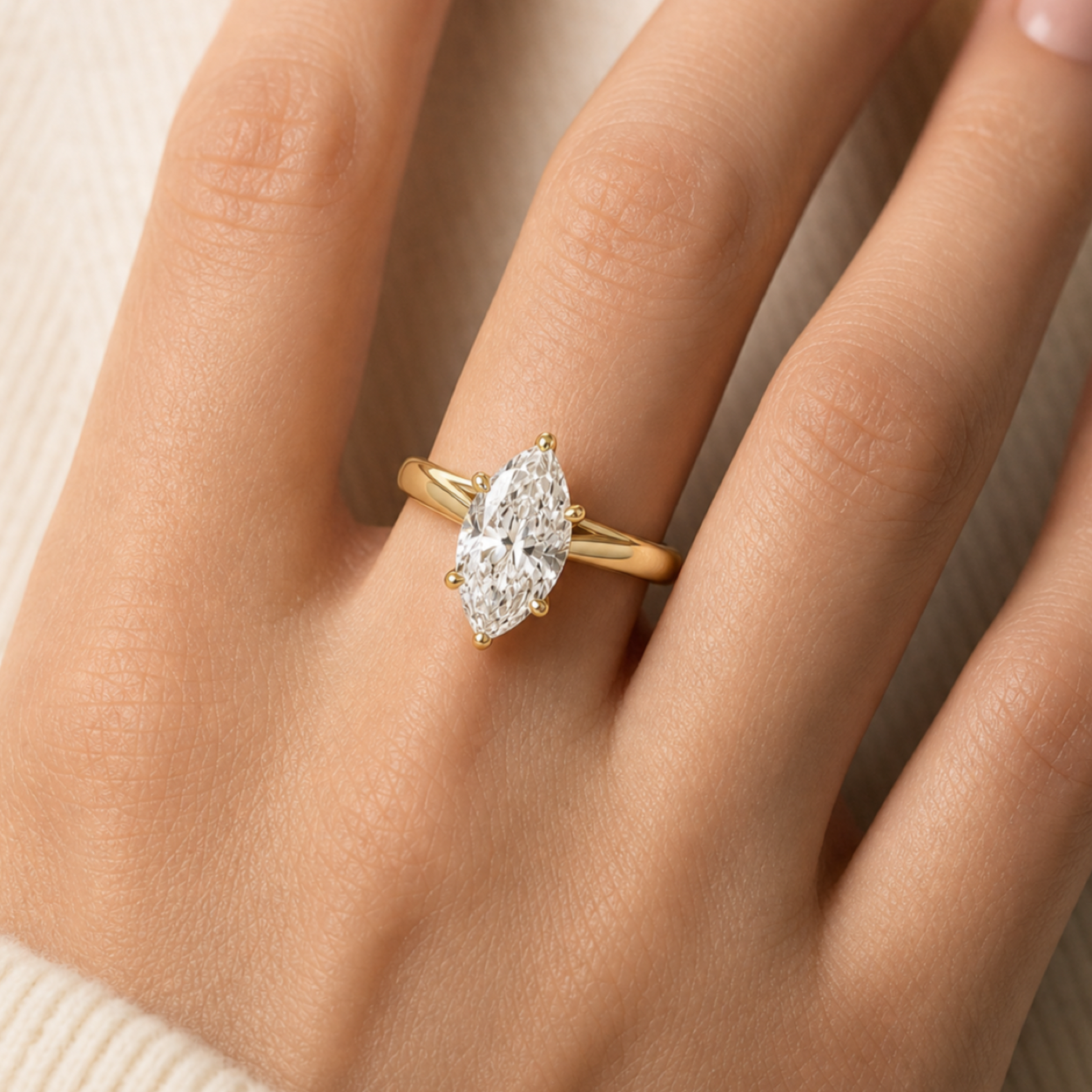
Both pointed ends are vulnerable areas. When prongs are used, V-shaped or chevron-style treatments are often chosen to shield the tips; a bezel can create more continuous coverage. Some marquise diamonds also use French-tip faceting at the ends. These features can support durability, but no style name alone guarantees security.
Point angle, girdle thickness and condition, inclusions near either tip, setting dimensions, workmanship, wear, and maintenance remain part of the decision. An independent report documents clarity characteristics and finish; the center must then be matched to support that holds it precisely without obscuring the decisive line. Both ends should be inspected as carefully as the center.
Architecture Can Reinforce, Interrupt, or Rotate the Line
A north–south Solitaire isolates the full length and makes point alignment, prong placement, basket, and band proportion especially visible. Halo and Side Stone designs add width around that length. Three Stone compositions can use Pear, Marquise, or other accents to carry a measured transition toward the shank, while bypass and vine designs turn the center’s axis into movement.
An East–West bezel rotates the marquise through ninety degrees and lets metal articulate its entire perimeter. The effect is not simply modern versus classic; it changes how the ring occupies the finger, how the points are supported, and how a wedding band approaches. Burvonti’s current public collection includes this orientation, allowing the choice to be grounded in actual architecture rather than a hypothetical custom route.
Metal, Profile, and Pairing Complete the Line
White Gold can create a cooler visual continuity around the center and accents. Yellow or Rose Gold can make the double-ended outline and setting boundary more explicit. These are compositional tendencies, not fixed prescriptions for a diamond grade, skin tone, or personal style. Alloy, finish, care, and product specification remain part of the final selection.
In profile, setting height, basket width, bezel, side stones, and shoulder geometry determine the ring’s contact line. A straight wedding band may sit close, meet the setting, or leave a deliberate interval; a contour, chevron, open band, or coordinated design can address more projecting architecture. Neither a marquise center nor a narrow band guarantees a flush fit.
Precision Along Every Part of the Axis
Burvonti pairs responsibly sourced, independently graded lab-grown diamonds with settings resolved through proportion and human judgment. For a Marquise, that means comparing the two ends, the two wings, the center pattern, and the supporting architecture as one system. Its presence should arise from the accuracy of the line, not an exaggerated historical or size claim.
When structurally feasible, custom work may refine the Marquise center specifications, orientation, double-point treatment, metal, accent rhythm, band line, or engraving. Care should be gentle and suited to the selected diamond, alloy, and construction; avoid abrasive products and harsh chemical exposure, and request inspection if either end catches, the center moves, or the ring receives a significant impact. Current availability, sizing limits, documentation, setting security, and pairing compatibility must be confirmed for the chosen configuration.
Frequently Asked Questions
What is a marquise diamond engagement ring?
It is an engagement ring centered on an elongated diamond with curved sides and two pointed ends aligned along one axis. Most marquise diamonds use brilliant-style faceting, but outline, proportion, and light pattern vary individually.
Is a navette diamond the same as a marquise diamond?
Navette is another trade term for the marquise outline, derived from a word associated with a small boat. Marquise is the more familiar jewelry term; neither name establishes the center’s quality, proportions, or setting suitability.
How is a marquise different from an oval or pear diamond?
A marquise has two points; an oval has no point; a pear has one rounded head and one point. Those outlines create different symmetry axes, vulnerable areas, orientation choices, and setting relationships even when all use brilliant-style faceting.
What is the best length-to-width ratio for a marquise diamond?
There is no universal best. Ratio describes relative length and width, while wing fullness, point angle, symmetry, and light pattern complete the shape. Compare the entire outline in the intended setting rather than treating one numerical range as a quality grade.
What makes a marquise outline look balanced?
Look for two points that align, mirrored halves, and wings and shoulders that transition intentionally around the belly. Unintended bulges, flat wings, uneven ends, or off-axis alignment can disturb the continuous double-ended line.
Does GIA give marquise diamonds an overall cut grade?
No. GIA currently gives an overall cut grade to eligible standard Round Brilliant diamonds, not marquise-shaped fancy diamonds. A marquise report still documents dimensions, polish, symmetry, color, clarity, and identifying characteristics for informed comparison.
What is a bow-tie in a marquise diamond?
It is a band or segmented zone of contrast that can appear across the center of an elongated brilliant-style diamond. Its width, darkness, persistence, and behavior in motion matter more than the mere presence of some contrast.
Is any bow-tie effect in a marquise diamond undesirable?
No. Many marquise diamonds show some bow-tie, and contrast helps define facets. A large, dark, or persistent region that dominates the face-up view is a stronger negative than a subtle pattern that changes and brightens as the diamond moves.
How should I assess a marquise diamond’s light pattern?
View it face-up and in motion at a normal distance, ideally under more than one ordinary lighting condition. Look for responsive light through the belly, wings, and points, balanced contrast, and no broad fixed dark or dull zone.
Does a marquise diamond look larger at the same carat weight?
Its elongated outline can create a long visual span, but no universal same-carat size promise is accurate. Compare length, width, depth, girdle, outline, and weight distribution, then consider how the setting changes the complete ring.
Are the points of a marquise diamond fragile?
They are more vulnerable to impact than rounded edges. Exact risk depends on point angle, girdle, inclusions near either point, setting support, workmanship, wear, and maintenance, so both ends should be evaluated and protected deliberately.
Does a marquise diamond need V-prongs?
V-shaped or chevron-style prongs are commonly used to shield pointed ends in a prong setting. A bezel can provide more continuous coverage. The correct solution depends on the center, orientation, dimensions, and design rather than one universal requirement.
What are French tips on a marquise diamond?
French tips are a faceting variation in which several facets replace a larger bezel facet at a point. They may support the pointed area, but setting design, girdle, inclusions, condition, and care still influence durability.
Can a marquise diamond be set East–West?
Yes. An East–West setting turns the long axis across the finger. Burvonti’s current public collection includes an East–West bezel design; exact availability, proportions, point support, profile, resizing, and band pairing should be confirmed for the product.
Which marquise engagement ring settings are available at Burvonti?
The current public collection includes Solitaire, Halo, Side Stone, Three Stone, bezel, bypass, vine, vintage-detail, north–south, and East–West designs in 14K White, Yellow, and Rose Gold. Confirm exact current availability.
Is a solitaire a good setting for a marquise diamond?
A Solitaire gives the long axis and internal pattern the greatest visual space. It also makes point alignment, point protection, basket, prong placement, band proportion, and profile especially visible, so each detail must suit the selected center.
Which side stones work with a marquise center?
Pear, Marquise, Round, and other brilliant accents can create distinct transitions. Their scale, orientation, spacing, height, and relationship to the center matter more than a universal shape pairing, and current product configurations should guide the choice.
Which metal works best for a marquise engagement ring?
There is no universal best. White Gold can create cooler continuity; Yellow or Rose Gold gives the double-ended outline a warmer frame. Consider prong color, alloy, finish, care, sensitivity considerations, and exact product specifications together.
Will a marquise engagement ring sit flush with a wedding band?
Not necessarily. Basket or bezel width, point orientation, setting height, side stones, and shoulders determine the contact line. Straight, contour, chevron, open, or intentionally spaced bands can answer different architectures.
How should I clean a marquise diamond engagement ring?
Choose a gentle method suited to the diamond, alloy, and exact construction. Avoid abrasive cleaners and harsh chemicals, clean carefully around both pointed ends and the underside, and arrange inspection if a tip prong catches or the center moves.
Can a Burvonti marquise engagement ring be resized or customized?
Resize and custom possibilities depend on the setting. Center specifications, orientation, metal, point treatment, accents, band line, or engraving may be adjustable when structurally feasible, but sizing range, security, documentation, and band fit must be confirmed for the chosen configuration.