
Diamond Education

Diamond Shape Guide

Compare the major diamond shapes by outline, proportion, light behavior, setting fit, and the final ring language each shape creates.

Solitaire diamond ring with loose lab grown diamonds in several shapes on a neutral stone surface

Start Here

Shape is the outline. Cut is the performance.

Diamond shape describes the silhouette seen from above: round, oval, emerald, pear, cushion, radiant, princess, marquise, asscher, heart, and other variations. Shape influences the visual language of the piece. A round diamond reads balanced and classic; an emerald cut reads linear and architectural; an oval or marquise can make the stone appear longer on the finger.

Cut is different. Cut refers to the facet arrangement, polish, symmetry, and proportions that determine how the diamond returns light. A shape can be chosen for style, but the individual stone still needs strong cut quality, careful proportion, and a setting that supports its geometry.

Ten loose lab grown diamond shapes arranged on a neutral surface for comparison

Shape Comparison

Read each shape by outline, light, and proportion.

The strongest shape choice is rarely about popularity alone. It is a balance between face-up presence, light behavior, hand coverage, and the setting that will hold the diamond. Brilliant-cut shapes tend to emphasize sparkle. Step-cut shapes tend to emphasize clarity, symmetry, and quiet flashes of light.

For lab grown diamonds, this choice can be especially strategic: the same budget may allow you to compare a broader range of sizes, ratios, and clarity grades before committing to one visual direction.

Shape Profiles

Ten diamond shapes, each with its own design language.

Round diamond engagement ring in a refined solitaire setting

Round Shape Diamonds

Round: the benchmark for brilliance.

History and character

The round diamond is the modern standard because its proportions were refined around light performance. Earlier round stones evolved through old European and early brilliant styles; the modern round brilliant became the dominant benchmark as cutters studied how angles, symmetry, and facet placement return light to the eye.

How it reads in a ring

Round diamonds feel balanced from every direction. They work in almost any engagement ring setting: solitaire, pave, halo, bezel, cathedral, three-stone, and vintage-inspired designs. The shape does not rely on elongation or directional styling, so the focus stays on brightness, proportion, and the ring's construction.

Burvonti buying standard

Prioritize cut quality first. Because round diamonds are highly standardized, small differences in cut grade, table, depth, and optical symmetry can change how lively the stone appears. Expect round diamonds to carry a price premium compared with many fancy shapes, but also expect the clearest performance benchmark.

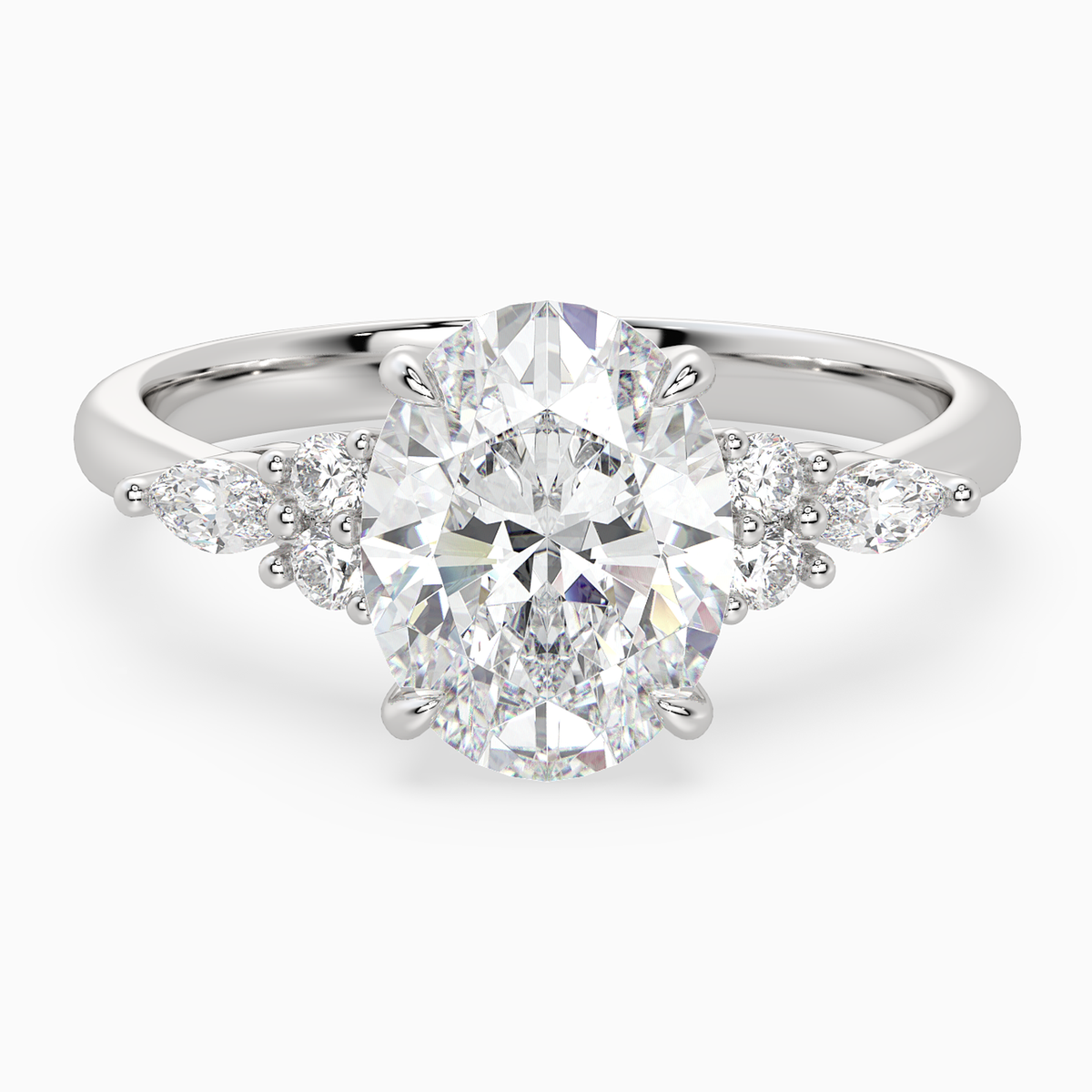
Oval diamond engagement ring in a slim modern setting

Oval Shape Diamonds

Oval: elongated brilliance with a softer outline.

History and character

Oval diamonds have existed in earlier forms for centuries, but the modern oval brilliant is usually associated with mid-twentieth-century cutting development. It keeps much of the round brilliant's light behavior while stretching the outline into a more directional, finger-lengthening shape.

How it reads in a ring

An oval can look classic in a solitaire, sculptural in an east-west setting, or more ornate with side stones and hidden halo details. Ratio is the main design lever. A longer oval feels sleek and lengthening; a fuller oval reads softer and more balanced. Both can be correct when the setting is proportioned around the stone.

Burvonti buying standard

Evaluate the bow-tie effect in real imagery or video, not only on a grading report. Compare length-to-width ratio, symmetry, and the way the ends of the oval return light. For buyers who want a larger-looking diamond without a sharp outline, oval is often one of the strongest starting points.

Cushion cut diamond engagement ring with a softly squared center stone

Cushion Shape Diamonds

Cushion: softened geometry with antique roots.

History and character

Cushion diamonds trace their lineage to old mine cuts, one of the important historic cutting styles before modern brilliant standards. Their pillow-like outline and rounded corners carry that heritage, even when the contemporary stone is cut for a sharper, more modern sparkle pattern.

How it reads in a ring

A cushion can feel soft, substantial, and highly adaptable. Square cushions suit balanced solitaires and halos; elongated cushions bring more finger coverage and a cleaner vertical line. The same shape can feel vintage, modern, or architectural depending on prongs, band weight, and whether the facet pattern is chunky or crushed-ice.

Burvonti buying standard

Do not evaluate cushions by name alone. Ask whether the stone is square or elongated, how much weight is held in depth, and whether the faceting creates broad flashes or denser scintillation. A well-chosen cushion should have a deliberate outline, not just a softened version of another shape.

Princess cut diamond engagement ring with a clean square center stone

Princess Shape Diamonds

Princess: sharp square lines with brilliant energy.

History and character

The princess cut is a relatively modern diamond shape compared with round, pear, or cushion. Its current form developed in the late twentieth century as cutters sought a square stone with the lively sparkle associated with brilliant-style faceting. The result is clean, geometric, and distinctly contemporary.

How it reads in a ring

Princess diamonds bring a crisp center line to solitaires, channel-set bands, and clean cathedral settings. They can look precise without the quieter glass-like effect of step cuts. Because the corners are pointed, the setting should protect them with strong prongs or a design that supports the square outline.

Burvonti buying standard

Look for symmetry, corner integrity, and an even pattern of light across the stone. Princess cuts can be efficient in how rough is used, which may create value opportunities, but the ring should never treat the corners casually. Protection is part of the design, not an afterthought.

Pear shaped diamond engagement ring with a protected pointed tip

Pear Shape Diamonds

Pear: a directional shape with graceful tension.

History and character

The pear shape is often connected to the long history of brilliant cutting and the development of more precise faceting tools. Its profile combines a rounded end with a pointed tip, creating a shape that feels both soft and directional. That contrast is why pear diamonds remain distinctive in engagement rings, pendants, and toi et moi designs.

How it reads in a ring

Pear diamonds create movement. Worn point-up, they lengthen the finger; worn point-down, they feel more teardrop-like and dramatic. They pair well with solitaires, halos, asymmetrical side stones, and modern two-stone compositions. The shape needs careful alignment because uneven shoulders are easy to see.

Burvonti buying standard

Check the point, shoulders, and bow-tie. A beautiful pear diamond should not feel lopsided or thin through the middle. The setting should protect the tip with a V-prong or equivalent structure and keep the stone centered so the asymmetry looks intentional.

Emerald cut diamond engagement ring with a rectangular step-cut center stone

Emerald Shape Diamonds

Emerald: architectural restraint and broad flashes.

History and character

The emerald cut began as a cutting approach for emerald gemstones, where trimmed corners helped reduce chipping. In diamonds, the shape became especially associated with Art Deco geometry: long lines, clipped corners, and a controlled hall-of-mirrors effect rather than dense sparkle.

How it reads in a ring

Emerald cuts do not perform like round brilliants. They give broad, linear flashes and a clear window into the stone. In a solitaire, the effect is disciplined and modern; with tapered baguettes or a bezel, it becomes even more architectural. The setting should preserve the long lines rather than overcomplicate them.

Burvonti buying standard

Prioritize clarity, symmetry, and proportion. Inclusions can be easier to see through step-cut facets, and uneven facet alignment will disturb the calm geometry. Compare ratios carefully: a slimmer emerald feels elongated, while a fuller one feels more substantial and quietly formal.

Marquise diamond engagement ring with a long pointed center stone

Marquise Shape Diamonds

Marquise: maximum length with a sculptural profile.

History and character

The marquise is one of the most recognizable historic fancy shapes, often linked in jewelry lore to the French court and the elongated smile of the Marquise de Pompadour. Whatever the origin story, the design language is clear: long, pointed, and intentionally dramatic.

How it reads in a ring

Marquise diamonds create strong finger coverage and a precise north-south line. They can look minimal in a solitaire, ornate in a halo, or highly contemporary when set east-west. Because the tips define the shape, the prong structure becomes a visible part of the design.

Burvonti buying standard

Compare bow-tie, symmetry, and tip protection. Marquise diamonds often look large for their carat weight, but a shallow or poorly balanced stone can lose life through the center. A strong marquise should feel deliberate from tip to tip.

Asscher cut diamond engagement ring with a square step-cut center stone

Asscher Shape Diamonds

Asscher: square step-cut precision.

History and character

The Asscher cut was introduced by the Asscher family in the early twentieth century and later revived in modernized forms. It shares step-cut discipline with the emerald cut, but its square outline and concentric facet pattern create a more compact, graphic presence.

How it reads in a ring

Asscher diamonds feel ordered and architectural. They suit solitaires, geometric side stones, bezel settings, and designs that leave enough visual room for the facet pattern to read. The shape is less about constant glitter and more about depth, symmetry, and controlled flashes.

Burvonti buying standard

Look closely at clarity, center pattern, and face-up size. Asschers can appear smaller than elongated shapes of the same carat because more weight may sit in depth. The best examples feel crisp from the center outward, with a pattern that looks intentional rather than crowded.

Radiant cut diamond engagement ring with a trimmed-corner rectangular center stone

Radiant Shape Diamonds

Radiant: structured outline, brilliant movement.

History and character

The radiant cut is a modern shape, developed to bring more brilliant-style scintillation into a squared or rectangular outline. It sits between the emerald cut's geometry and the round brilliant's light activity, making it a useful choice for buyers who want both structure and movement.

How it reads in a ring

Radiant diamonds can feel sleek, confident, and versatile. A rectangular radiant lengthens the finger; a square radiant gives a more compact, modern center. Trimmed corners make the shape practical for prong design, and the lively faceting works well with solitaires, three-stone settings, and halos.

Burvonti buying standard

Compare facet pattern, depth, and ratio. Some radiants show a more crushed-ice look, while others show broader flashes. Neither is automatically better, but the style should be chosen intentionally and supported by a setting that does not crowd the outline.

Heart shaped diamond engagement ring in a refined protective setting

Heart Shape Diamonds

Heart: symbolic, but still technical.

History and character

Heart-shaped stones have long been used as symbolic jewels, but a refined heart diamond is not simply decorative. It requires a clear cleft, balanced lobes, and a centered point. Without that precision, the shape can lose definition, especially at smaller sizes.

How it reads in a ring

A heart diamond is graphic and unmistakable. It can be modern when the setting is restrained, or more expressive with a halo or side stones. The strongest versions avoid excessive sentimentality by making the shape clean, proportionate, and structurally protected.

Burvonti buying standard

Choose heart diamonds by symmetry first. The lobes should feel even, the cleft should be visible, and the point should be protected in the setting. This shape benefits from enough size for the outline to read clearly from normal viewing distance.

Shape Chart

Diamond shape chart: what each shape tends to change.

Shape Visual language Light behavior Setting compatibility Burvonti buying note
Round Balanced, classic, symmetrical. Often the strongest benchmark for brilliance. Works across solitaire, pave, halo, three-stone, and bezel settings. Start here if light performance is the leading priority.
Oval Elongated, soft, contemporary-classic. Brilliant sparkle with possible bow-tie variation. Excellent in solitaires, hidden halos, three-stone rings, and east-west settings. Compare length-to-width ratio before comparing carat weight.
Emerald Linear, architectural, refined. Broad flashes instead of dense sparkle. Strong with tapered baguettes, bezels, cathedral settings, and clean solitaires. Clarity and symmetry matter because the facet pattern is open.
Pear Directional, graceful, lengthening. Brilliant sparkle with a point that needs evaluation. Works well in solitaires, halos, toi et moi, and pendant designs. Check shoulder balance and protect the tip in the setting.
Cushion Soft square or rectangle, adaptable. Can show chunky flashes or crushed-ice sparkle. Strong in solitaires, halos, vintage-inspired settings, and split shanks. Ask whether you prefer square or elongated before choosing size.
Radiant Structured but lively. Brilliant sparkle in a trimmed-corner outline. Works in solitaires, three-stone settings, halos, and clean modern bands. Useful when you want geometry without giving up scintillation.
Loose round, oval, pear, emerald, and marquise diamonds showing different face-up proportions

Choosing Method

Choose by proportion, not only by name.

Two diamonds can share the same shape and still feel very different. Length-to-width ratio, depth, table size, and facet pattern all influence whether a stone looks elongated, compact, crisp, soft, bright, or glassy.

For elongated shapes, compare ratio on the hand rather than relying on a generic standard. A higher ratio often looks longer and more directional; a lower ratio can feel fuller and more balanced. For step cuts, look for clean facet alignment and a face-up appearance that feels composed rather than flat.

Oval, emerald, and cushion diamond engagement rings in refined setting styles on a graphite surface

Setting Fit

The setting should protect the shape and clarify the design.

Pointed shapes such as pear and marquise need secure tip protection. Step cuts often benefit from settings that reinforce their geometry. Brilliant elongated shapes can look especially clean in solitaires, hidden halos, and three-stone settings when the proportions are controlled.

A shape is not finished until it is placed in a setting. The best choice is the one where stone, metal, prongs, and side details operate as one design system.

Practical Standard

What shape looks largest?

Face-up size is not the same as carat weight. Oval, pear, and marquise diamonds often create more visible length for the same weight, while step cuts can carry more weight in depth. If presence is the goal, compare millimeter measurements, ratio, and setting coverage alongside carat.

Browse By Shape

Shop diamonds by shape.

Build the ring around the right shape.

When you have a shape direction, the next step is to compare proportions, certification, and setting architecture together.

Request a Diamond Consultation

FAQ

Diamond shape questions.

What is the difference between diamond shape and diamond cut?

Diamond shape is the outline of the stone, such as round, oval, emerald, or pear. Diamond cut is the quality and arrangement of facets that control light performance. Shape defines the silhouette; cut determines how well that stone returns light.

Which diamond shape sparkles the most?

Round brilliant diamonds are the traditional benchmark for sparkle because their facet pattern is optimized for light return. Radiant, oval, pear, cushion, princess, and marquise diamonds can also be lively when the individual stone is well cut.

Which diamond shape looks the biggest?

Elongated shapes such as oval, pear, and marquise often look larger face-up than their carat weight suggests because they create more visible length. Always compare millimeter measurements and proportions, not carat weight alone.

Are some diamond shapes better for engagement rings?

Most major diamond shapes can work beautifully in engagement rings. The better question is whether the setting protects the shape and supports the intended design. Pointed shapes need secure tips, while step cuts need careful clarity and symmetry selection.

What is length-to-width ratio?

Length-to-width ratio compares a diamond's length with its width. It has a major effect on elongated shapes. A higher ratio usually appears longer and slimmer, while a lower ratio appears fuller or more compact.

Is there a best diamond shape for lab grown diamonds?

No single shape is best for all lab grown diamonds. The advantage is choice: buyers can often compare more sizes, ratios, and clarity options within a budget. The right shape is the one that meets the visual goal and performs well in the chosen setting.