
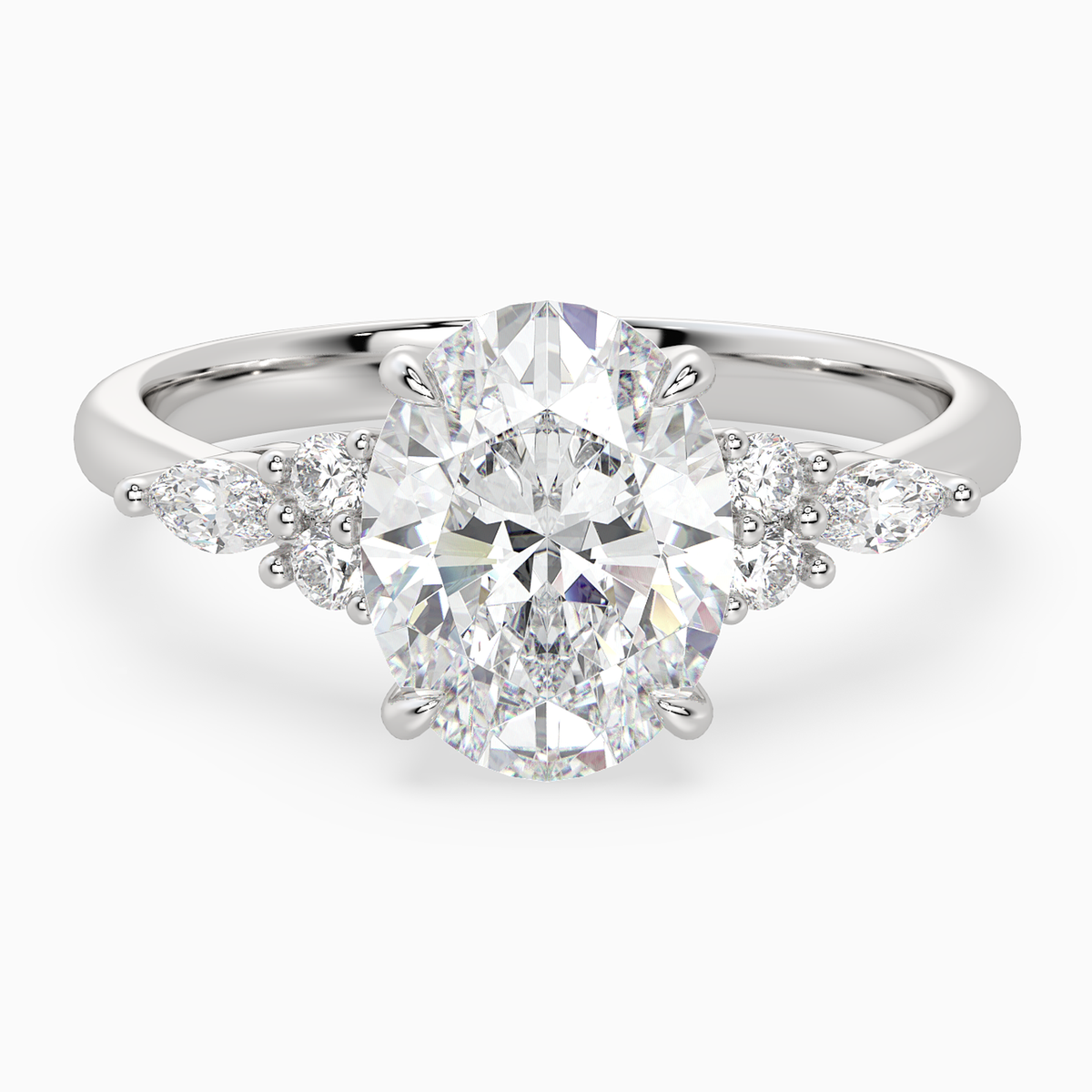


Asscher Diamond Engagement Rings
A square drawn inward. Asscher centers layer measured planes and cropped corners into a precise, quietly dimensional field of light.





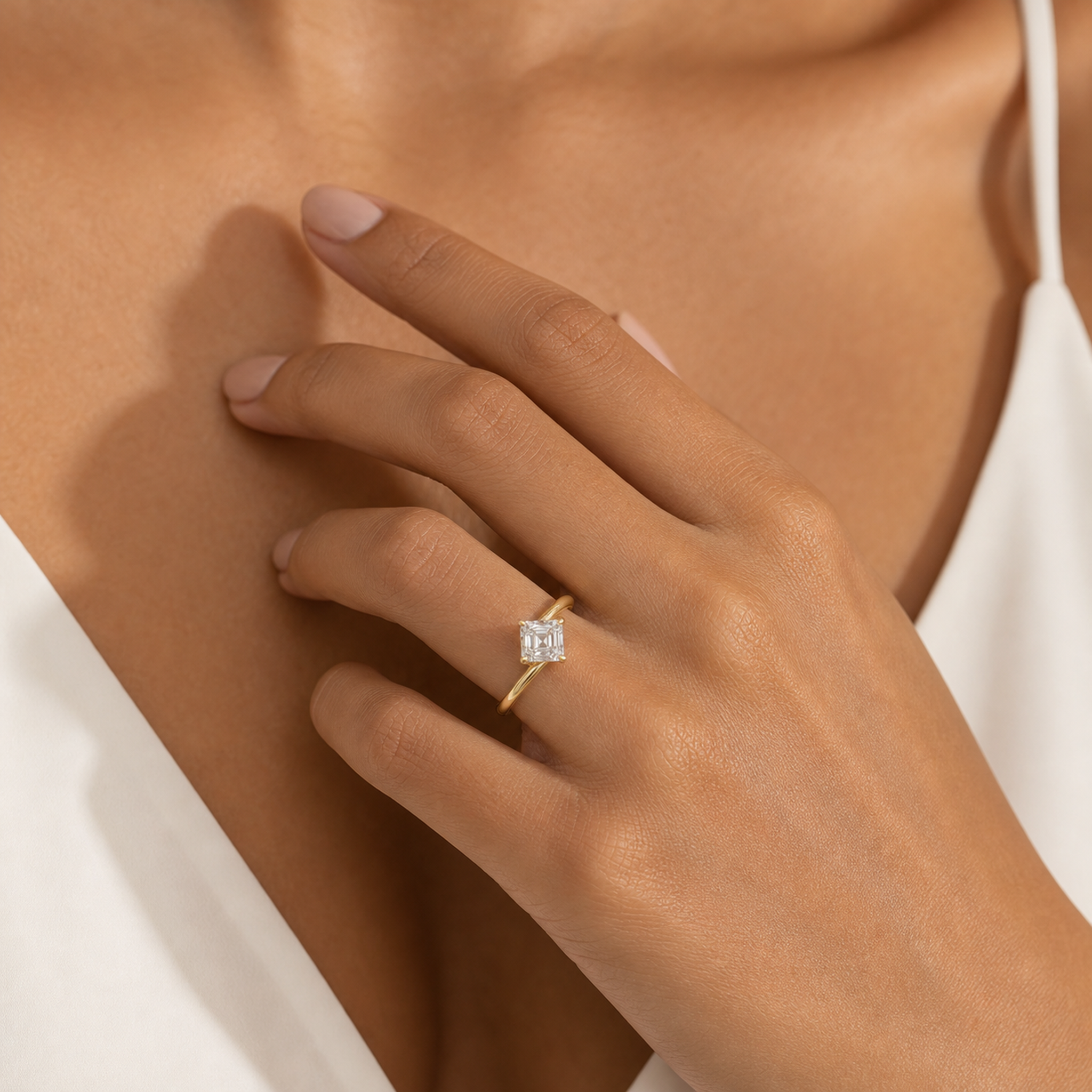
Asscher Diamond Engagement Rings: Depth Within a Measured Square
An Asscher-cut diamond draws the eye inward. Its square outline is interrupted by four cropped corners, while concentric step facets descend toward the center in ordered planes. Instead of breaking light into a dense field of small flashes, those planes alternate brightness and shadow with movement, creating a sense of depth held inside a compact frame.
Burvonti’s current public Asscher collection is exceptionally focused: Nora is a milgrain bezel Solitaire in 14K White Gold, and Amara is a bypass Solitaire in 14K Yellow Gold. These two settings provide distinct readings of the same center—one contains the perimeter in metal and detail; the other sets its measured square against a crossing band line.
Asscher Is Related to Emerald Cut, Not Interchangeable with It
Both Asscher and Emerald Cut diamonds use step facets and cropped corners, but proportion changes their visual grammar. Emerald Cuts extend long rectangular planes along a dominant axis. Asschers usually remain closer to square, with more pronounced corner crops, a higher crown, deeper pavilion, and a pattern that appears to gather toward the center.
That inward order is sometimes called a hall-of-mirrors effect. The phrase is useful only when it describes what is actually visible: broad alternating reflections, a coherent central pattern, and movement from one step to the next. It is not a grading term or a guarantee that every Asscher will display identical depth.
Read the Outline and the Steps as One System
Length-to-width ratio indicates how close the outline is to square, but no single ratio establishes beauty. Compare opposite sides, cropped-corner size, central alignment, facet spacing, and the symmetry of the repeating pattern. Larger corner crops can make the center appear more octagonal; smaller ones retain more of the square. The setting should recognize that perimeter rather than obscure it unevenly.
Step-cut light depends on orderly contrast. Broad dark areas are not automatically defects—shadow helps the planes remain legible—but a fixed, dominant dark or transparent-looking region can interrupt the pattern. View the center face-up and in motion under more than one ordinary lighting condition when possible, noting whether the reflections remain crisp, balanced, and responsive.
Open Facets Make Individual Visibility Important
Asscher diamonds are fancy shapes and do not currently receive a regular overall GIA cut grade. Their reports still document shape and cutting style, measurements, polish, symmetry, color, clarity, fluorescence, and identifying characteristics. Those records structure the comparison; they do not replace a direct reading of the center.
Large, open step facets may reveal certain inclusions or body color more readily than a busier brilliant pattern. This does not create one mandatory VS1, VS2, D–F, or G-and-above formula. Visibility depends on a characteristic’s size, nature, position, and relief, together with the diamond’s dimensions, facet arrangement, metal, and viewing conditions. The report provides the map; observation decides what is perceptible.
Depth and Carat Weight Need Separate Interpretation
Carat is weight. Asscher diamonds often have a comparatively deep pavilion and high crown, so face-up dimensions can differ from other square diamonds of the same weight. Rather than calling that depth inefficient or assuming a universal smaller appearance, compare length, width, depth, girdle, corner crop, and the strength of the internal pattern together.
The setting changes scale again. Nora’s bezel adds a continuous perimeter and milgrain detail around the square; Amara’s bypass shoulders open and redirect the surrounding space. A fine or crossing band, metal boundary, profile, and negative space can make the same dimensions read differently without altering the documented carat weight.
Two Current Settings, Two Complete Architectures
A bezel can articulate all eight visible sides of an Asscher outline and provide continuous metal coverage around its cropped corners. In Nora, milgrain adds a finer edge outside that geometric frame. The effect is contained and detailed, but security still depends on the exact seat, metal coverage, girdle, workmanship, condition, and maintenance.
Amara places the Asscher within a bypass Solitaire, bringing controlled movement to an otherwise centered shape. Yellow Gold makes the band line and corner transitions more visible against the step-cut center. Because the public Collection contains only these two products, broader Halo, Three Stone, vintage, or Platinum claims must remain educational possibilities—not statements of current assortment.
Profile and Wedding-Band Fit Cannot Be Read from the Square Alone
A cropped-corner square may appear orderly from above, but wedding-band contact is determined in profile. Bezel width, basket or under-gallery, setting height, bypass shoulders, and any projection beyond the band define whether a straight ring can approach closely or whether it meets the engagement setting first.
A contour, chevron, open band, or intentional interval can answer different geometries. White Gold may create cooler continuity around the center; Yellow Gold gives the frame a warmer contrast. Current Burvonti Asscher assortment is limited to those metals and two settings, so exact fit, resize range, and alternative configurations require product-level confirmation.
Quiet Geometry, Calibrated at Final Scale
Burvonti pairs responsibly sourced, independently graded lab-grown diamonds with settings resolved through proportion and human judgment. For an Asscher, that means examining the square, cropped corners, concentric steps, depth, and visible characteristics as one system. Its presence comes from ordered reflection and material precision, not from vintage language alone.
Custom possibilities may refine center specifications, setting, metal, corner treatment, band line, or engraving when structurally feasible. Clean with a gentle method suited to the diamond, alloy, bezel or prongs, and detailed surfaces; avoid abrasive products and harsh chemicals, and arrange inspection if the center moves or the ring receives a significant impact. Assortment, documentation, security, sizing, and wedding-band compatibility remain product-specific.
Frequently Asked Questions
What is an Asscher-cut diamond engagement ring?
It is an engagement ring centered on a usually square diamond with cropped corners and concentric step facets. Those facets create broad, ordered reflections and a visual movement toward the center rather than a dense brilliant-style field.
Is an Asscher cut square or octagonal?
Its underlying outline is generally square, but four cropped corners create eight visible sides and can make it appear octagonal. The size of those crops, side proportions, and setting coverage influence which geometry reads most strongly.
How is an Asscher cut different from an Emerald Cut?
Both use step facets and cropped corners. Asschers are usually closer to square with a more centralized pattern, higher crown, and deeper pavilion; Emerald Cuts extend broader planes along an elongated rectangular axis.
How is an Asscher cut different from a Princess cut?
An Asscher has cropped corners and step facets that create broad planes of light. A Princess usually has four pointed corners and modified-brilliant facets that create a busier pattern. Their supports, visible characteristics, and overall rhythm therefore differ.
What is the hall-of-mirrors effect in an Asscher diamond?
It is a trade description for the alternating broad reflections created by concentric step facets as the diamond moves. It is not a GIA grade and should be judged by the actual clarity, order, contrast, and responsiveness of the center’s pattern.
What length-to-width ratio is best for an Asscher diamond?
There is no universal best. A ratio near one reads more square, but corner-crop size, opposite-side balance, central alignment, facet spacing, depth, and setting response also determine the complete outline and appearance.
Does GIA give Asscher diamonds an overall cut grade?
No. GIA’s regular overall cut grade currently applies only to eligible standard Round Brilliant diamonds. An Asscher report still documents shape and cutting style, measurements, polish, symmetry, color, clarity, fluorescence, and identifying characteristics.
How should I judge an Asscher diamond without an overall cut grade?
Use the report for documented facts, then view the diamond face-up and in motion. Look for a balanced outline, coherent cropped corners, aligned steps, responsive broad reflections, and no fixed dark or transparent-looking region that overwhelms the pattern.
Do Asscher diamonds show inclusions more easily?
Their larger, less busy facets may make some characteristics easier to notice than in many brilliant cuts. Visibility still depends on size, nature, position, relief, facet arrangement, dimensions, and viewing conditions, so no single clarity grade guarantees the result.
What clarity grade should I choose for an Asscher diamond?
There is no mandatory grade such as VS1 or VS2 for every center. Review the independent report and the actual face-up visibility at the intended scale, paying particular attention to characteristics under the table and within prominent step reflections.
Do Asscher diamonds show more body color?
Open step facets may make warmth more perceptible in some centers, but no fixed color cutoff suits every diamond or metal. Compare the independently graded center within the intended White or Yellow Gold setting and under normal viewing conditions.
Does carat weight tell me how large an Asscher diamond will look?
Not by itself. Carat measures weight. Length, width, depth, crown, pavilion, girdle, corner crops, and weight distribution affect face-up dimensions, while the bezel, bypass shoulders, and band change the complete ring’s scale.
Are cropped Asscher corners vulnerable?
They remove acute points, but the diamond is not damage-proof. Girdle thickness and condition, inclusions, setting coverage, prong or bezel placement, workmanship, wear, maintenance, and impact remain relevant.
Is a bezel a good setting for an Asscher diamond?
A bezel can trace the eight-sided perimeter and provide continuous metal coverage, but it is not universally better or automatically secure. Coverage, symmetry, profile, seat, workmanship, maintenance, and the selected center determine the result.
Which Asscher engagement rings are currently available at Burvonti?
The current public collection contains two Solitaire designs: Nora, a 14K White Gold milgrain bezel, and Amara, a 14K Yellow Gold bypass setting. Confirm live availability and the center specification for each.
Does Burvonti currently offer Asscher Halo or Three Stone rings?
They are not present in the current public Asscher collection at this audit. Such architectures can be discussed educationally or explored as custom possibilities when structurally feasible, but they should not be represented as current assortment.
Which metal works best for an Asscher engagement ring?
There is no universal best. White Gold can create cooler continuity around the step-cut center; Yellow Gold makes the frame and band line warmer and more visible. Current Burvonti availability is limited to these two metal configurations.
Will an Asscher engagement ring sit flush with a wedding band?
Not necessarily. Bezel or basket width, setting height, under-gallery, bypass shoulders, and projection determine the contact line. Straight, contour, chevron, open, or intentionally spaced pairings may suit different profiles.
How should I clean an Asscher diamond engagement ring?
Use a gentle method appropriate to the diamond, metal, setting, and milgrain where present. Avoid abrasive cleaners and harsh chemicals, clean beneath the center carefully, and arrange inspection if the stone moves or the setting is damaged.
Can a Burvonti Asscher engagement ring be resized or customized?
Resize and custom possibilities depend on the exact construction. Center specifications, setting, metal, corner treatment, band line, or engraving may be adjustable when structurally feasible, but sizing limits, security, documentation, assortment, and band fit need individual confirmation.