
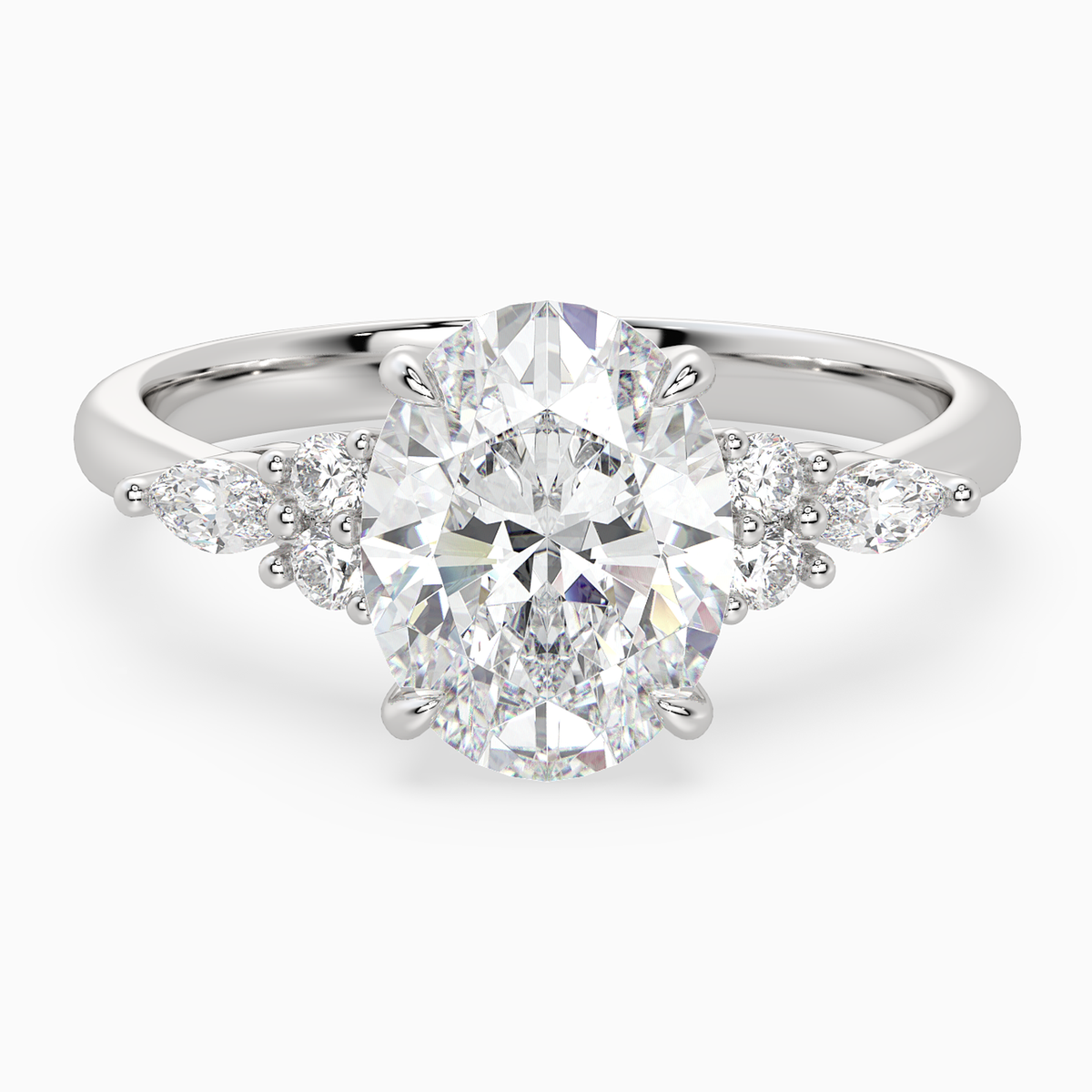


Emerald Diamond Engagement Rings
Quietly architectural. Broad flashes of light move through elongated step-cut geometry, framed by settings calibrated to each center.


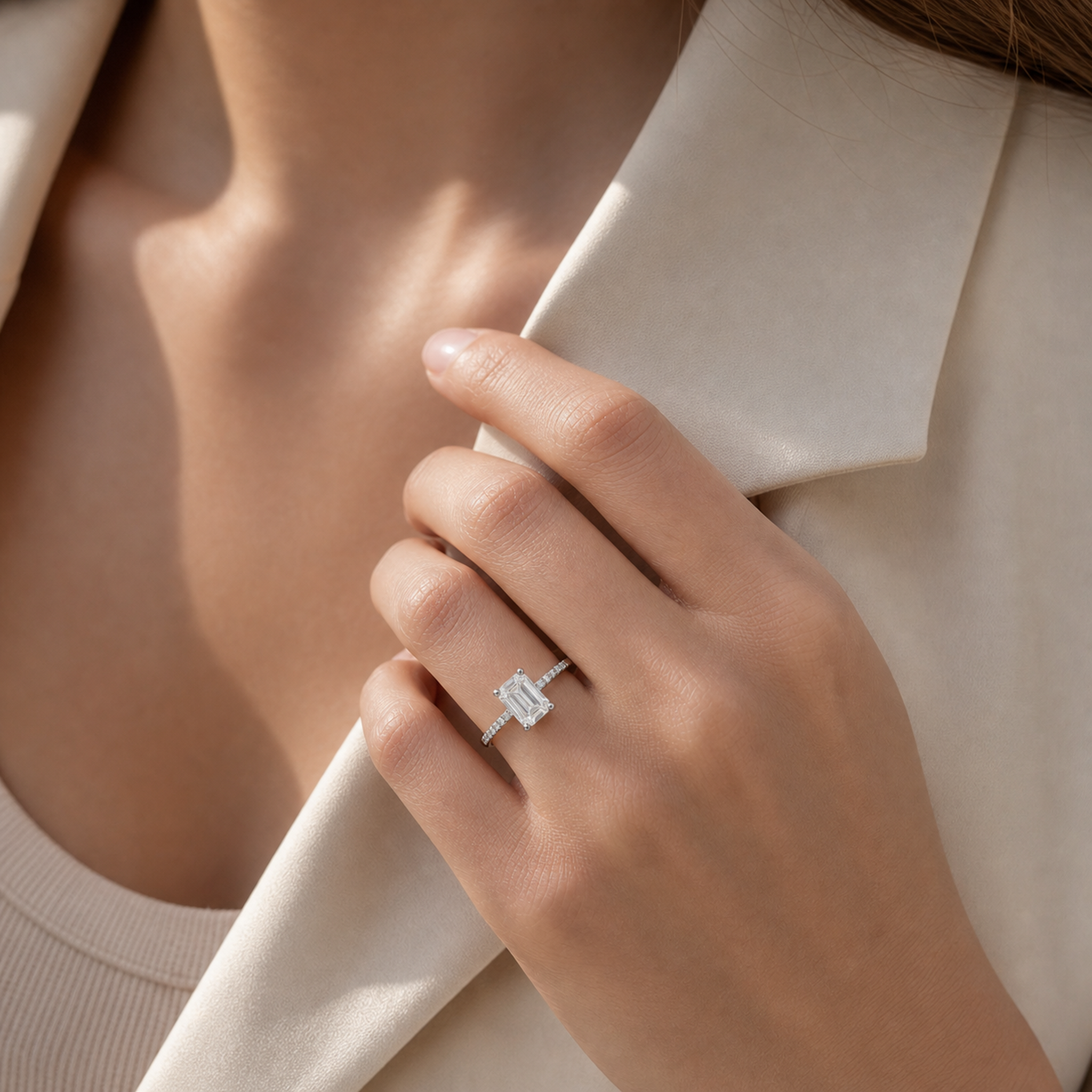


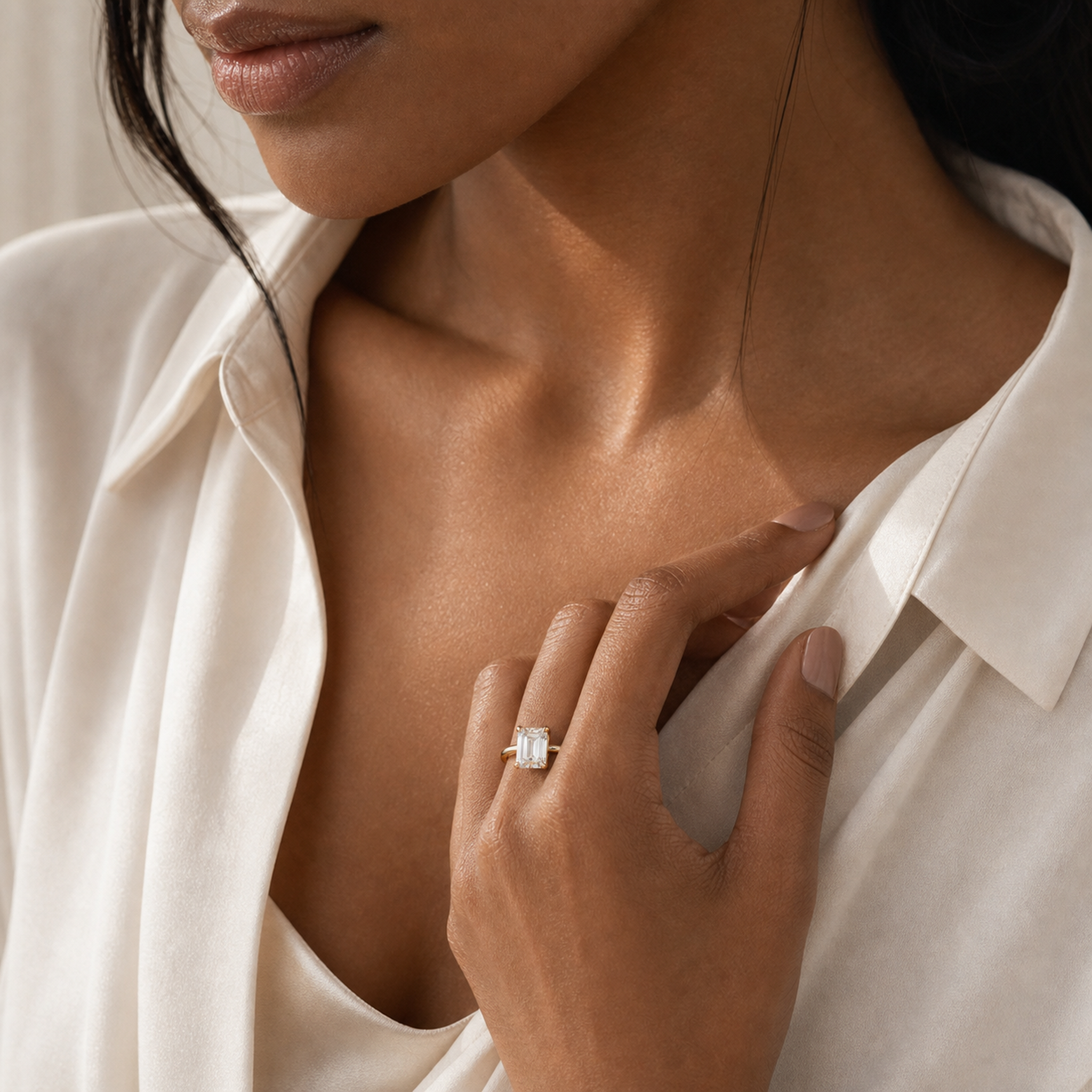


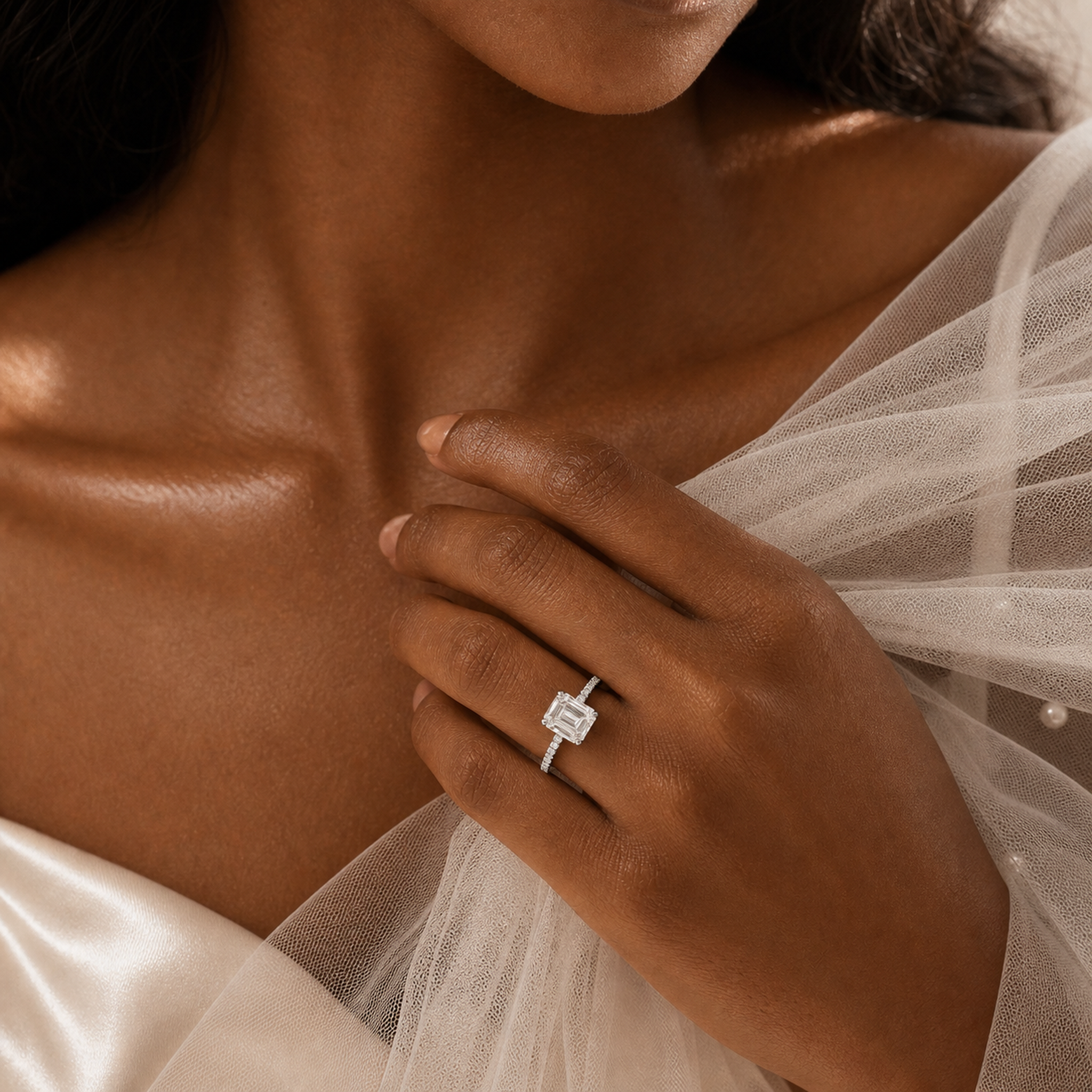


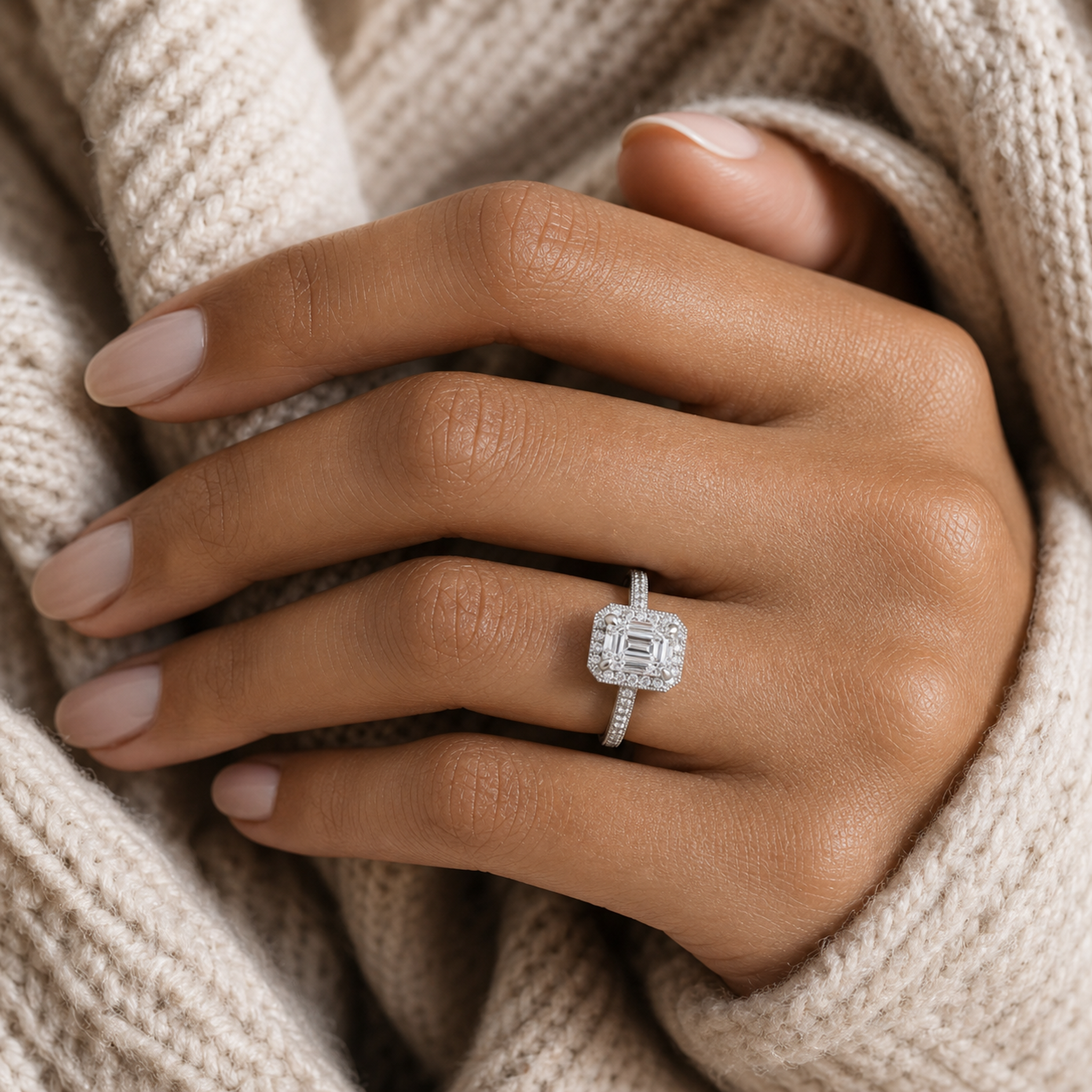


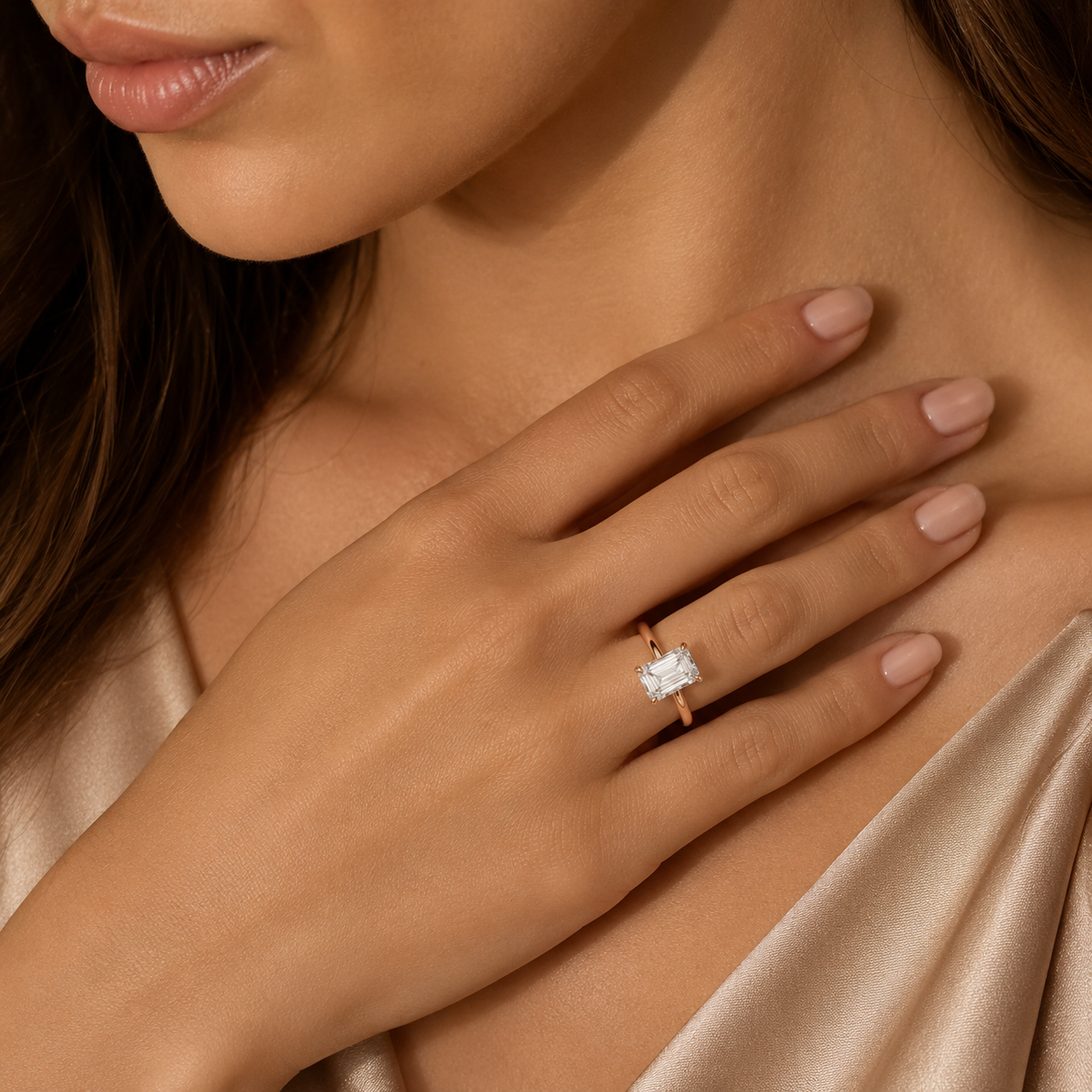


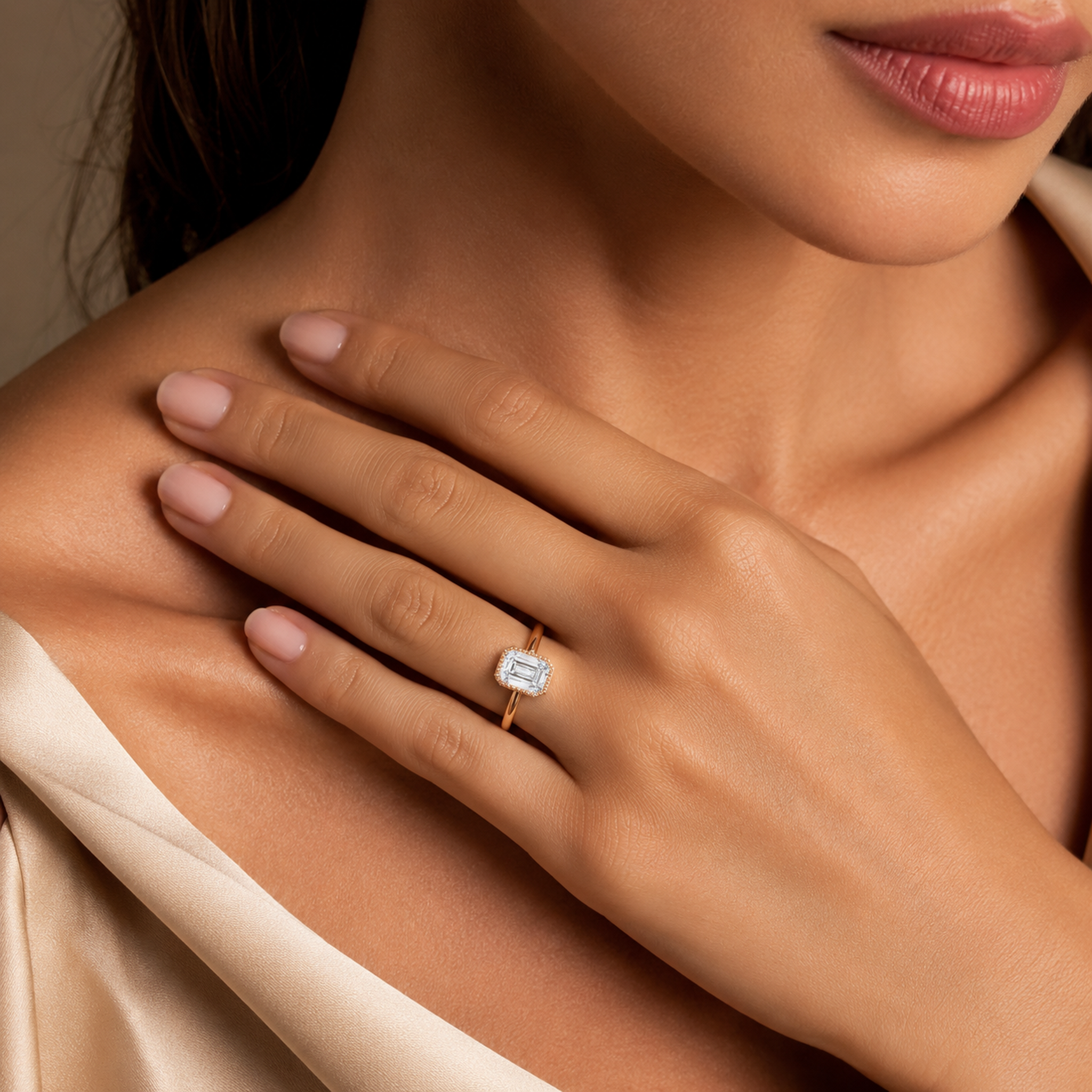


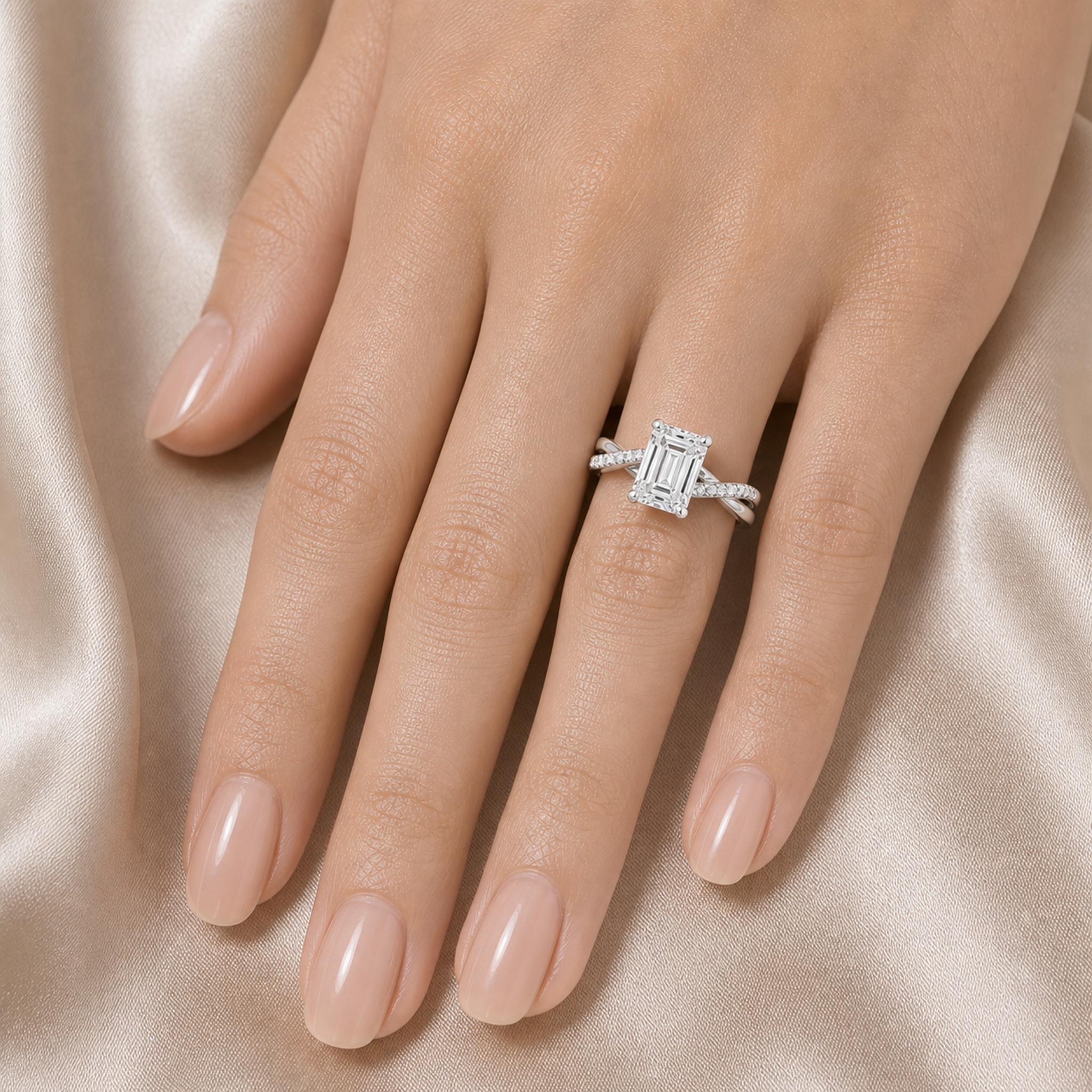


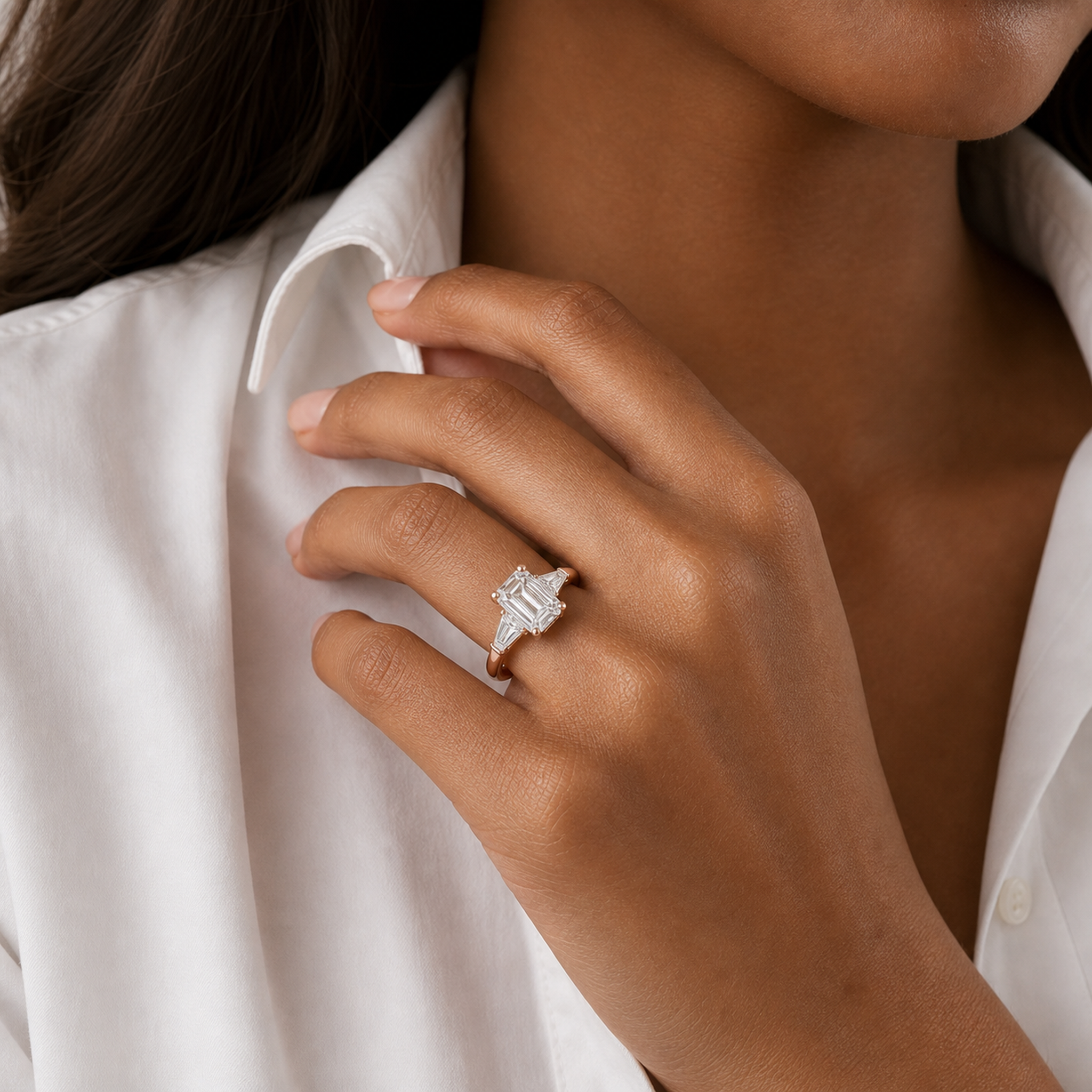


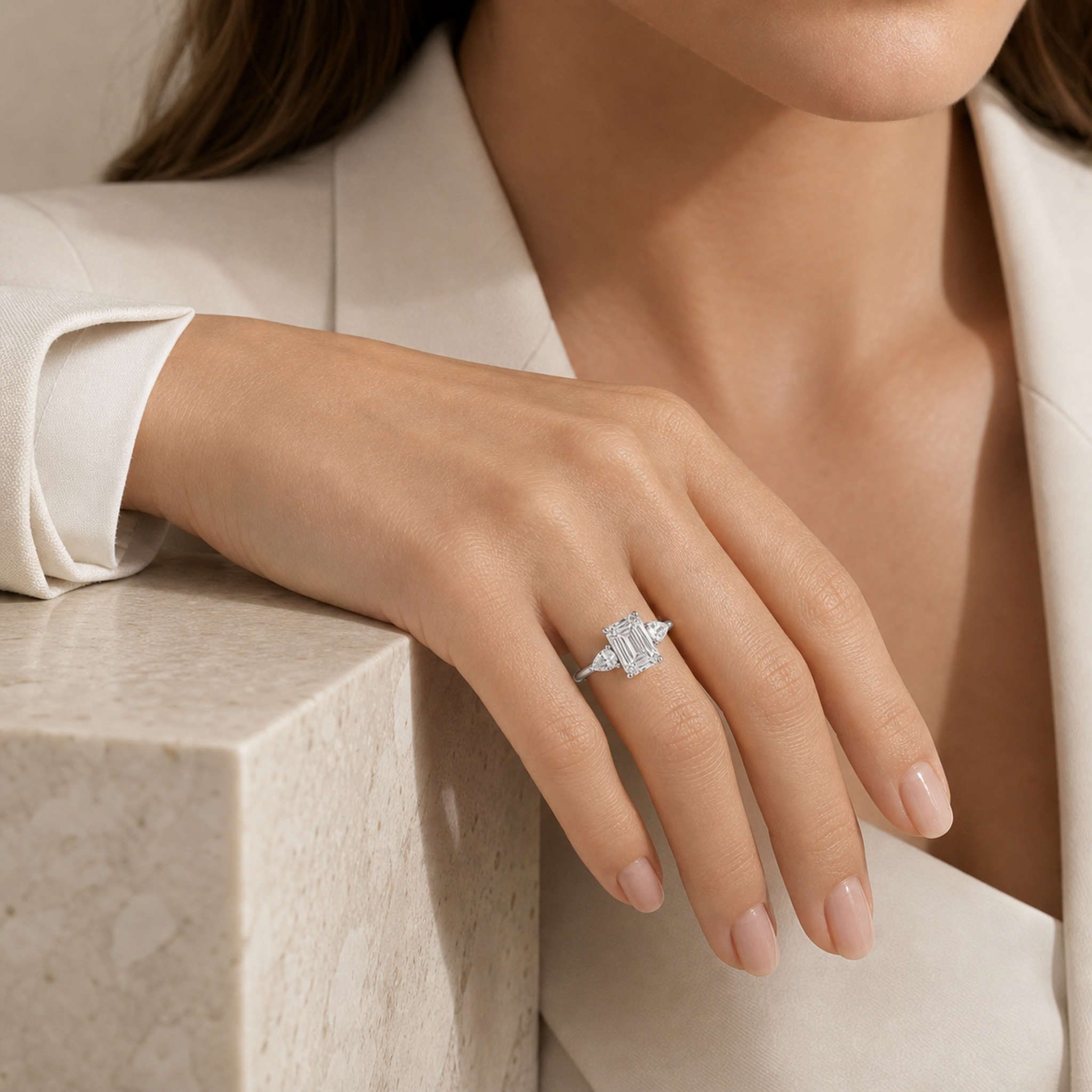


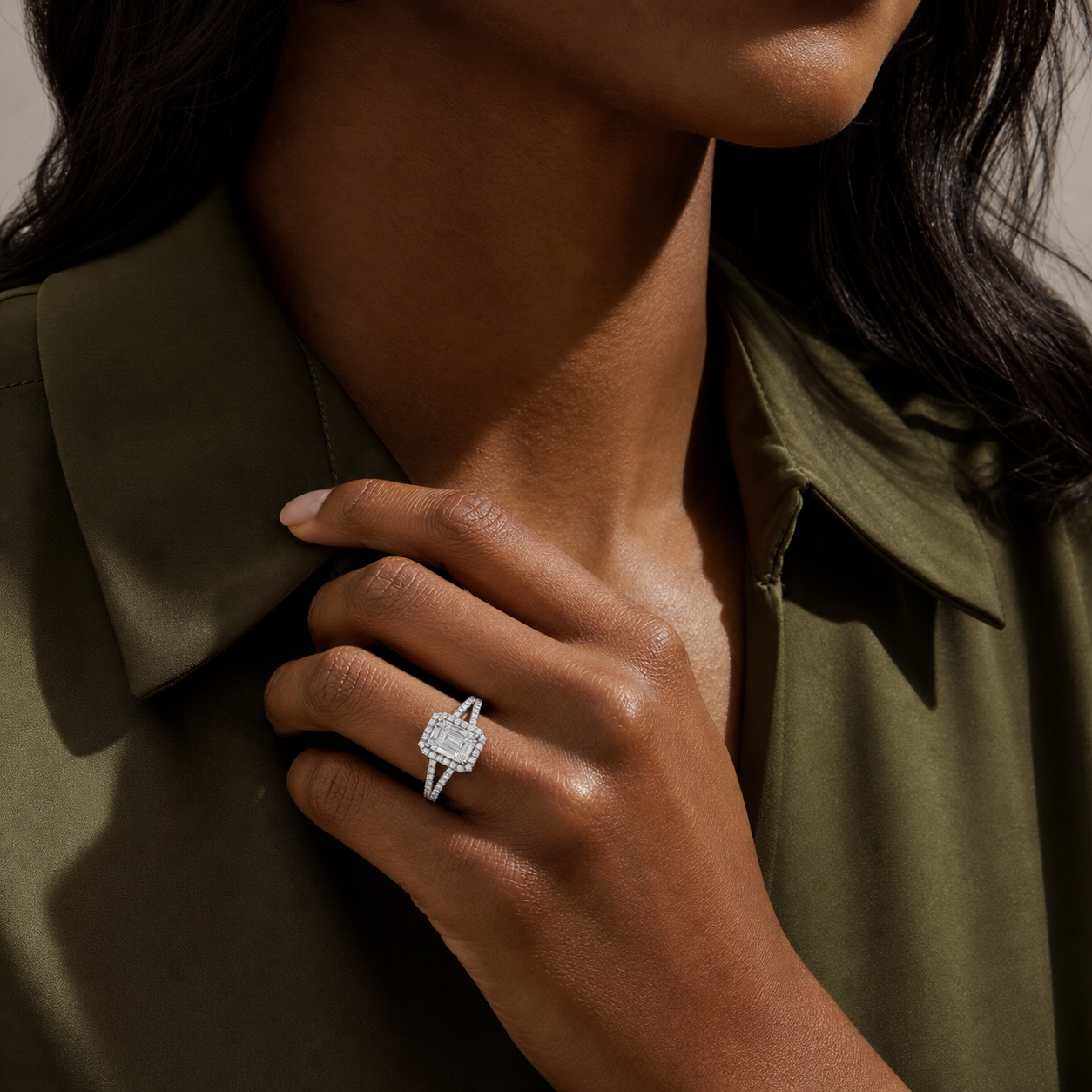


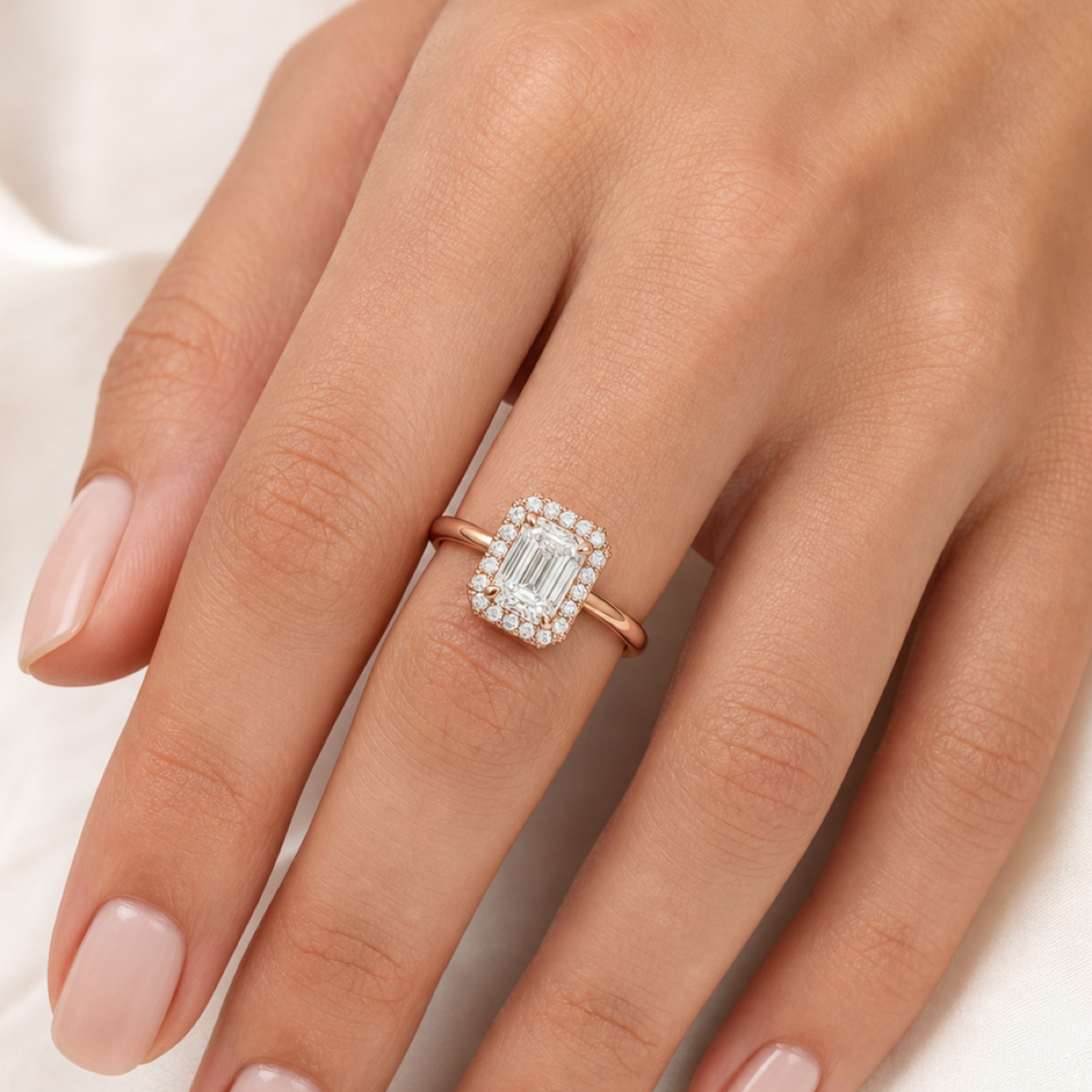


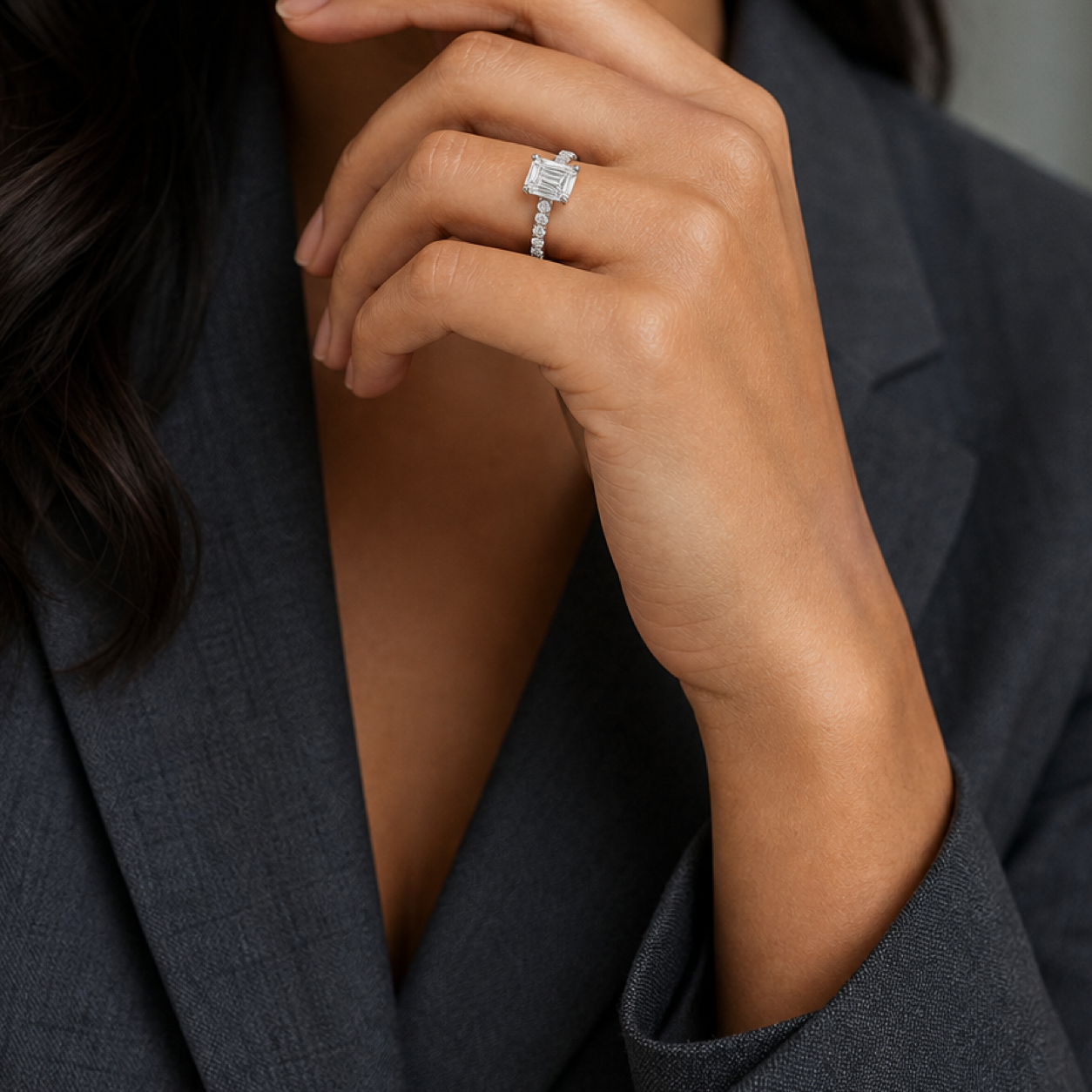


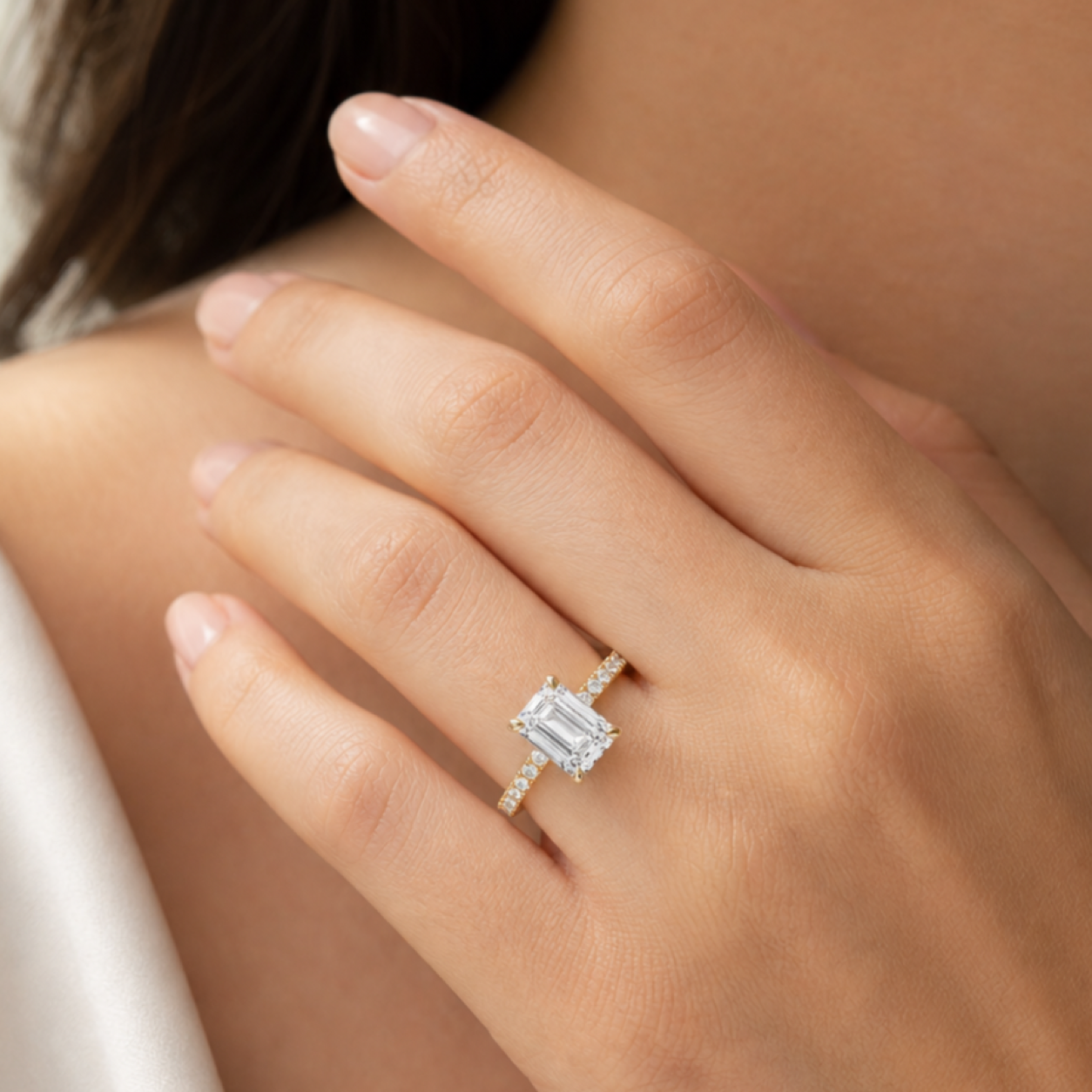


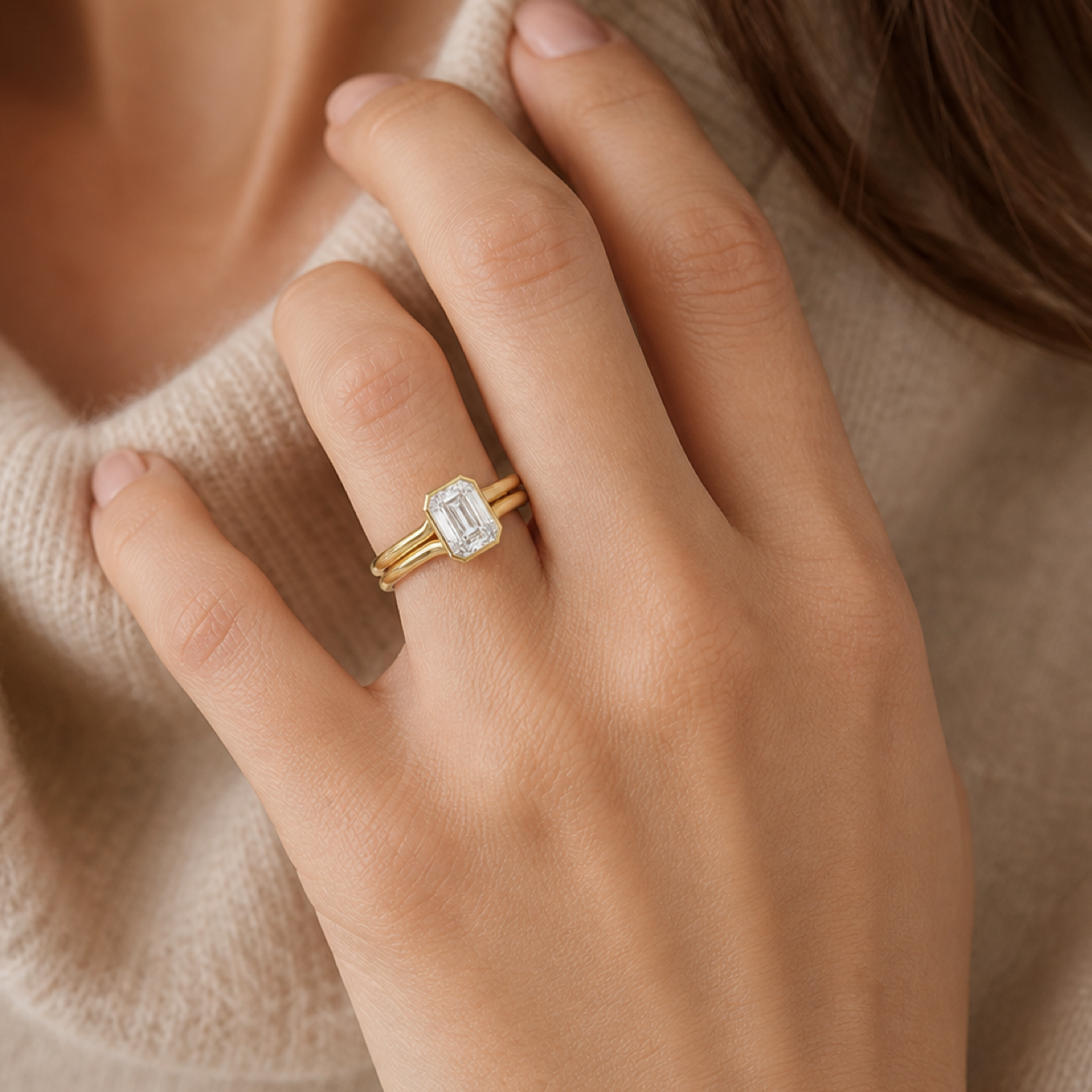


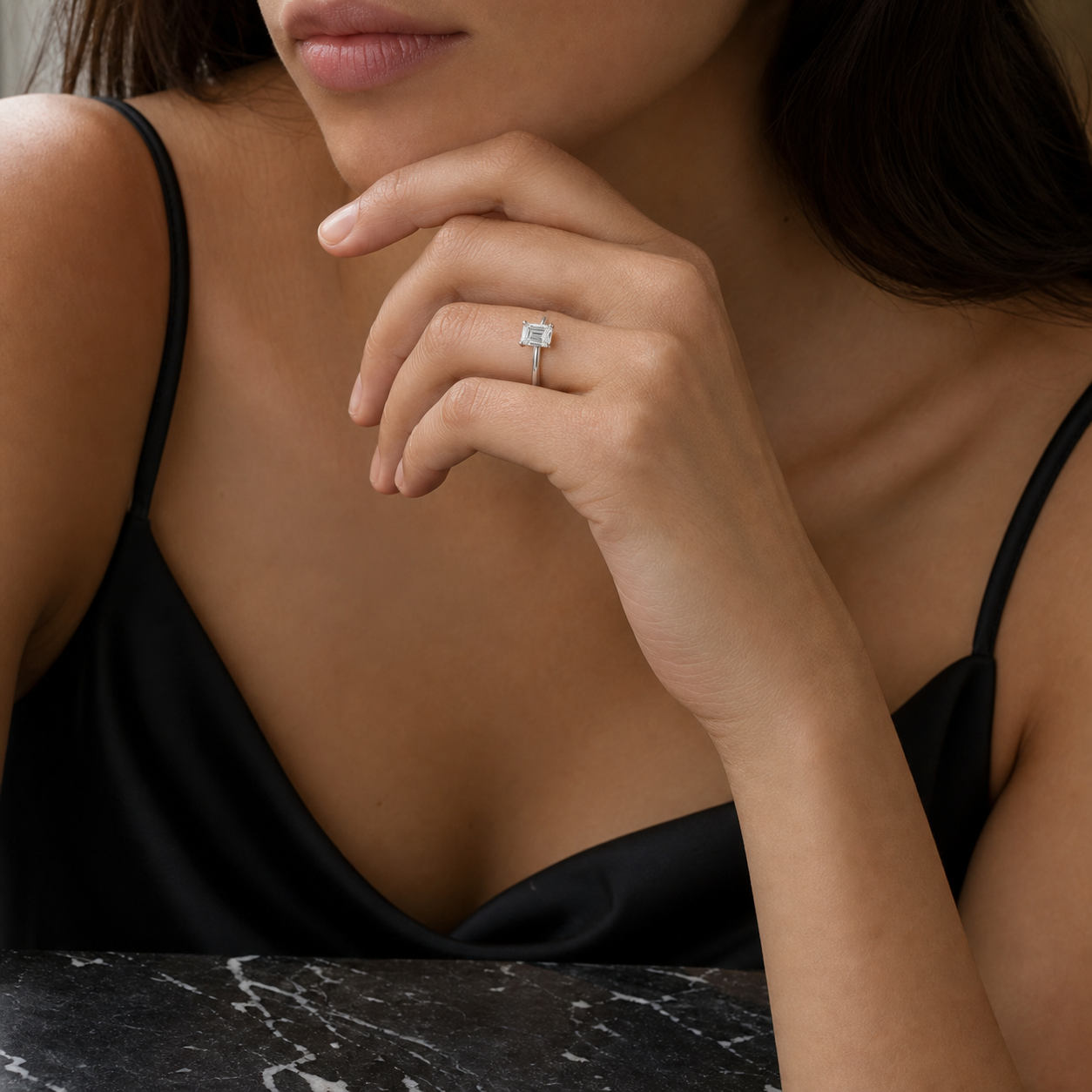


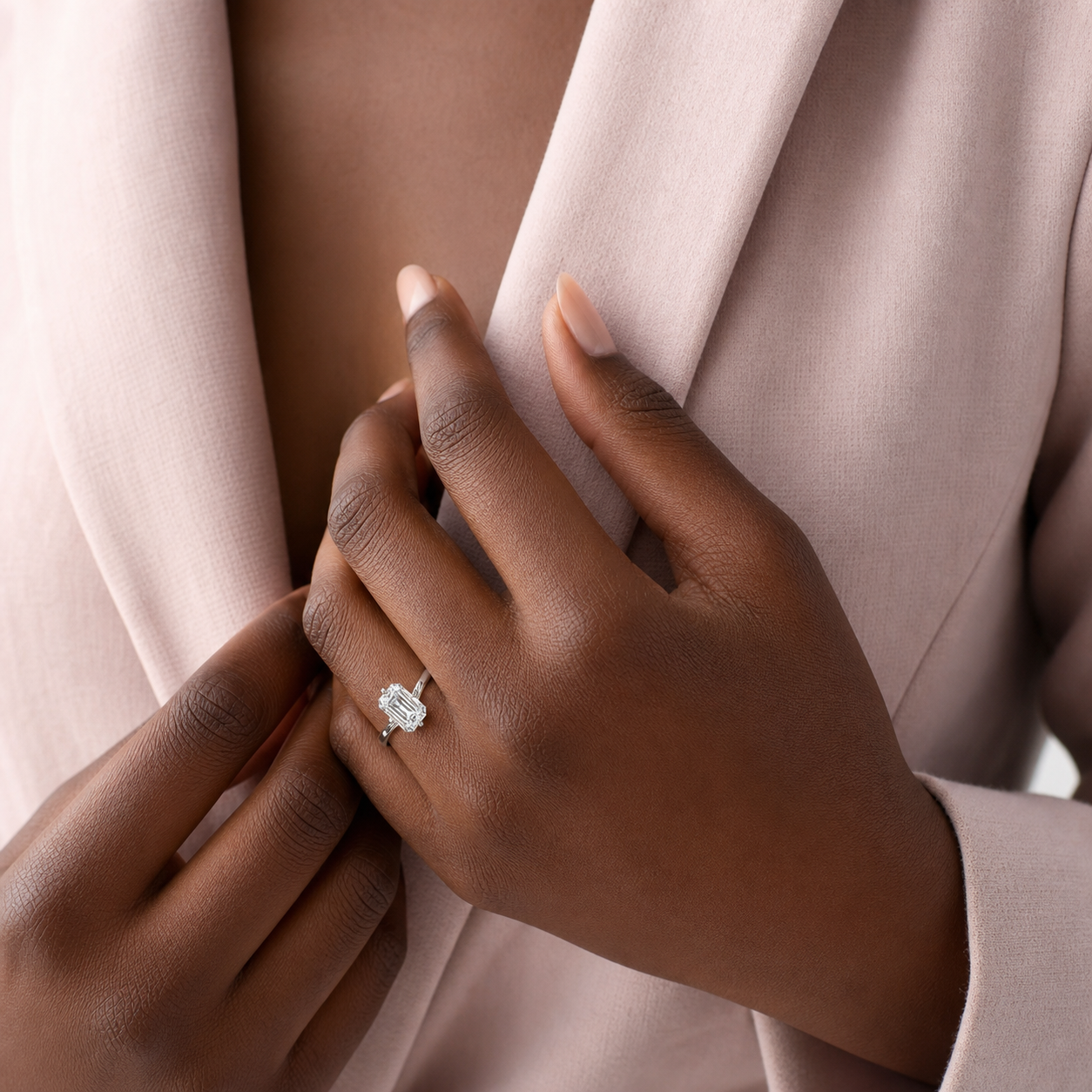


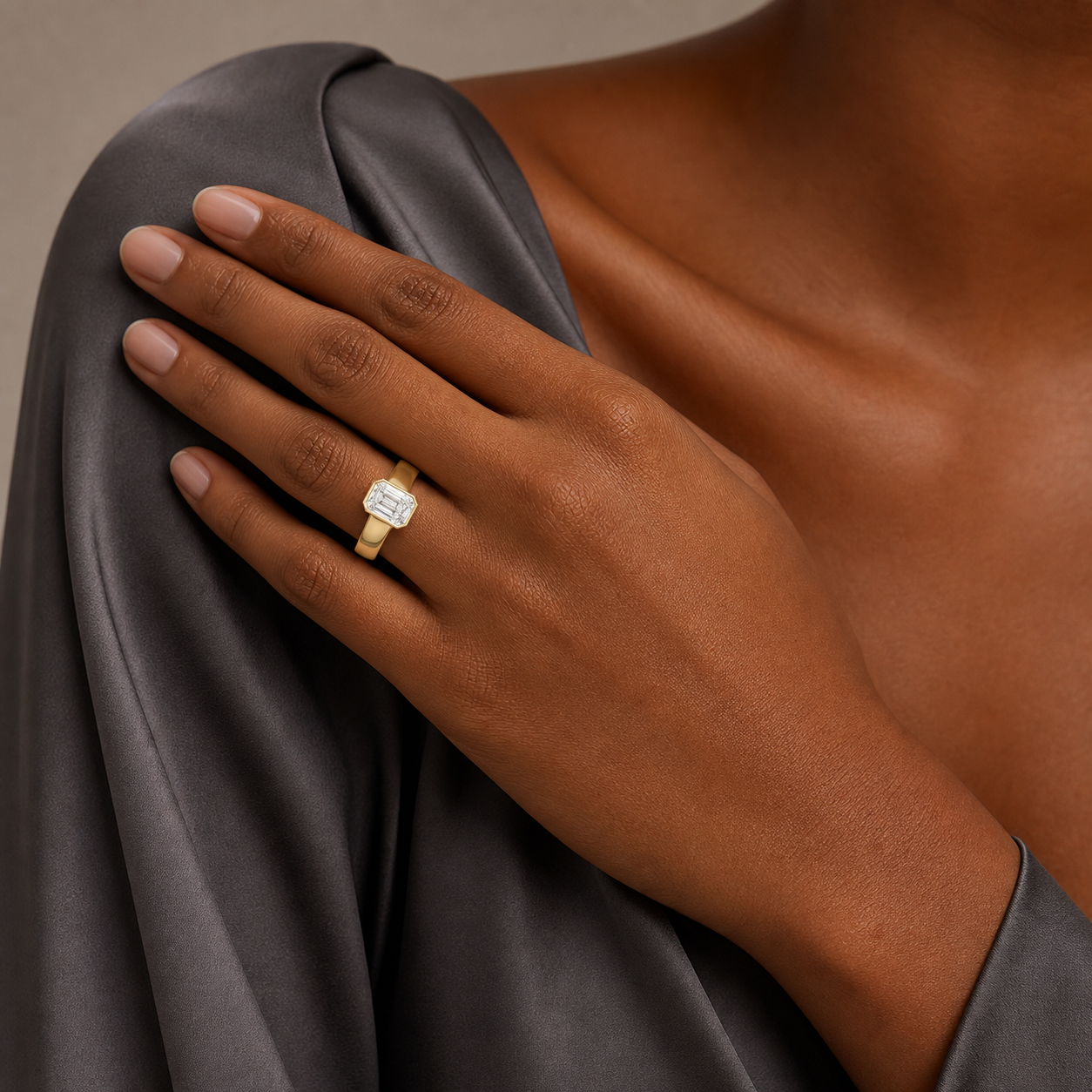





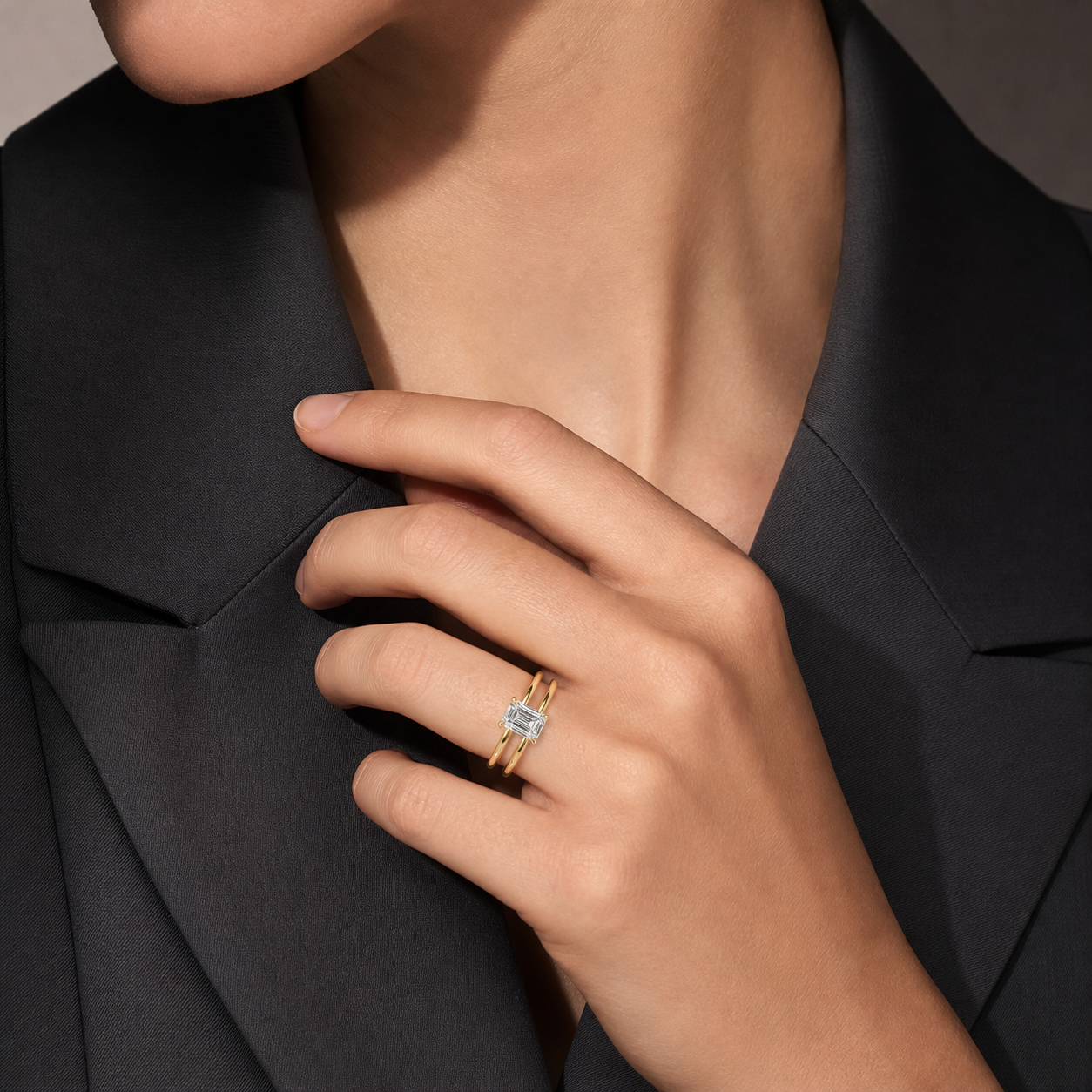


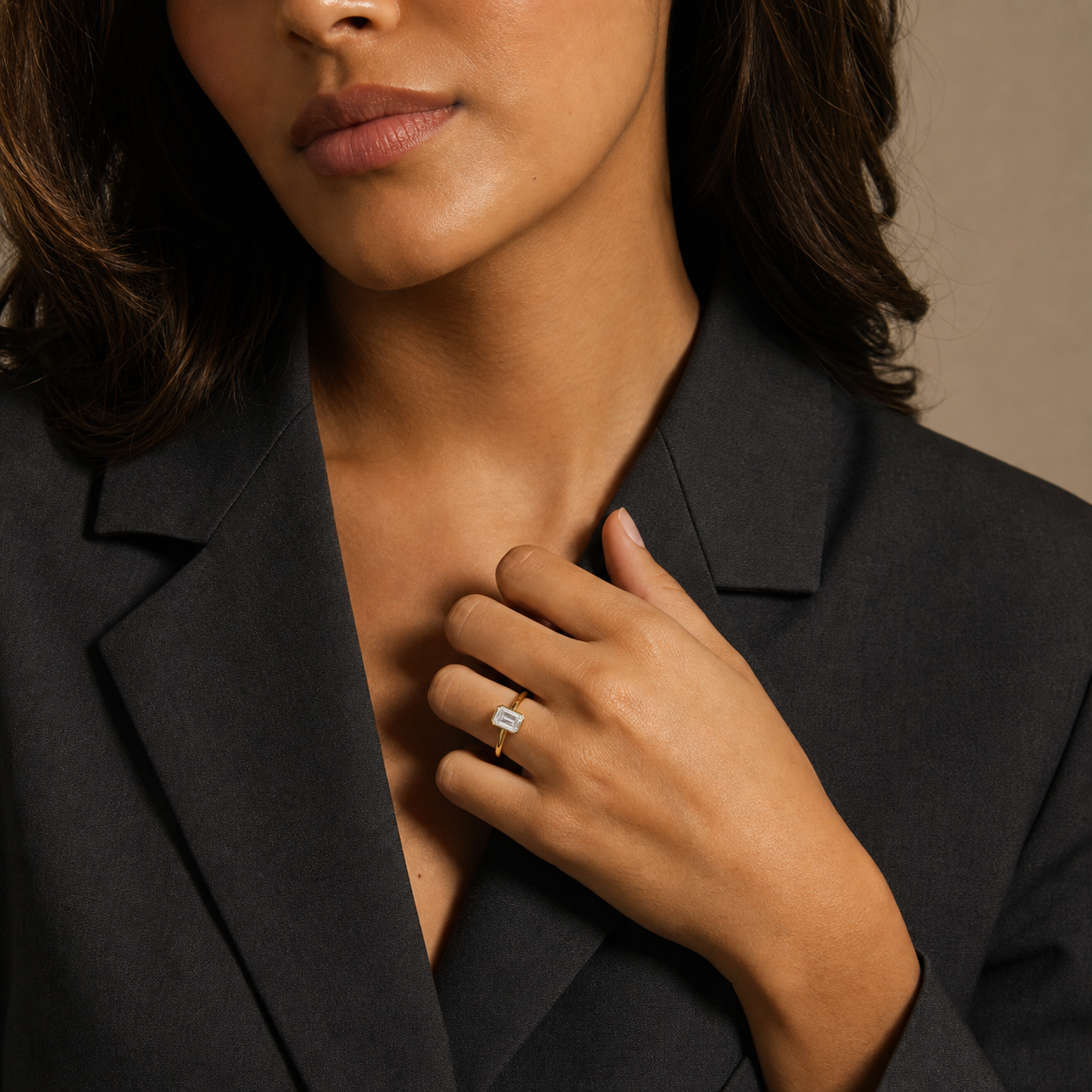


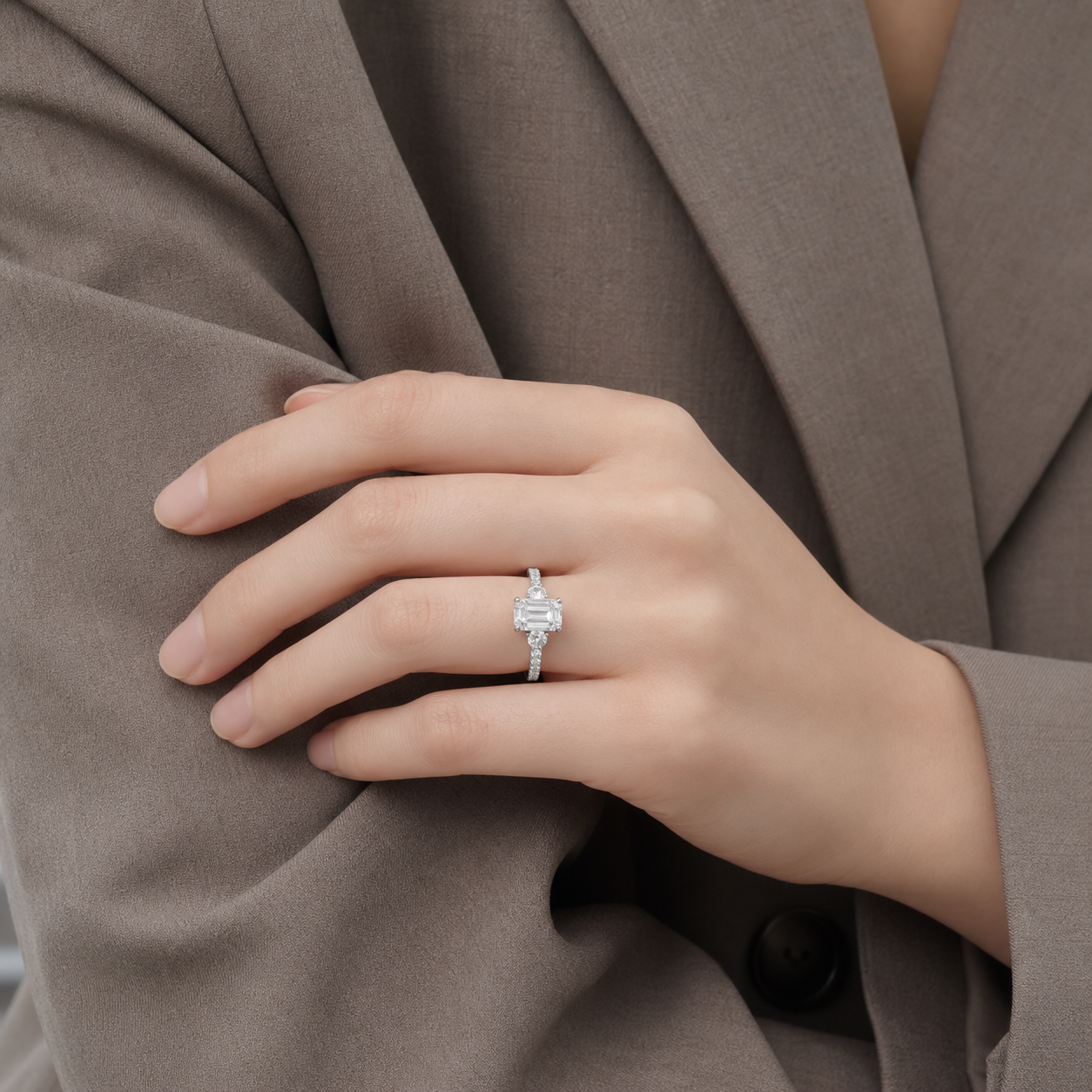


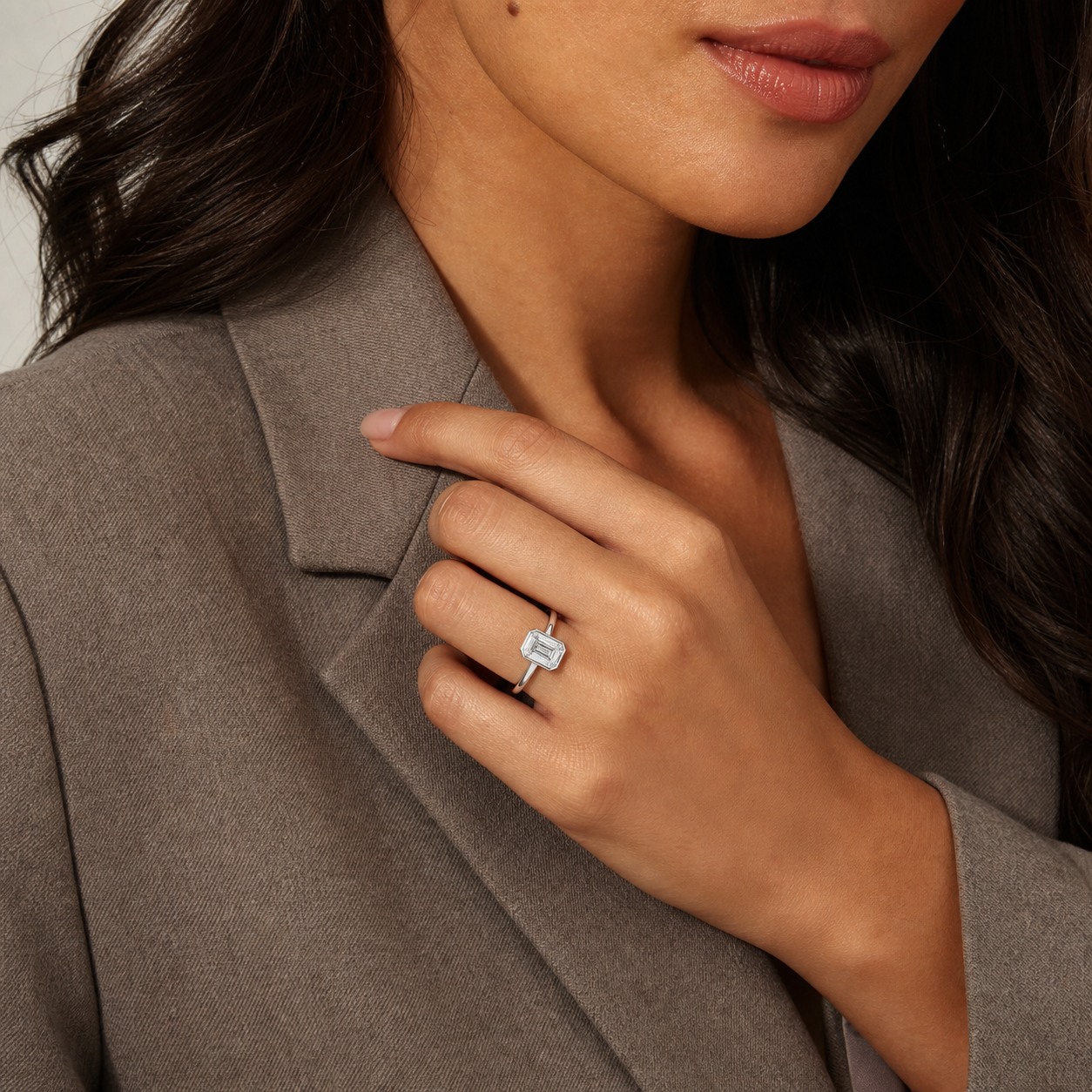


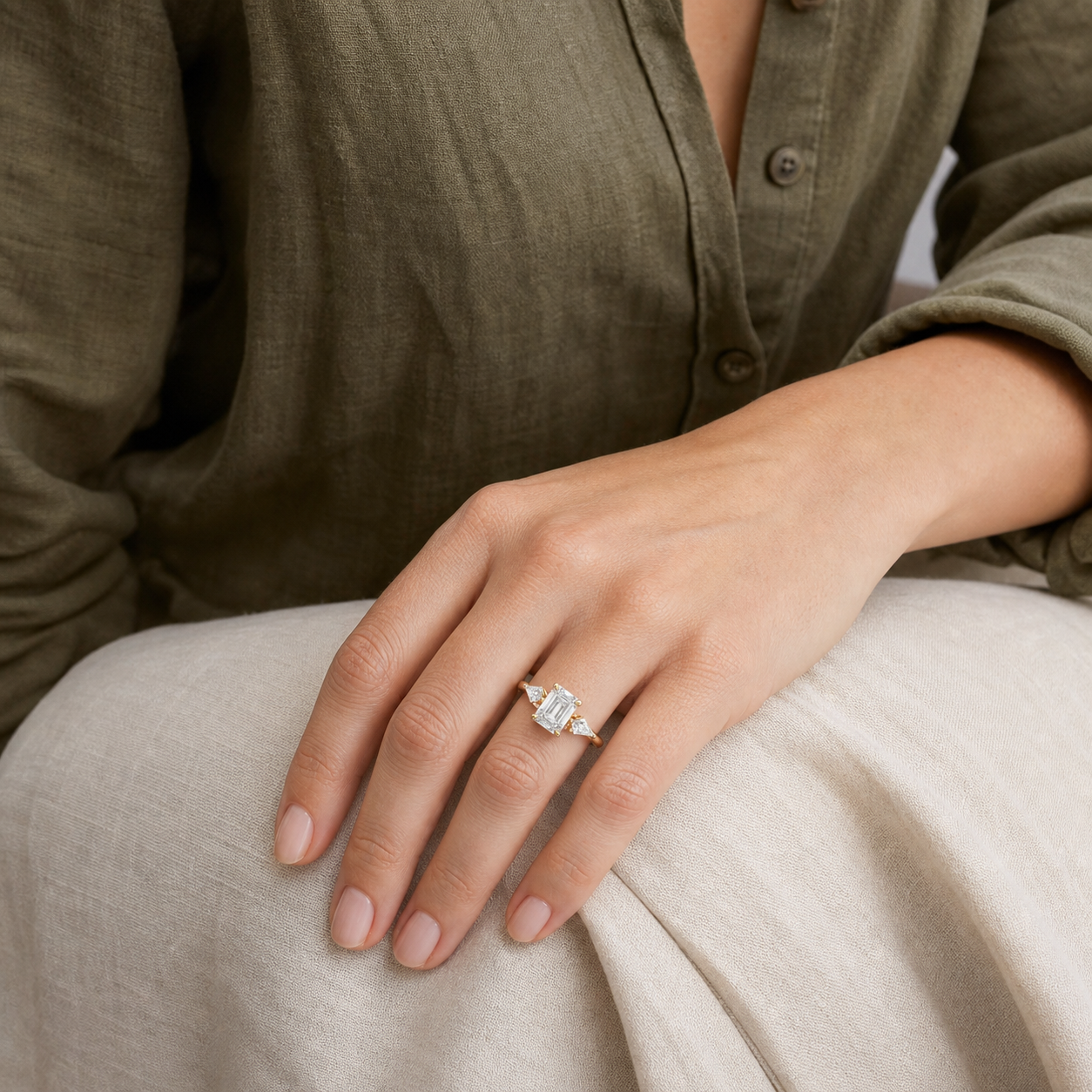


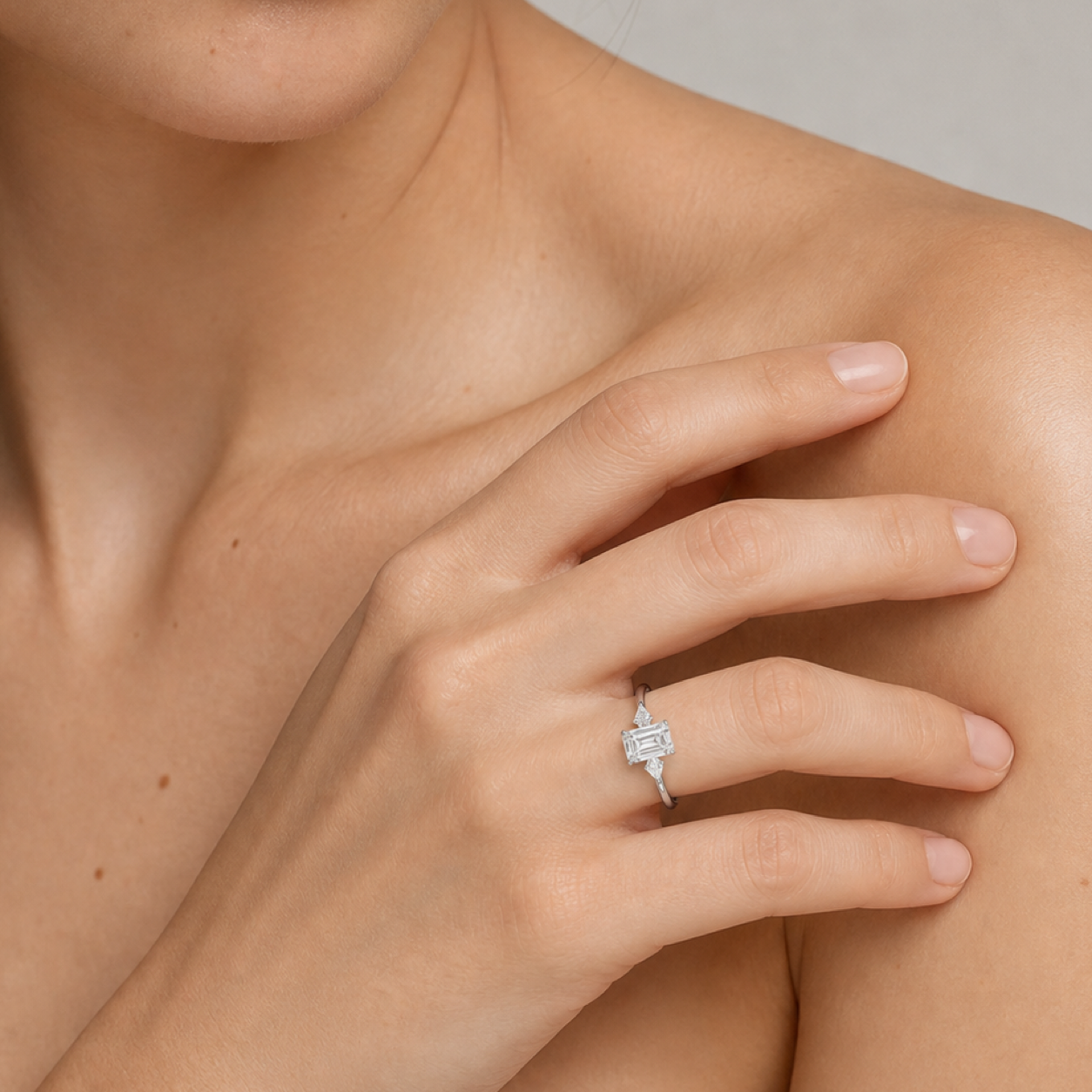
Emerald Cut Diamond Engagement Rings: Light in Measured Planes
An emerald-cut diamond organizes light rather than scattering it into a dense field of small flashes. Long step facets descend around an open table, creating alternating planes of brightness and shadow as the stone moves. Its elongated rectangle and clipped corners give that optical pattern a clear frame: precise, spacious, and quietly architectural.
Burvonti’s emerald-cut engagement rings carry this geometry through Solitaire, Bezel, Halo, Hidden Halo, and Three Stone settings. Some designs leave the center almost unbroken against a polished band; others extend its structure through step-cut sides, Pear accents, Kite forms, or a surrounding frame. The setting should clarify the center’s character, not replace the need to understand it.
Step-Cut Light Has Its Own Measure
Brilliant cuts divide light through many smaller facets. An emerald cut uses fewer, broader step facets, so its visual language is slower and more graphic: long flashes, dark intervals, and shifting rectangular reflections. The familiar term hall of mirrors describes this effect, but the phrase is only useful when it leads back to the individual stone’s balance and movement.
Do not evaluate an emerald cut by asking it to imitate a Round, Oval, or Radiant center. Look for a pattern that feels coherent from the middle to the edges, with responsive flashes as the diamond moves and no large area that remains lifeless across ordinary viewing positions. Broad contrast is part of the design; dullness or distracting asymmetry is not the same thing.
Proportion Extends Beyond Length-to-Width Ratio
Length-to-width ratio tells you whether an emerald-cut outline reads broader, more compact, or more elongated. It does not define an ideal stone on its own. Corner size, shoulder transition, table, depth, step spacing, and outline symmetry all contribute to the final geometry, and two diamonds with similar ratios can produce different face-up patterns.
Begin with the silhouette you prefer, then consider how its actual millimeter dimensions enter the ring. A narrow center can emphasize vertical direction; a broader center can create more visual weight across the band. Bezel thickness, prong placement, halo spacing, and side-stone proportions can make the same ratio feel quieter, wider, or more emphatically geometric.
Open Facets Make Clarity and Color More Visible
The larger, less visually busy facets of a step cut can reveal clarity characteristics more readily than many brilliant cuts. That does not create one mandatory clarity grade. Visibility depends on the characteristic’s size, position, relief, and nature, as well as the diamond’s dimensions, faceting, and viewing conditions. A grading report provides the map; the face-up view determines what you notice.
Step cuts can also show body color more openly. White metal may create stronger contrast with warmth in the diamond, while Yellow or Rose Gold can establish a warmer overall composition. Neither effect is inherently better, and no fixed color range suits every center or setting. Compare the graded diamond in the intended metal rather than applying a universal D–F, G–H, or eye-clean formula.
Read the Report, Then Read the Diamond
Emerald cuts are fancy shapes and do not receive an overall GIA cut grade. An independent grading report can document carat weight, dimensions, color, clarity, polish, symmetry, and identifying characteristics, but it does not compress the complete visual result into one cut label. Proportion charts can narrow a search; they cannot decide how the planes of light will feel in motion.
Compare carat weight with length, width, and depth, because equal weights do not guarantee equal face-up dimensions. Review corner alignment, outline symmetry, polish, and the rhythm of bright and dark steps. Clear video or direct observation under more than one lighting condition helps reveal whether the pattern remains composed rather than convincing only in a single still image.
Settings Can Echo or Counter the Geometry
A Solitaire gives the clipped rectangle maximum visual authority. A bezel repeats its perimeter in metal, turning the outline into a stronger frame. A Halo adds a second field of light around the steps, while a Hidden Halo keeps more of that detail in profile. Each approach changes edge visibility, maintenance points, and the relationship between center and band.
Three Stone settings can create a continuous architectural span. Step-cut side diamonds extend the center through parallel planes; Pear sides soften the transition; Kite or more angular forms create a deliberate change in direction. The current Burvonti collection includes all of these ideas, so the useful question is not which setting is universally best, but which composition preserves the quality you value in the emerald cut.
Orientation and Profile Reshape the Composition
A north–south emerald cut emphasizes length and procession through its steps. Turned East–West, the center becomes a horizontal bar of light, bringing bezel line, overall width, and band integration forward. Orientation affects prong or corner support, finger coverage, adjacent stones, and wedding-band contact; it must be engineered for the selected center rather than treated as a decorative switch.
The profile shows whether the head is open or enclosed, how high the center sits, and where another ring may meet it. A straight wedding band may align, touch the basket, or leave an intentional gap. A contour, open band, chevron, or coordinated setting can respond when desired. Flush fit is a product-specific geometric outcome, not a defining feature of emerald-cut rings.
Clarity in the Design, Precision in the Decision
Burvonti brings responsibly sourced, independently graded lab-grown diamonds into settings resolved through proportion and human judgment. The report establishes documented characteristics; careful comparison establishes which outline, pattern, and setting feel right. This distinction matters especially for a step cut, where visual restraint leaves little room for generic superlatives to substitute for what the center actually shows.
Custom possibilities may refine center proportion, orientation, metal, setting, side-stone relationship, band line, or engraving when structurally feasible. Clean gently with methods appropriate to the diamond, metal, and construction, and arrange inspection if a corner support catches, a stone moves, or the ring receives significant impact. Availability, resize range, setting security, documentation, and wedding-band compatibility remain specific to the chosen ring.
Frequently Asked Questions
What is an emerald-cut diamond engagement ring?
It is an engagement ring centered on a diamond with a rectangular or near-square outline, clipped corners, and rows of broad step facets. These facets create measured flashes and alternating light-dark planes rather than the denser sparkle of a brilliant cut.
Is an emerald-cut diamond the same as a green emerald gemstone?
No. Emerald cut describes an outline and step-facet arrangement that can be used for diamonds and other gems. On this Collection page, Emerald refers to the cut of a lab-grown diamond, not to a green emerald gemstone.
What is a step cut?
A step cut uses long, usually four-sided facets arranged in descending rows around the table. In an emerald-cut diamond, those broad planes create larger flashes, clearer geometry, and more visible contrast than a typical brilliant-style facet pattern.
What does hall of mirrors mean in an emerald-cut diamond?
It describes the alternating bright and dark reflections produced by parallel step facets as the diamond moves. It is a visual metaphor, not a grading category, and the balance and responsiveness of the pattern should be assessed in the individual stone.
Do emerald-cut diamonds sparkle less than brilliant cuts?
They express light differently. Brilliant cuts generally create more numerous, smaller flashes; emerald cuts produce broader, slower flashes and stronger geometric contrast. Choose between these visual languages rather than treating one as a failed version of the other.
Why is clarity important in an emerald-cut diamond?
Broad, open step facets can make some clarity characteristics easier to notice. Visibility still depends on size, position, relief, nature, faceting, and viewing conditions, so the grading report and face-up appearance should be considered together.
Does an emerald-cut diamond need to be VS1 or higher?
No single clarity threshold guarantees the preferred appearance. A lower or higher grade can look different depending on the specific clarity characteristics and the stone’s size and faceting. Review the report and the actual diamond rather than relying on a universal cutoff.
Does an emerald-cut diamond need a D–F color grade?
No. Step cuts can show body color more openly, but the preferred grade depends on the individual diamond, metal, size, lighting, and the warmth you want. Compare graded centers in the intended setting instead of using one mandatory range.
What does length-to-width ratio mean for an emerald-cut diamond?
It is the diamond’s length divided by its width. A lower ratio generally creates a broader or more compact rectangle; a higher ratio creates a more elongated one. Corner size, table, step pattern, dimensions, and setting still change the result.
Is there one ideal emerald-cut diamond ratio?
No. Ratio expresses outline preference, not an overall beauty grade. Select a broader or more elongated silhouette, then assess its corners, symmetry, light pattern, actual dimensions, and relationship to the setting.
Does GIA give emerald-cut diamonds an overall cut grade?
No. GIA currently assigns an overall cut grade only to standard Round Brilliant diamonds. An emerald-cut report can still document polish, symmetry, dimensions, color, clarity, carat weight, and other identifying information.
What should I examine if an emerald cut has no overall cut grade?
Review its independent grading report, outline and corner symmetry, polish, millimeter dimensions, depth, bright-dark step pattern, and appearance in motion. Ratio charts alone cannot show whether the planes of light are balanced and responsive.
Does carat weight tell me how large an emerald-cut diamond will look?
Not by itself. Carat measures weight. Face-up presence depends on length, width, depth, outline, and the surrounding setting, so compare millimeter dimensions and the complete ring alongside carat weight.
Which emerald-cut engagement ring styles are available at Burvonti?
The current public collection includes Solitaire, Bezel, Halo, Hidden Halo, Three Stone, step-cut side-stone, Pear-side, Kite, pavé-basket, bypass, double-shank, and East–West designs in 14K White, Yellow, and Rose Gold. Confirm current product availability.
Which setting works best with an emerald-cut diamond?
There is no universal best. A Solitaire isolates the geometry; a bezel reinforces the outline; a Halo adds a second field of light; a Three Stone setting extends the composition. Compare edge support, profile, maintenance, and wedding-band fit for the exact ring.
Which side stones work with an emerald-cut center?
Step-cut sides can continue its parallel geometry; Pear shapes soften the transition; Kite or other angular forms introduce contrast. Scale, spacing, facet relationship, support, and the desired dominance of the center matter more than one prescribed pairing.
Can an emerald-cut diamond be set East–West?
Yes, when the design and center dimensions allow it. East–West orientation changes overall width, corner support, bezel or prong placement, and the relationship to the band, so it should be resolved as a complete setting.
Which metal works best for an emerald-cut engagement ring?
There is no universal best metal. White Gold can create a cooler frame and stronger contrast with body color; Yellow or Rose Gold creates a warmer composition. Consider appearance together with alloy, finish, care, sensitivity considerations, and exact product specification.
Do clipped corners make an emerald-cut diamond protected from damage?
Clipped corners remove the sharp points of a pure rectangle, but they do not make the diamond or setting immune to impact. Security depends on corner support, prong or bezel geometry, workmanship, condition, and wear.
Will an emerald-cut engagement ring sit flush with a wedding band?
Not always. Basket width, setting height, bezel, halo, side stones, and shoulder geometry establish the contact line. A straight band may work, or the ring may suit a contour, open band, chevron, or intentional gap.
How should I clean an emerald-cut engagement ring?
Use gentle methods appropriate to its diamond, metal, and construction. Avoid abrasive cleaners and harsh chemicals, clean around the underside and setting details, and arrange inspection if a corner support catches or any stone appears to move.
Can a Burvonti emerald-cut engagement ring be resized or customized?
Resize and custom possibilities depend on the setting. Center proportion, orientation, metal, side stones, band line, or engraving may be adjustable when structurally feasible, but sizing range, documentation, security, and wedding-band fit must be confirmed for the chosen configuration.