
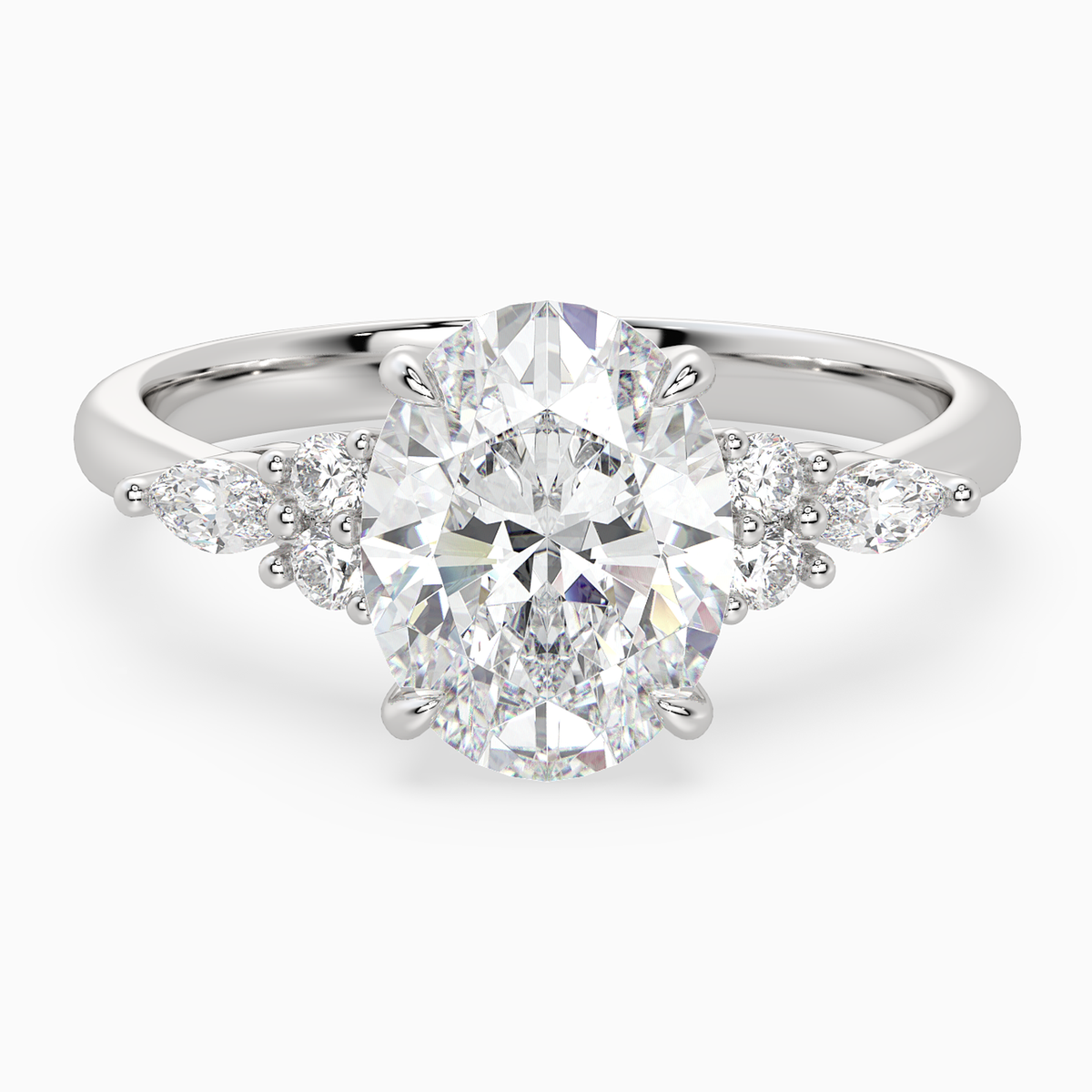


Cut
How the diamond's facets, proportions, polish, and symmetry return light to the eye.
Begin with a familiar route, explore a collection, or continue through a practical guide.

Burvonti Diamond Education
A modern guide to cut, color, clarity, and carat weight for choosing lab grown diamonds with proportion, evidence, and restraint.

The 4Cs give diamond quality a shared language: cut, color, clarity, and carat weight. They do not remove taste from the decision. They make the decision inspectable.
Burvonti reads the 4Cs as a standard, not a scoreboard. The right diamond is not simply the highest grade in every column. It is the stone whose performance, appearance, scale, and documentation resolve into the design you intend to wear.
The Standard
How the diamond's facets, proportions, polish, and symmetry return light to the eye.
How colorless a white diamond appears when graded against a recognized scale.
The presence, size, position, and visibility of internal inclusions and surface blemishes.
The diamond's weight, which influences rarity and price but does not equal visible size.
Shop Diamond by Shape
Shape determines the silhouette and face-up presence. The 4Cs help evaluate the individual stone within that shape. Collection links are placeholders for now.

How To Read The 4Cs
Cut often changes the visible life of a diamond more than a small color or clarity upgrade. Color tolerance changes by shape, metal, and size. Clarity matters most when an inclusion is visible or interferes with transparency. Carat changes presence, but measurements decide how much of that weight is actually seen.
A grading report gives the language. The final choice still requires comparison: proportions, video, face-up measurements, setting plan, and how the stone behaves under ordinary light.
Cut
Cut describes how a diamond's proportions and facet arrangement interact with light, including brightness, fire, scintillation, polish, and symmetry.
For round brilliant diamonds, cut grade is a strong first filter. For fancy shapes, inspect measurements, depth, table, symmetry, and video because the grading language is less standardized.
Read the cut/shape distinction in more detail: Diamond Cut vs. Shape.
Color
White diamonds are graded by how little body color they show. The D-to-Z scale begins at D for colorless and moves toward more visible warmth.
In practice, color should be judged with the design in mind. Larger stones, step cuts, and white metal settings can make warmth easier to notice. Yellow gold can make a near-colorless diamond read softer and more integrated.
Do not pay for invisible color precision just to win a grade column. Pay for the color standard the eye will actually register in the selected shape, size, and setting metal.
Continue with the color-stability question: Do Lab-Grown Diamonds Turn Yellow.
Clarity
An inclusion near the center can matter more than a similar inclusion near the edge, especially in open-facet stones.
Many clarity characteristics require magnification. Eye-clean performance is often more important than a symbolic grade jump.
The concern is not only whether an inclusion exists, but whether it affects transparency, brilliance, or durability.
Compare practical clarity ranges next: VVS vs VS Diamonds.

Carat
A metric carat equals 200 milligrams. It is a weight measurement, not a direct measurement of visible size. Two diamonds of the same carat weight can look different because shape, depth, table, and measurements change face-up spread.
This is why the carat decision should be read with the millimeter measurements. A stone just below a popular weight mark can sometimes preserve the intended look while making the budget more disciplined.
Continue with the size and carat framework: Diamond Carat Size Guide.
Balance
| Buying priority | Start here | Then inspect | Burvonti note |
|---|---|---|---|
| Maximum brilliance | Cut quality and light performance | Color/clarity that do not distract from the stone | A lively smaller diamond can read more resolved than a heavier dull one. |
| Architectural clarity | Shape, clarity, and facet pattern | Color sensitivity in step cuts | Emerald and Asscher cuts reward clean material and careful proportion. |
| Visible scale | Carat, measurements, and face-up spread | Depth, girdle, and setting height | Presence should be seen from above, not hidden in unnecessary depth. |
| Disciplined value | Excellent cut logic, near-colorless range, eye-clean clarity | Report, video, and side-by-side comparison | The best value is not the lowest grade. It is the least wasteful upgrade path. |
Lab Grown Diamonds
Lab grown diamonds are evaluated through the same quality categories: cut, color, clarity, and carat weight. The origin changes how the diamond is created. It does not remove the need for a documented report, careful proportion, and a setting plan that respects the selected stone.
Burvonti can help compare grading reports, proportions, and setting direction before the final stone is selected.
Request a Diamond Consultation4Cs FAQs
The 4Cs are cut, color, clarity, and carat weight. They are the standard categories used to describe diamond quality and help compare one diamond with another.
Cut often has the most immediate effect on visible beauty because it controls light return. The best priority still depends on the shape, size, setting, and budget.
No. Carat measures weight. Visible size depends on the diamond's millimeter measurements, shape, depth, and how the stone is set.
Yes. Lab grown diamonds are evaluated by cut, color, clarity, and carat weight. A grading report documents those qualities for comparison.
An eye-clean diamond has inclusions that are not readily visible to the unaided eye in normal viewing conditions. The term is practical, but it should still be confirmed with images, video, and the grading report.
Explore More Guides
A structured framework for certification, proportion, and choosing a stone with discipline.
How outline, facet style, and setting compatibility shape the final ring.
How prongs, bezels, halos, and side stones frame the center diamond.


