


Lab-Grown Diamond Radiant Diamond Engagement Rings in 18K Yellow Gold
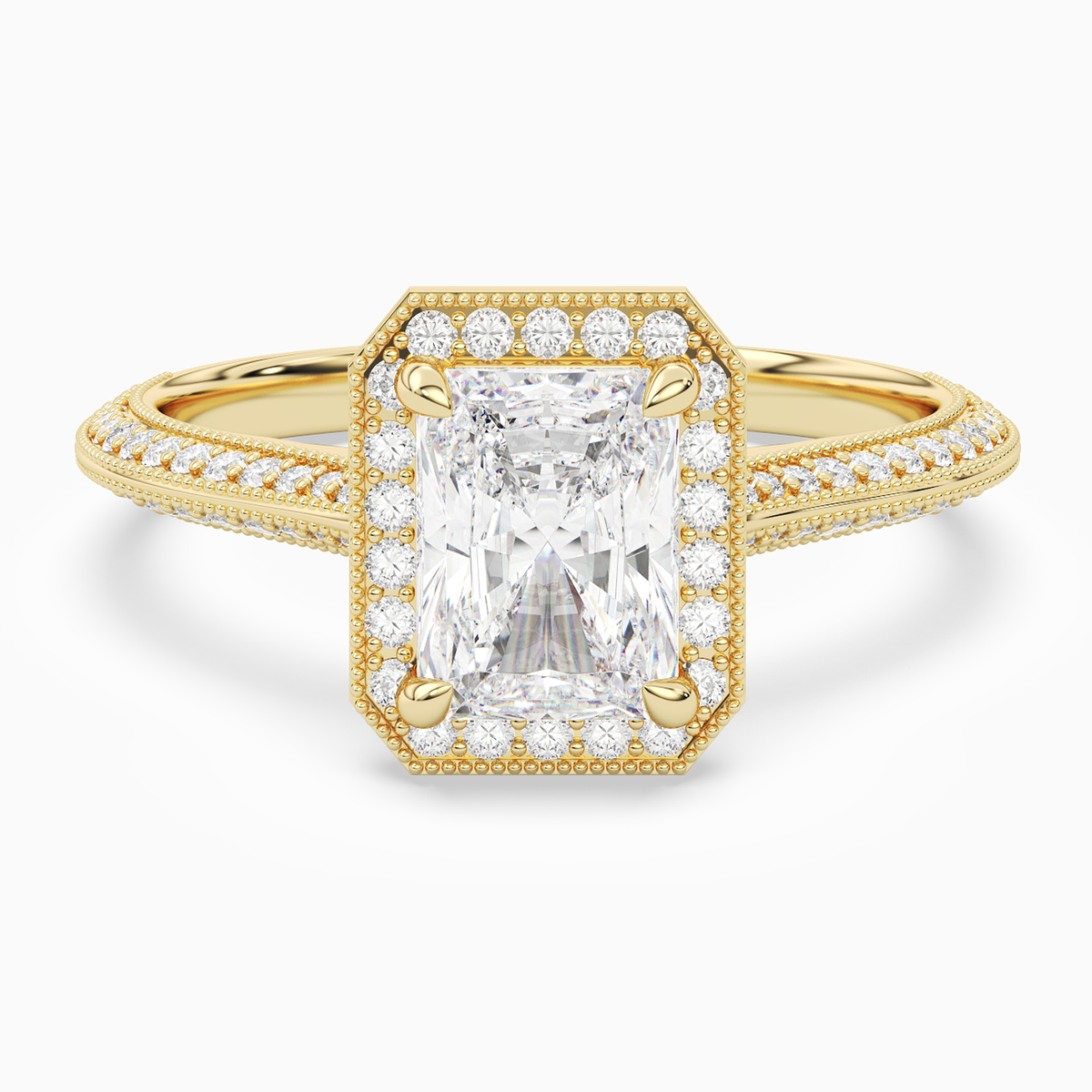
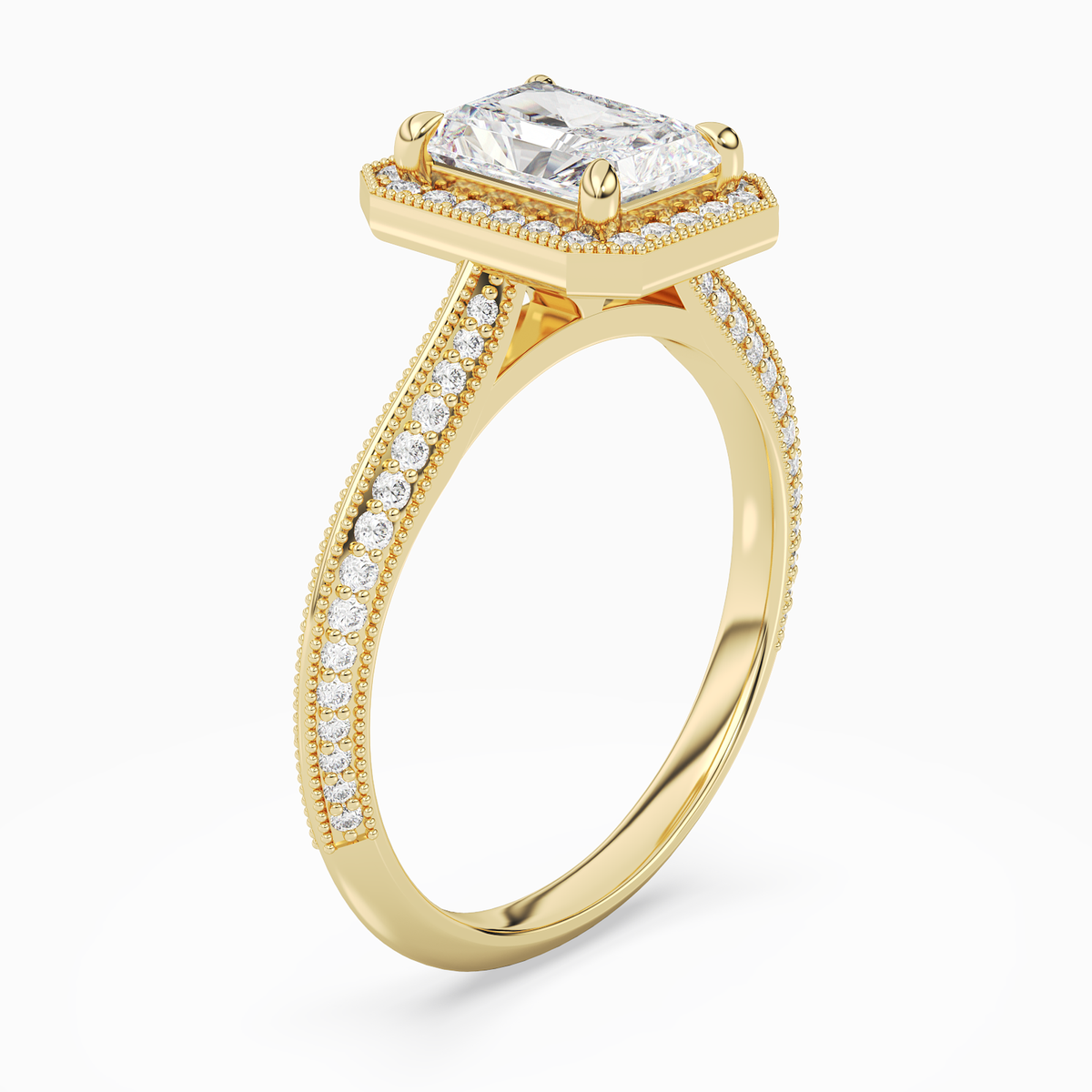
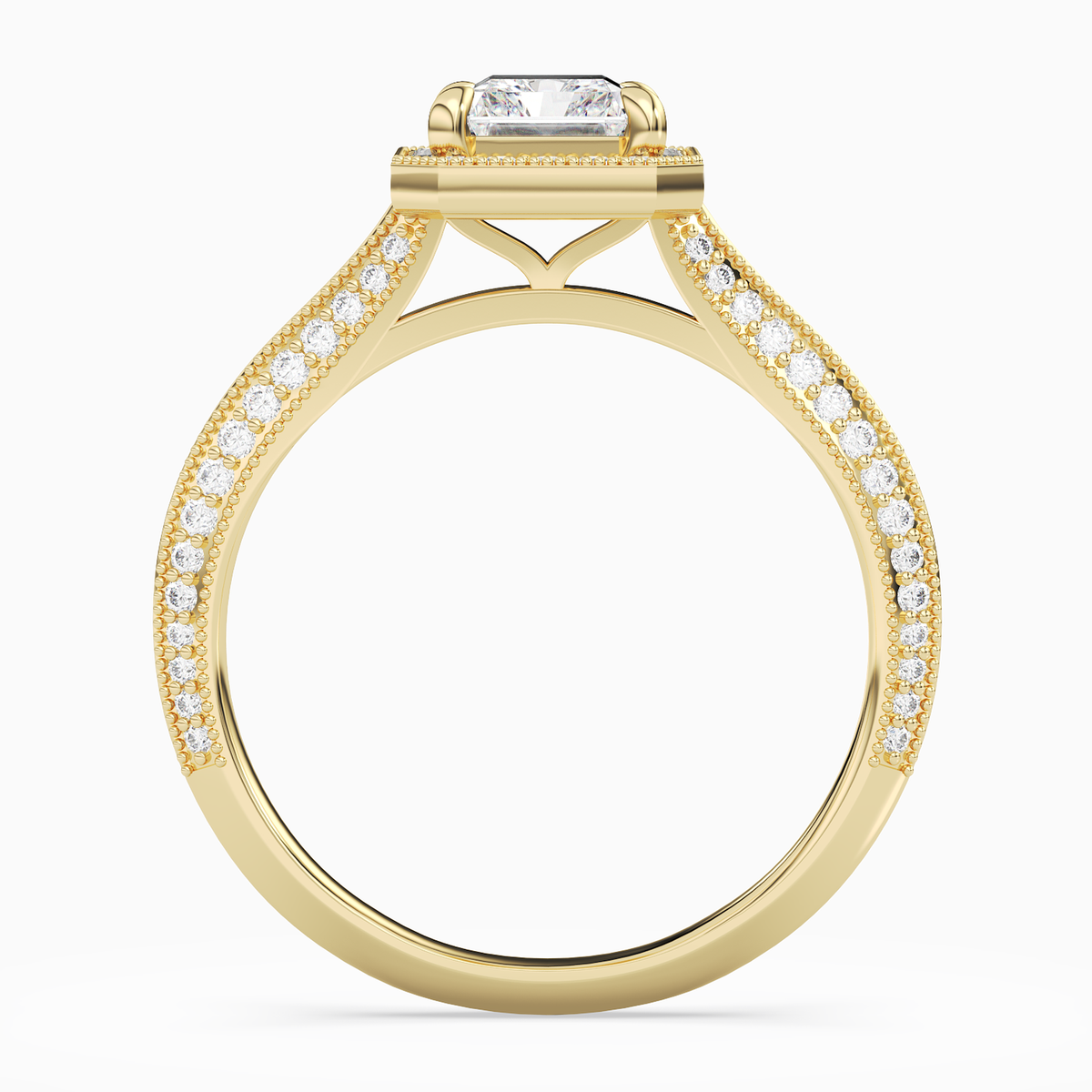
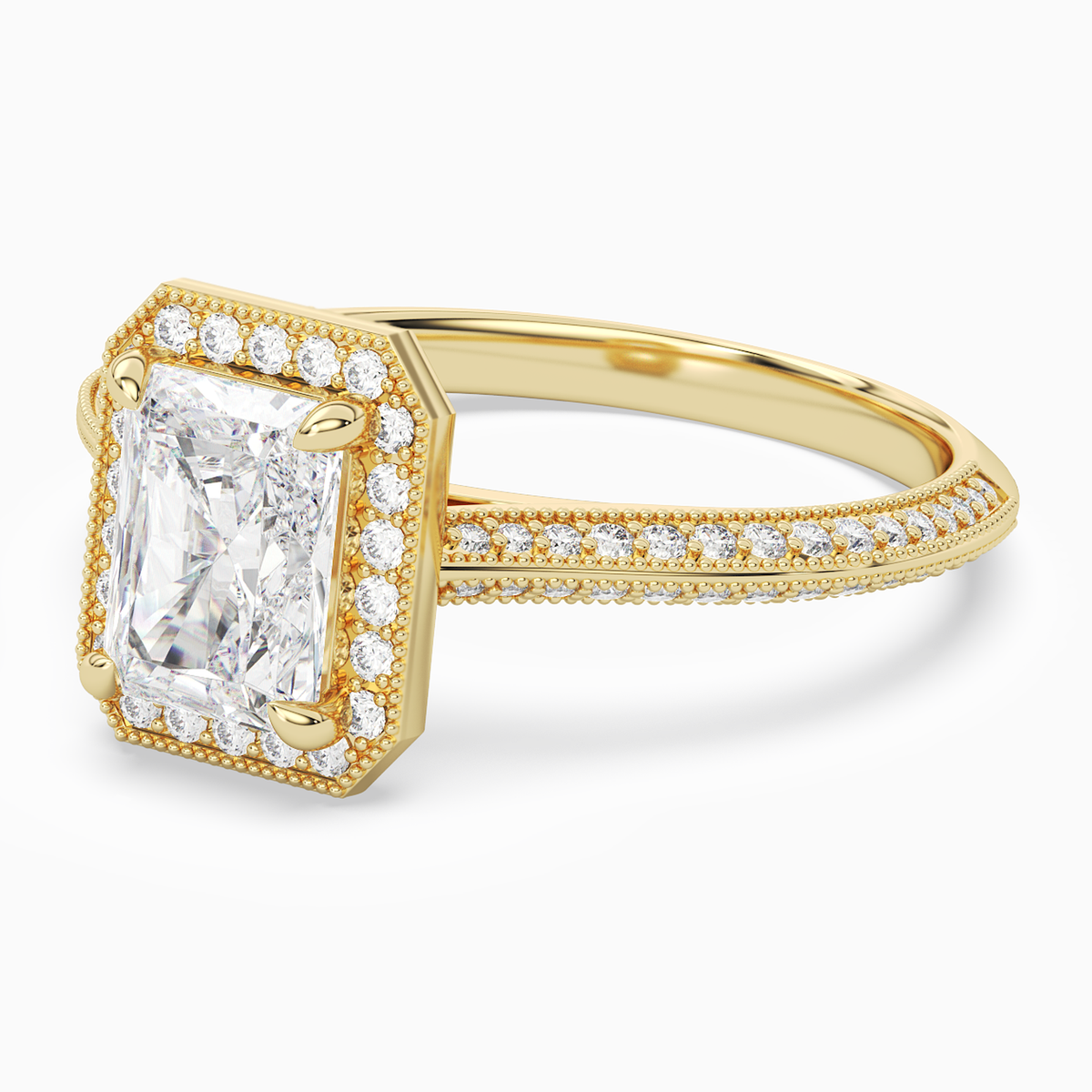
Yellow 18K gold warms Carina’s frame. Study long axis, cut corners, halo border, shoulder light, profile, center scale and motion.



- Free Express Shipping
- Free Resizing
- 60-Day Free Returns
- Lifetime Warranty
18K Yellow Gold Radiant Rings: Axis and Halo in Warm Relief
The Long Axis Should Remain Legible
Carina is the only current 18K yellow gold design. When its selected Radiant is elongated, the principal axis should remain clear through the octagonal halo; a near-square center shifts attention toward overall corner balance.
Warm metal outlines the setting strongly, but it cannot make a center more symmetrical or more brilliant. Read the diamond’s dimensions first, then judge how the second frame responds.
Corners Establish the Transition Between Frames
The four cropped corners distinguish Radiant from Princess points. On Carina, they also create reference points for the halo’s shorter sides and for the turn into the longer upper and lower runs.
Check whether the center-to-halo interval feels consistent and whether pavé shoulders join without crowding the side edges. Exact spacing, accent size, prong geometry, and finished width are not stated.
Scale Needs Millimeters, Not a Carat Shortcut
The public Center Carat menu spans 1.0 to 4.0 ct. Carat records weight; face-up length and width depend on depth, girdle, corner crop, and weight distribution.
The halo and shoulder accents change the complete ring’s visual span without changing center weight. No larger-looking, finger-lengthening, best-ratio, or maximum-sparkle language is supported.
Material Color and Taxonomy Are Separate Questions
18K is 75% gold; yellow color does not establish remaining alloy, hardness, scratch behavior, comfort, sensitivity, finish, or resizing.
Although Carina is publicly described through halo and hidden-profile language, it carries only its Radiant child membership. Complete normalized sibling overlap and missing style routes keep indexing unapproved.
Frequently Asked Questions
What is the page’s current scope?
A single Carina Octagonal Halo design.
What creates a Radiant’s long axis?
The relationship between its measured length and width.
Can the outline be near-square?
Yes. The selected center may have a compact proportion.
Do cropped corners remove all points?
They replace acute tips with four shorter sides.
How does Carina echo those corners?
Its octagonal halo repeats the cut-cornered frame.
Why compare halo intervals?
Spacing affects whether the two perimeters read coherently.
Does yellow metal improve symmetry?
No. Metal color cannot correct cutting or alignment.
Can modified-brilliant patterns differ?
Yes. Contrast and flash size vary among centers.
Should fixed darkness be reviewed?
Yes. Observe whether it persists instead of shifting in motion.
Can carat rank face-up presence?
Not without actual length, width, and depth.
Does a halo change center carat?
No. It changes the surrounding visual field.
Are pavé accent grades stated?
No Collection-level accent specification is provided.
Is wedding-band clearance known?
No. Profile and contact-line dimensions are required.
Does cropped geometry guarantee durability?
No impact or daily-wear guarantee is made.
Is Carina tagged Halo?
No current corresponding Collection tag is present.
Does 18K define all care needs?
No. Full alloy, finish, and construction are needed.
Is this an exclusive metal assortment?
No. The same normalized design appears in all six children.