
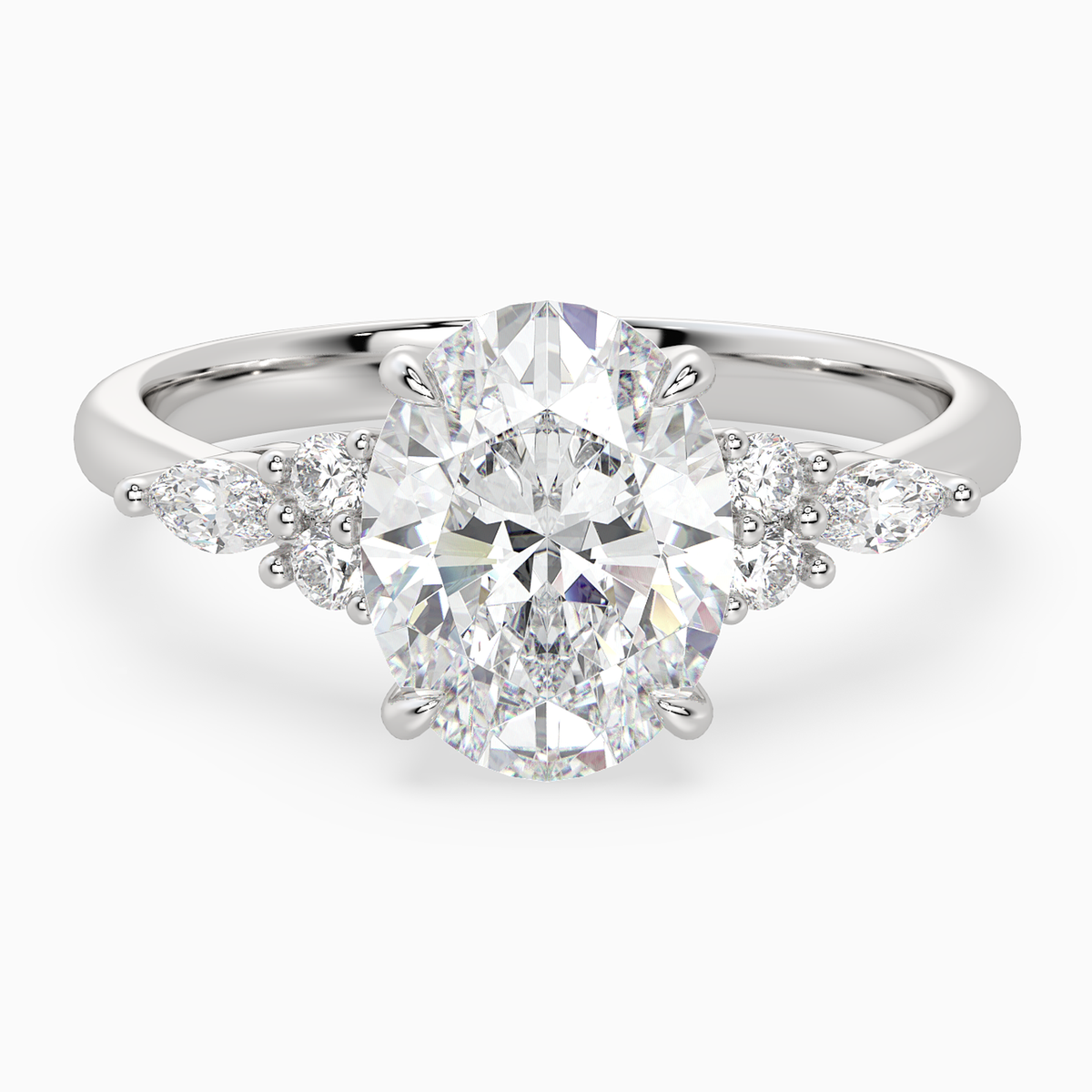


Princess Diamond Engagement Rings in 14K Yellow Gold
Yellow gold frames a pointed square. Study Estelle, Luna and Amara through corners, halo placement, crossed shoulders, profile and scale.


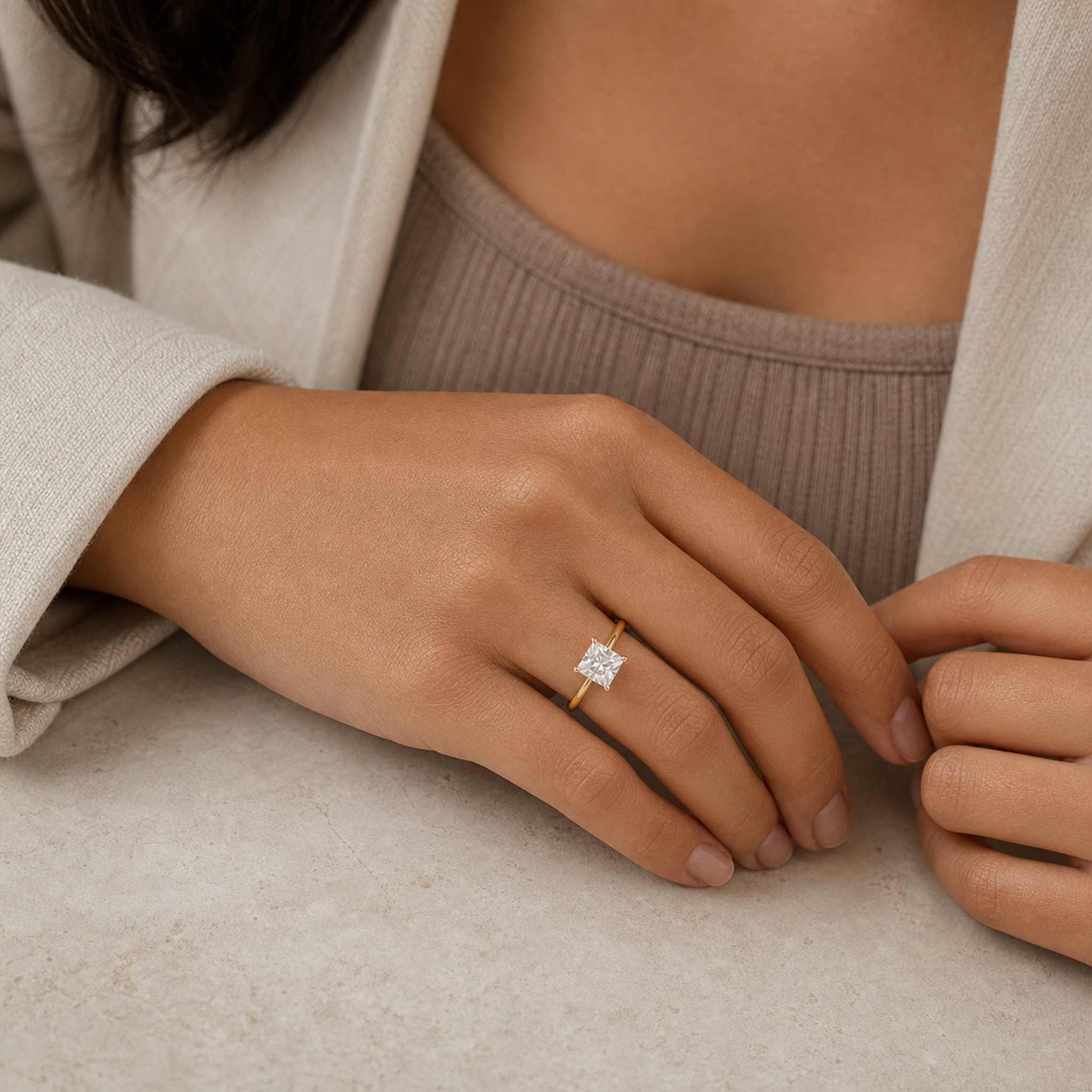


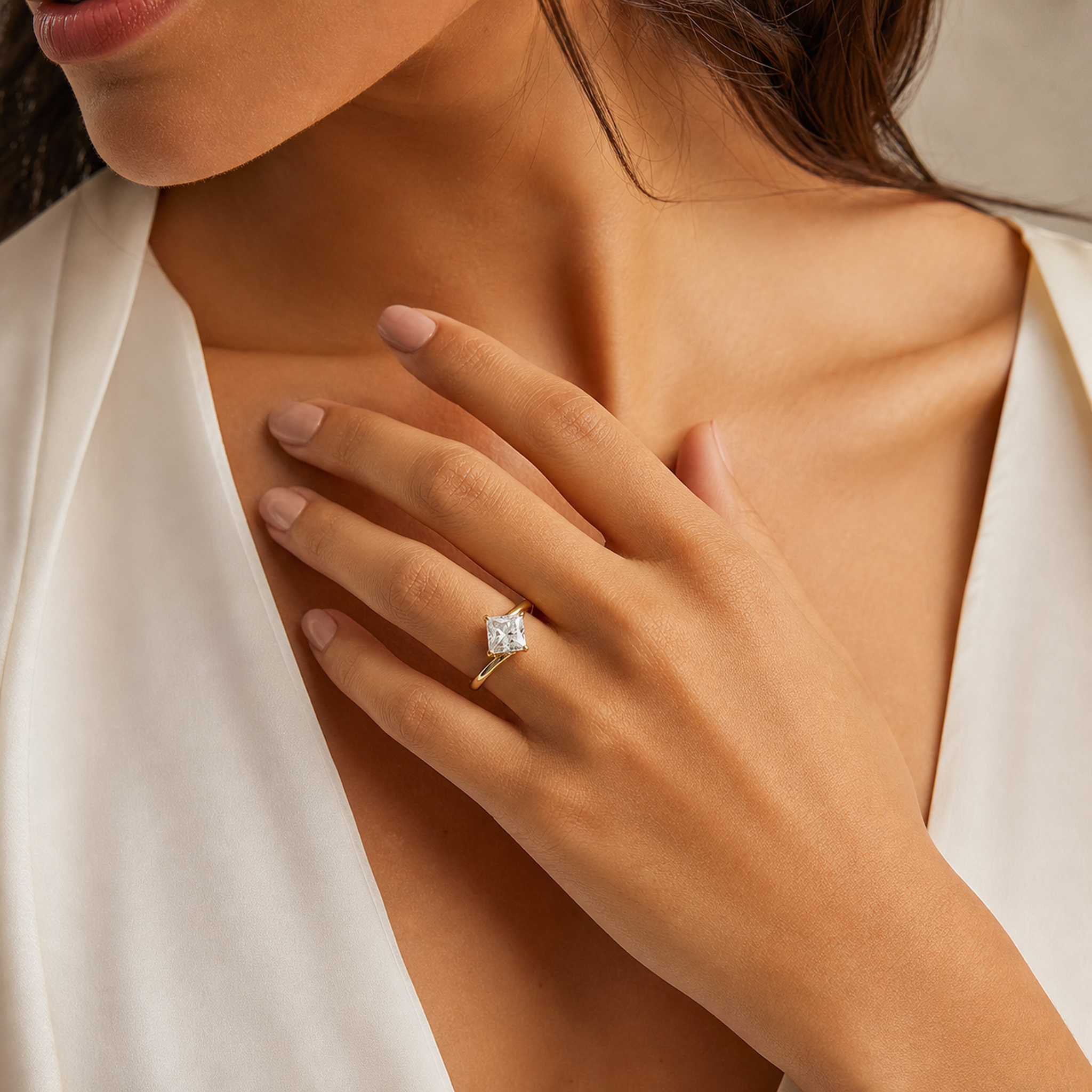
14K Yellow Gold Princess Rings: A Warm Boundary from Side to Point
The Square Reads Against a Visible Frame
Estelle, Luna, and Amara are the only current products on this child page. Yellow metal makes their setting boundary explicit, while the selected center still owns side equality and corner alignment.
Do not infer a preferred color grade or stronger light return from metal contrast. The diamond report and the complete ring must be read as related but separate evidence.
Three Hierarchies Change Where Light Sits
Estelle tucks its halo beneath a plain-band head. Luna makes the diagonal dominant with a kite-like halo and slim pavé shoulders. Amara keeps accents absent and lets crossed, smooth shoulders carry movement.
These verified differences affect face-up versus profile emphasis. They do not disclose exact point coverage, basket dimensions, setting height, or wedding-band spacing.
Check Sides, Diagonals, and Internal Pattern
A ratio records length against width. It does not reveal whether sides run cleanly, corners meet the diagonals, or the modified-brilliant pattern is balanced.
Compare ordinary views and motion, watching for centered contrast and responsive flashes across the full square. Avoid treating facet count or carat as a universal quality shortcut.
Warm Color Is Not a Performance Specification
Approximately 58.3% of 14K is gold. Yellow tone alone does not prove durability, scratch resistance, comfort, sensitivity outcome, low maintenance, or resizing.
Public membership counts are also incomplete: Estelle lacks expected style tags, and only two products overlap the main metal Engagement route. Keep indexing on hold pending cleanup and evidence.
Frequently Asked Questions
What is the current product set?
Estelle, Luna, and Amara comprise the page.
What is shared visually?
Each uses a Princess center with straight sides and four pointed corners.
How does Estelle place its halo?
The sparkle ring is tucked beneath the head rather than around the face-up edge.
Why does Luna read diagonally?
Its center is publicly described as set on point within a kite-like halo.
How does Amara interrupt symmetry?
Its bypass shoulders sweep into a controlled crossed profile.
Does yellow gold set the diamond grade?
No. Metal color does not determine grading.
Must all four sides be identical?
Near-square centers should be assessed through actual measurements and outline balance.
Can a Princess be longer than wide?
Yes. A rectangular Princess has a clearer axis.
Does ratio reveal facet alignment?
No. It says nothing about the complete internal pattern.
Can dark zones appear?
Yes. Judge their position and whether they remain fixed in motion.
Does a larger carat mean a wider square?
No. Depth and weight distribution can change face-up dimensions.
Are four V-prongs required?
No universal requirement is imposed, and these products do not publish the treatment.
Does a Hidden Halo protect corners?
No. Accent placement and corner protection are separate questions.
Is Luna also a Solitaire?
Its verified membership is Halo; no Solitaire claim is added here.
Is Amara tagged Solitaire?
Yes, along with nature-inspired membership for this metal.
Can universal comfort be promised?
No. Fit depends on dimensions, alloy, finish, and construction.
Are Center Carat options known?
Yes. Public menus span 1.0 to 4.0 ct; dimensions remain center-specific.