


Men's Rings
Width sets the first measure; surface and edge complete it. Explore 4–8 mm bands through profile, diamond placement, fit and meaning.








A Band, Considered from Every Edge
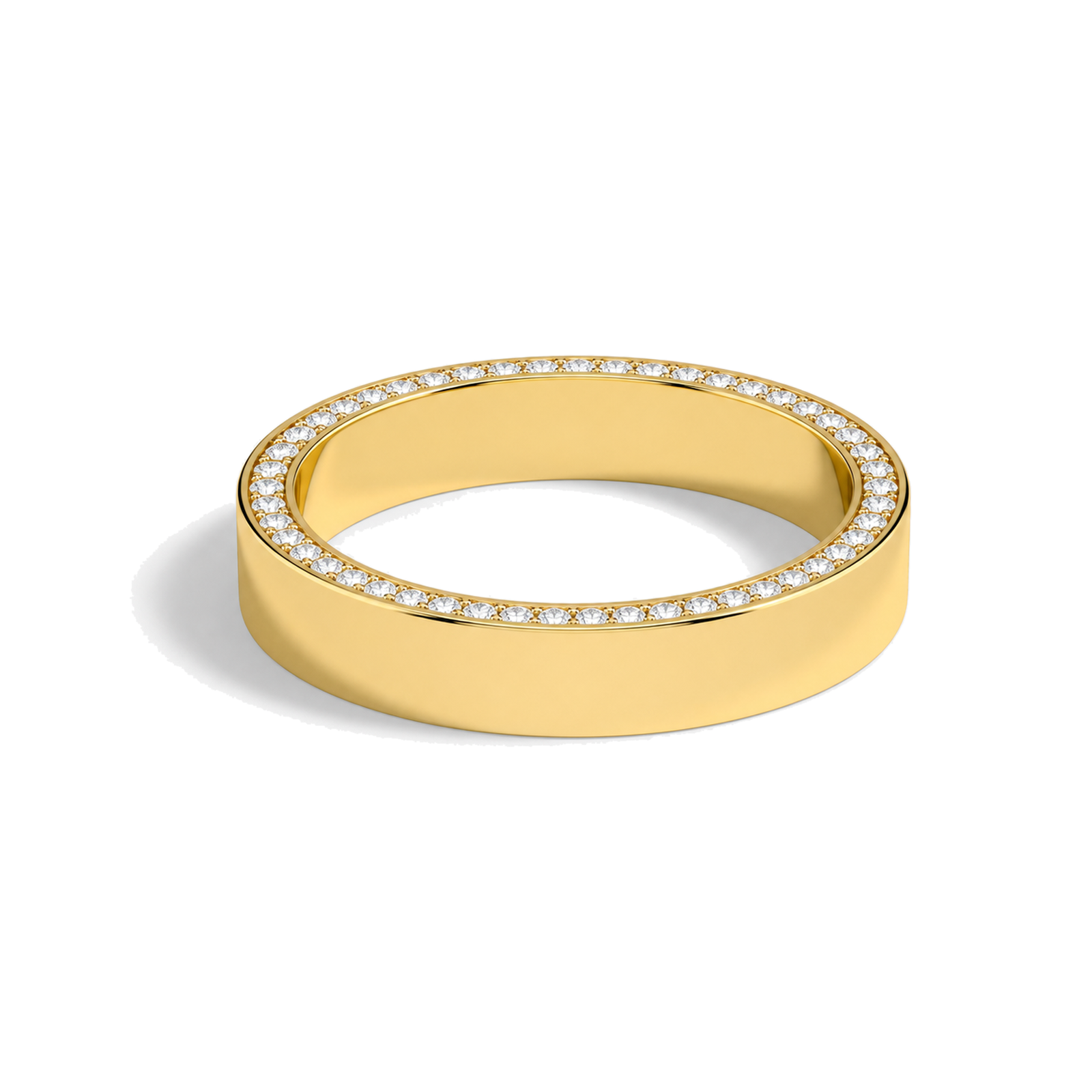
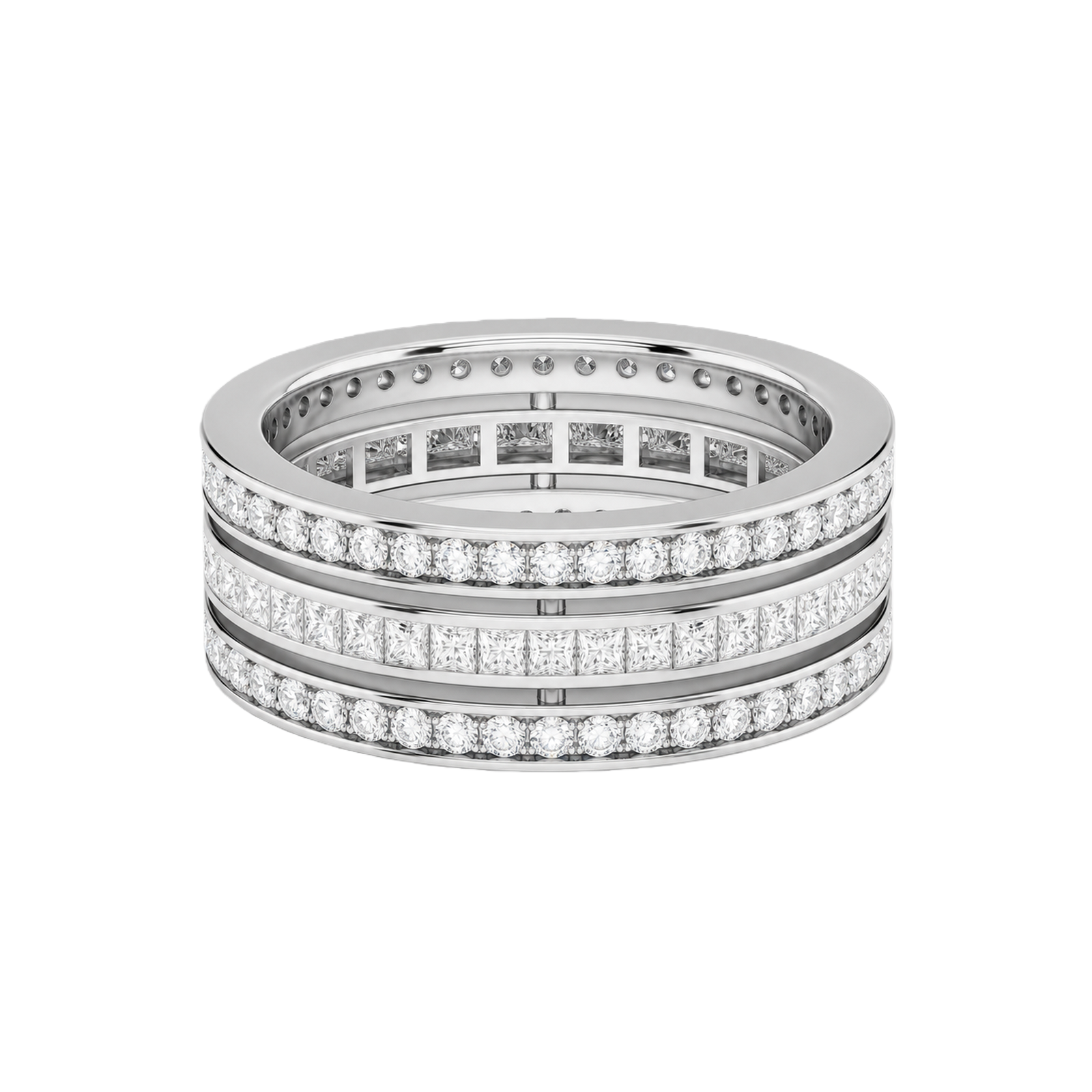
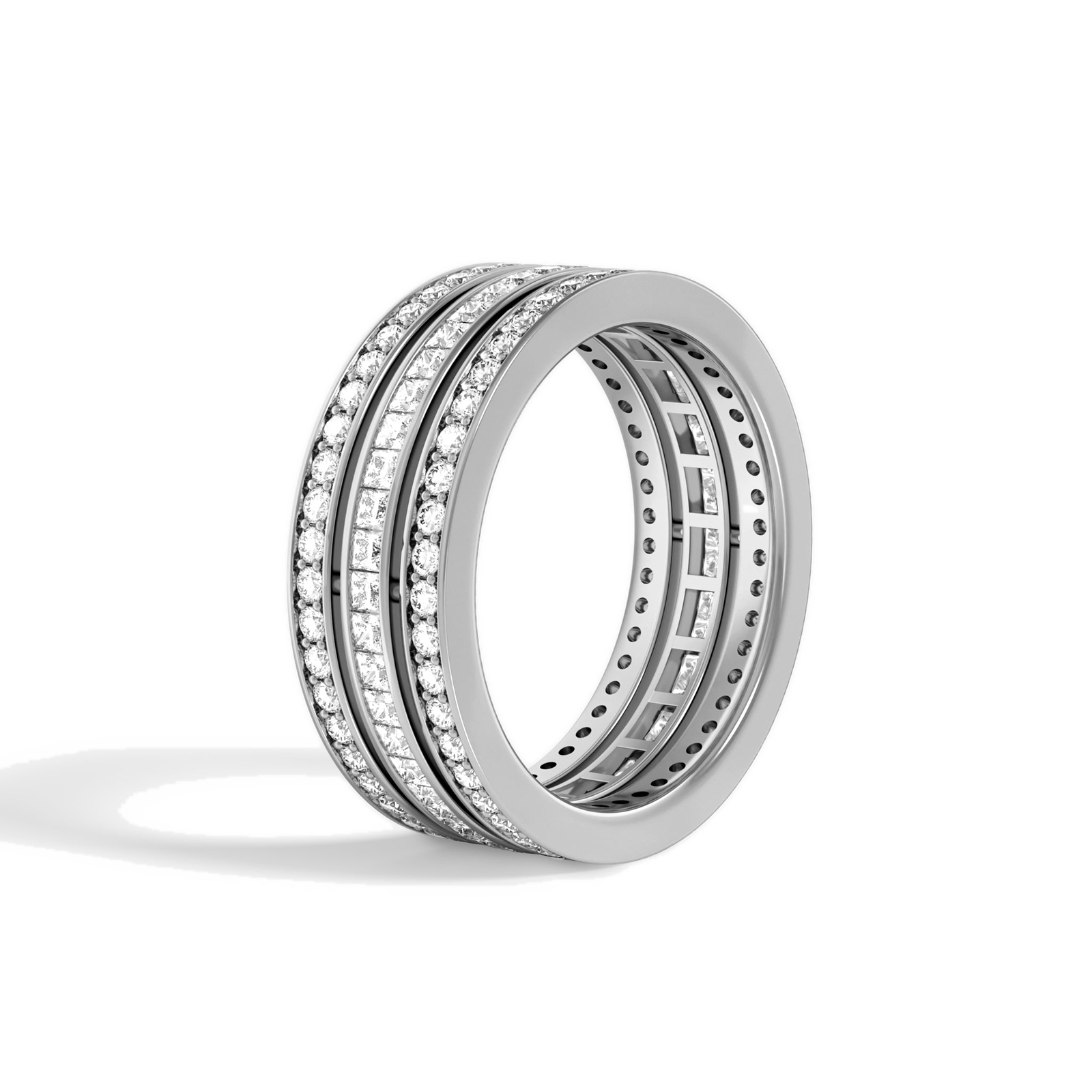
A ring meets the hand as more than a circle seen from above. Its width occupies the finger, its edge frames the silhouette, its outer surface organizes light, and its inner profile determines how the form meets skin. The most resolved choice is not the one that performs a generic idea of masculinity, but the one whose complete geometry belongs to the wearer.
Burvonti’s current public Men’s Ring Collection contains 28 products, and every title describes a wedding-band form. All 28 have design-normalized counterparts in the 97-product Wedding Band Collection, although exact product cards differ because the two pages represent designs in different metals. Men’s Rings is therefore a focused audience and proportion edit—not a claim of men-only engineering, and not a current assortment of signet, cocktail, or non-wedding ring types.
Width Establishes the First Measure
Current widths span 4 to 8 mm: one 4 mm, ten 4.5 mm, four 5 mm, four 5.5 mm, four 6 mm, one 6.5 mm, two 7 mm, and two 8 mm designs. Width changes how much of the finger is covered and how much room the design has for edge, surface, channels, facets, or isolated diamonds.
It does not determine identity. A 4 mm ring is not inherently slight, and an 8 mm ring is not automatically more masculine or visually successful. Thickness, profile, edge, finish, hand proportions, and neighboring fingers change the reading. Compare the complete cross-section and a realistic worn scale rather than choosing from width alone.
Profile Shapes Both Silhouette and Contact
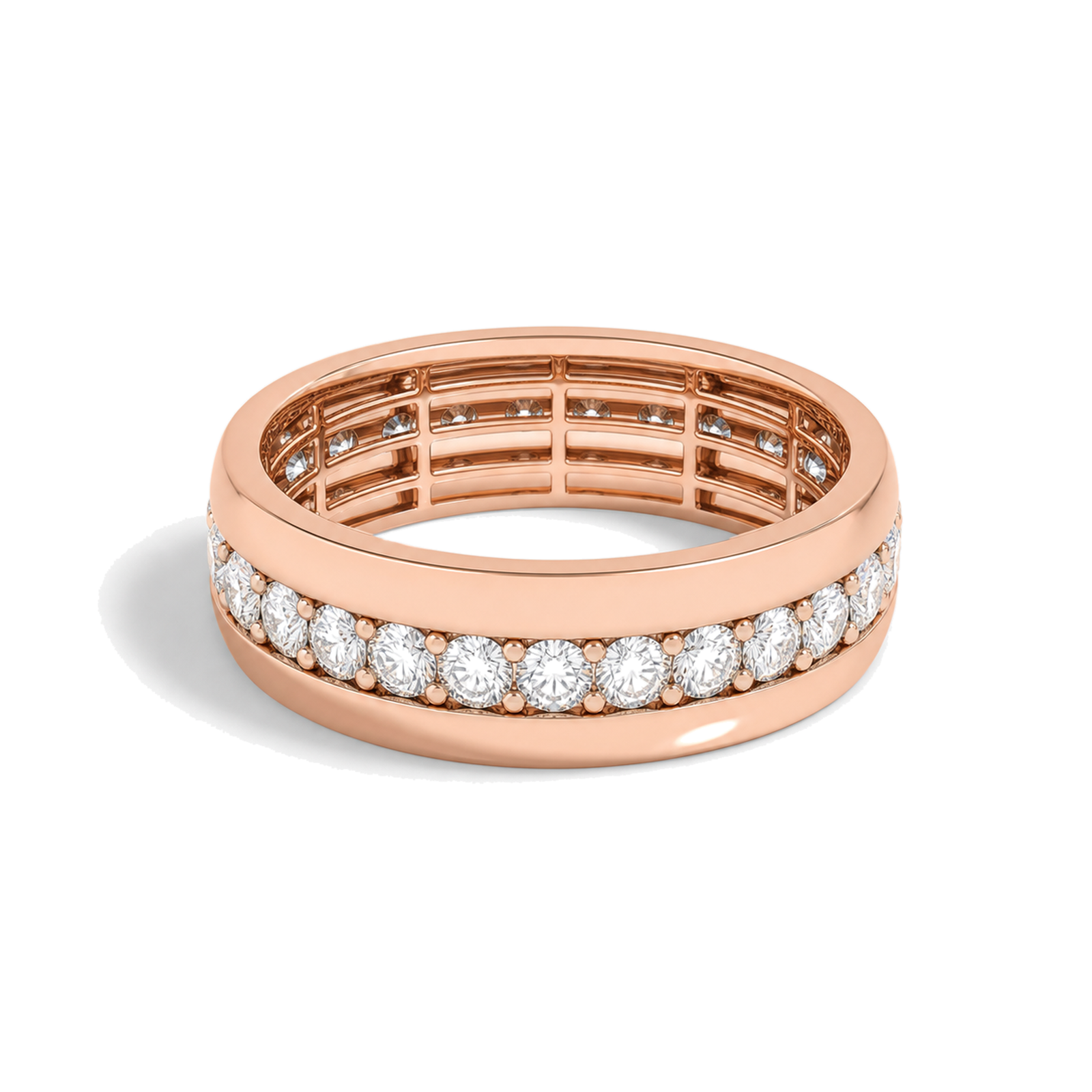
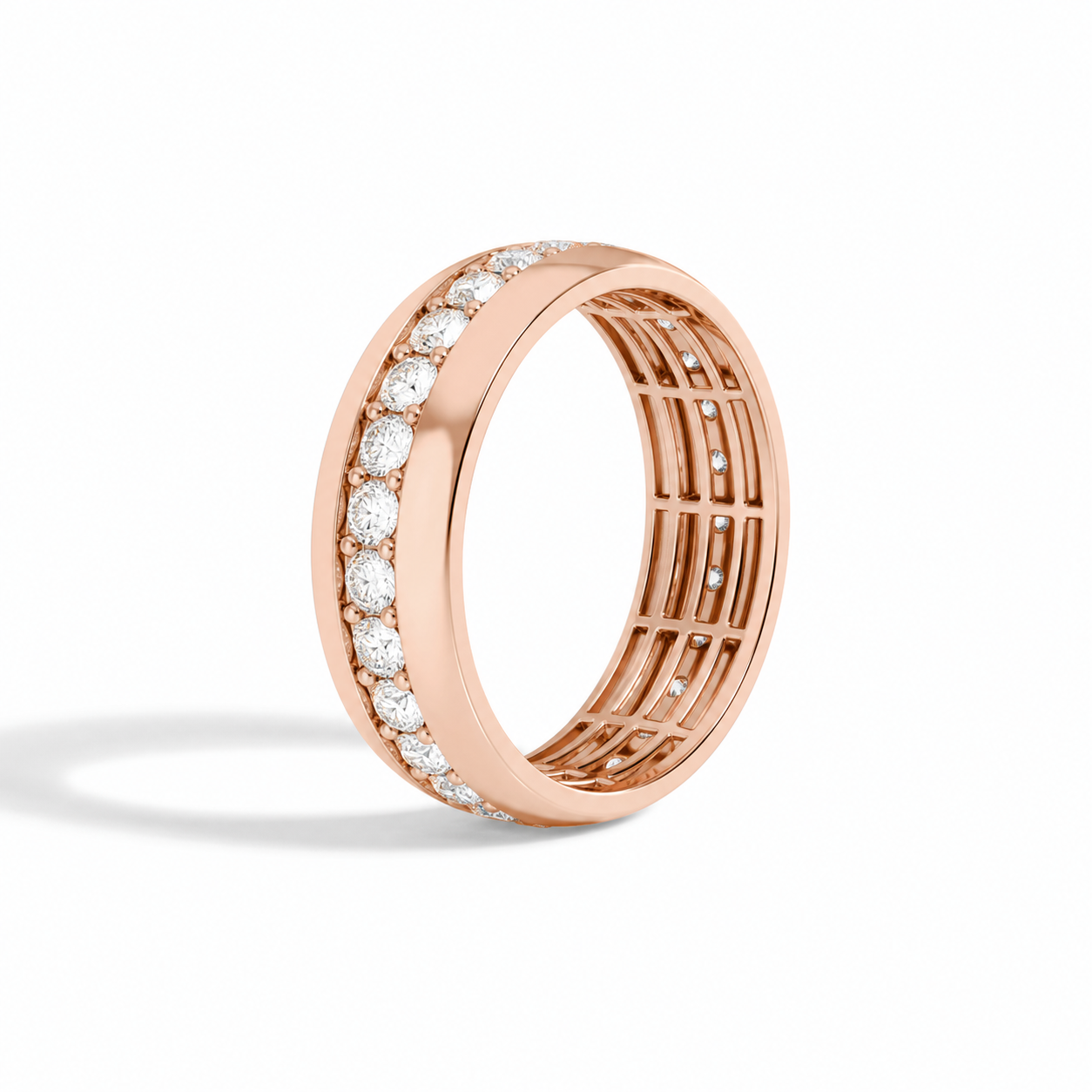
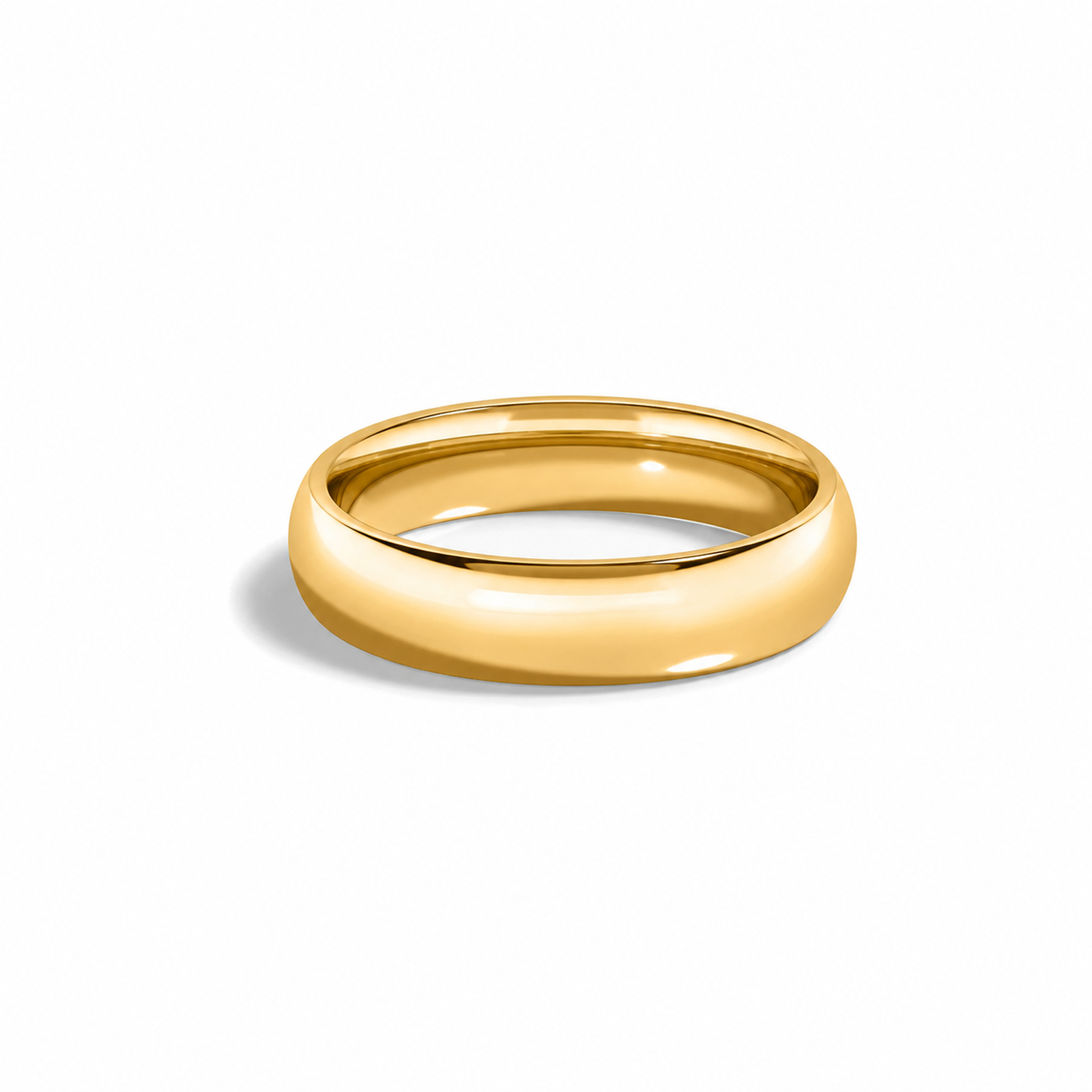
Current titles include flat, beveled, domed, knife-edge, concave, faceted, octagonal, and comfort-fit language. A bevel creates a transition at the edge; a dome carries a rounded exterior; a knife edge establishes a ridge; a concave surface turns inward; facets divide reflection into planes. These forms should be viewed from side and oblique angles, not reduced to a front-facing label.
Comfort-fit generally describes a rounded interior intention, but it cannot guarantee comfort for every wearer. Width, thickness, inner radius, ring size, knuckle, finger shape, temperature, swelling, and activity remain decisive. Nor should a slim-profile title be treated as a universal weight or fit outcome without product dimensions.
Surface Gives Metal Its Tempo
The edit includes polished, brushed, hammered, knurled, faceted, channel-led, pavé, and Art Deco-titled treatments. Polish produces a broader reflection; brushing diffuses light; hammering creates irregular intervals; knurling establishes a repeated texture; facets create planar changes. Channels and pavé alter the relationship between metal field and diamond rhythm.
No surface is scratch-proof, impact-proof, or maintenance-free. Polished areas can mark; textures can soften or collect residue; refinishing can change engraved lines, crisp facets, edges, or adjacent diamond work. Ask what care and restoration are appropriate for the selected surface rather than ranking one finish as universally more durable.
Diamond Placement Can Punctuate or Continue the Line
Sixteen current product records name a diamond shape: 11 Round, two Princess, two Emerald, and one Baguette. Eleven state Lab Grown Diamond without naming a shape in the same field, while one product does not publish a diamond line there. Current titles range from single and three-stone accents to channels, pavé, and eternity compositions.
A single diamond interrupts the surface with one point; three stones create an interval; a channel makes a directed track; broader or eternity coverage extends rhythm around more of the circumference. Shape and coverage should be confirmed product by product. Neither an eternity title nor an image alone proves complete 360-degree diamond coverage, resizing feasibility, or a fixed total weight.
Metal Changes Contrast at the Edge
Current cards represent 12 designs in 14K White Gold, 11 in 14K Yellow Gold, and five in 14K Rose Gold. White metal can quiet the division between near-colorless-looking diamonds and setting; yellow and rose metal can make bevels, channels, facets, and isolated stones more explicit. Actual effect depends on finish, rhodium treatment where applicable, lighting, skin, and diamond distribution.
Metal choice can connect the ring to existing jewelry or let it remain distinct. Partners do not need matching metals, widths, surfaces, or diamonds. Matching metal names also do not prove identical alloy, color, finish, age, or maintenance needs.
Fit Must Be Tested at the Chosen Width
A broader ring can feel different from a narrower ring at the same nominal size because more surface meets the finger, but no universal half-size or full-size adjustment applies. Measure or try the intended width and profile whenever possible. Consider knuckle passage, the base of the finger, interior shape, temperature, swelling, and how the ring moves during ordinary hand positions.
All 28 current public product records show Default Title rather than a public TCW selector. That is a current option fact, not proof that no product contains diamonds or that no custom variation is possible. Confirm selected size, dimensions, diamond specifications, availability, and alteration scope at product level.
A Wedding Band Can Stand Alone or Enter a Pair
Every current ring title places this edit within wedding-band intent. A band may stand alone, sit beside an engagement ring, relate to a partner’s ring through one shared detail, or remain deliberately different. Commitment provides context; it does not require a matched set, a prescribed hand, a fixed order, or one person to make the choice alone.
If another ring will sit beside it, compare edge, width, height, diamond setting, movement, and contact from several angles. A visual match does not guarantee mechanical compatibility, and no spacer or arrangement prevents every instance of abrasion, pressure, or catching.
Personalization Begins with the Existing Geometry
An engraving, altered width, surface, diamond interval, metal, or interior detail can be meaningful only when it respects the selected band’s geometry. Channels, facets, textures, eternity coverage, symmetry, and narrow engraving areas may limit what can be changed. Custom possibility is a technical conversation, not a promise that every request can be executed.
Burvonti uses responsibly sourced lab-grown diamonds and supports independent grading and certification where applicable. Confirm what documentation covers and whether alteration could affect it. Care for the complete band: clean according to metal, surface, and settings; inspect diamonds and edges; and remove the ring when an activity or chemical would place unnecessary stress on it.
Frequently Asked Questions
What rings are currently included in Burvonti’s Men’s Ring Collection?
The current public Collection contains 28 wedding-band-titled designs from 4 to 8 mm, with varied profiles, surfaces, edges, and diamond placements.
Are Men’s Rings different from Wedding Bands?
This is a focused audience edit. All 28 current designs have normalized counterparts in Wedding Bands, while representative metal cards differ between the two Collections.
Does Burvonti currently include men’s signet or fashion rings here?
Not in the current public membership. Every present product title describes a wedding-band form; future assortment should be checked rather than assumed.
What widths are currently available?
Current products span 4, 4.5, 5, 5.5, 6, 6.5, 7, and 8 mm, with 4.5 mm the most represented width.
How should I choose a ring width?
Compare finger and hand proportions, complete profile, thickness, edge, surface, neighboring fingers, and realistic worn-scale imagery. Width is not a gender rule.
Does a wider band require a larger size?
It may feel tighter, but no fixed adjustment applies. Measure or try the intended width, inner profile, and complete construction.
What is a comfort-fit ring?
It generally describes a rounded interior intention. Comfort still depends on width, thickness, size, anatomy, temperature, swelling, and activity.
What is a beveled-edge ring?
A bevel creates an angled transition between the main surface and edge, changing silhouette and reflection. Its exact angle and depth remain product-specific.
What is the difference between flat, domed, knife-edge, and concave profiles?
Flat emphasizes a plane, domed rounds outward, knife-edge forms a ridge, and concave turns inward. Interior shape and thickness must still be reviewed separately.
Which finishes and textures are currently represented?
Current titles include polished, brushed, hammered, knurled, faceted, channel-led, pavé, and Art Deco-titled treatments.
Which ring finish is most durable?
No Collection-wide ranking applies. Construction, finish depth, geometry, contact, maintenance, and refinishing determine how a selected surface changes.
Are brushed or hammered rings scratch-proof?
No. Texture may change how marks appear, but no finish is scratch-proof, impact-proof, or maintenance-free.
Which diamond shapes are currently named?
Sixteen records name shapes: 11 Round, two Princess, two Emerald, and one Baguette. Eleven name lab-grown diamond without a shape in the same field.
What diamond arrangements are currently represented?
Current titles include single and three-stone accents, channels, pavé, and eternity designs. Exact count, coverage, and specifications remain product-specific.
Does an eternity title mean diamonds circle the entire band?
Do not assume this from the title alone. Confirm the selected product’s actual coverage, underside, sizing, documentation, and alteration limits.
Which metals are currently represented?
Current cards represent 14K White, Yellow, and Rose Gold. Exact alloy, finish, rhodium treatment, sensitivity, maintenance, and alternatives remain product-specific.
Should partners’ wedding rings match?
Only if desired. Rings can match, share one detail, or differ in width, profile, surface, metal, and diamond treatment while carrying the same commitment.
Can a Men’s Ring be engraved, resized, or customized?
Possibly after technical review. Width, profile, surface, diamond coverage, symmetry, metal, and requested change affect feasibility.
Are the diamonds independently graded?
Independent grading and certification apply where stated. Confirm which diamond or diamonds selected documentation identifies and whether accents are included.
How should a Men’s Ring be cared for?
Use care suited to its metal, finish, profile, and settings; inspect diamonds and edges; and avoid unnecessary chemical, impact, or abrasive stress.