
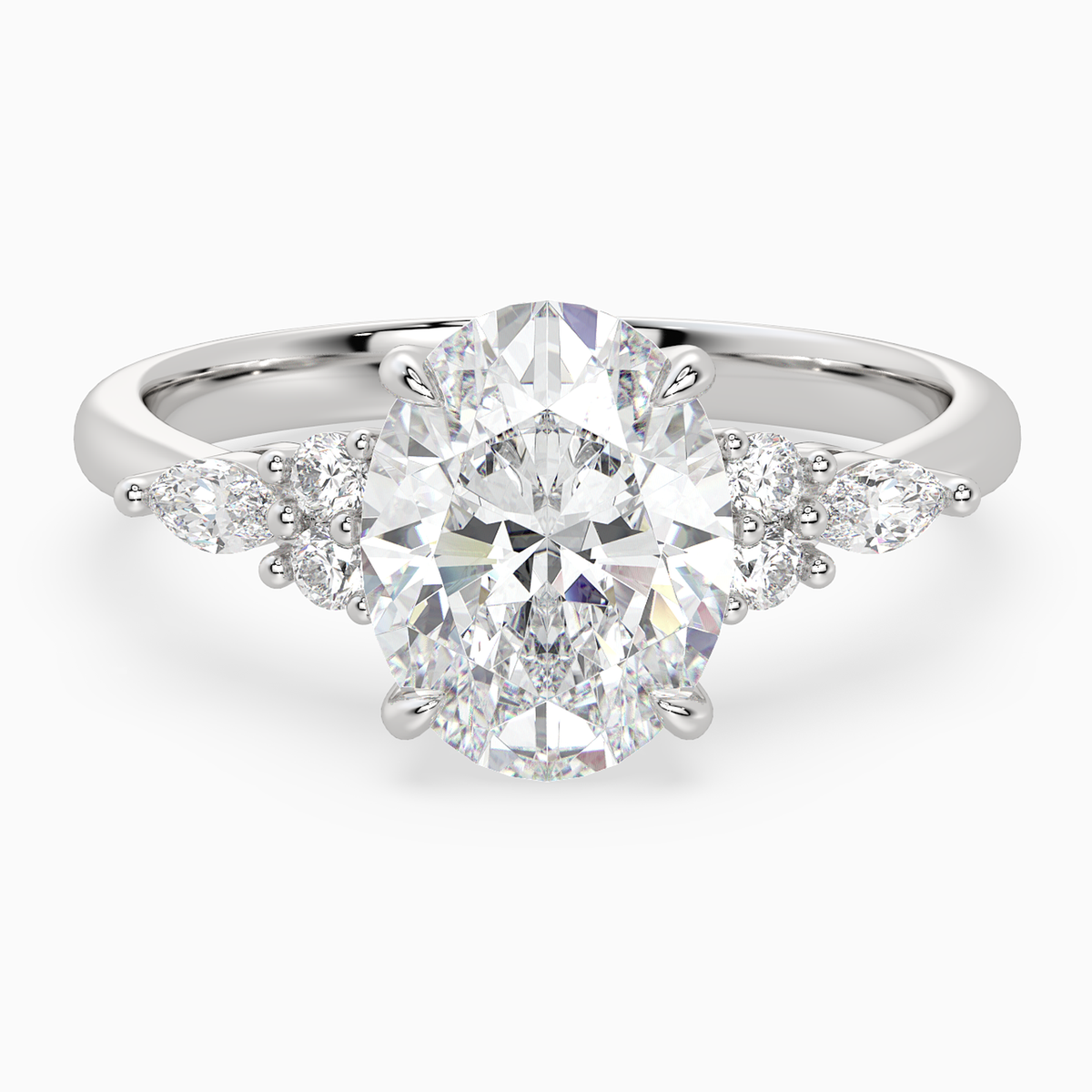


Marquise Diamond Engagement Ring Guide: Shape, Settings, and What to Check

A marquise diamond engagement ring has a strong point of view. Its long, pointed shape can make the diamond look larger for its carat weight, lengthen the look of the finger, and feel more distinctive than a round or oval center stone. The tradeoff is that marquise diamonds demand more careful selection: proportion, symmetry, bow-tie visibility, and point protection all matter.
Choose a marquise engagement ring if you want a dramatic silhouette, strong face-up presence, and a shape that can feel elegant or modern depending on the setting. Before buying, check the length-to-width ratio, point alignment, bow-tie effect, color appearance, clarity placement, and whether the setting protects both tips.
This guide explains what makes marquise diamonds different, how to evaluate the shape, which settings work best, and how to choose a ring that feels precise rather than simply dramatic.
What Is a Marquise Diamond Engagement Ring?
A marquise diamond has an elongated outline with curved sides and pointed tips at both ends. In an engagement ring, that shape creates a directional line across the finger. Set vertically, it can make the finger appear longer. Set east-west, it becomes more modern and graphic.
The shape has historical associations, but modern shoppers do not need to choose it for nostalgia. The strongest reason to choose a marquise is design intent: it gives a ring a clear silhouette, strong spread, and a sense of movement that many round stones do not have.
Elongated presence
A marquise diamond usually appears longer on the hand than many shapes of similar carat weight, which can create impressive visual scale.
Distinctive outline
The pointed ends and curved sides make the ring immediately recognizable, even in a very simple setting.
Flexible styling
Marquise diamonds can look classic in a solitaire, architectural in an east-west setting, or ornate in a halo or three-stone design.
More selection sensitivity
The same shape that makes marquise diamonds striking also makes symmetry, bow-tie, and point protection harder to ignore.
Why Marquise Diamonds Look Larger Than Their Carat Weight
Carat weight measures weight, not visual size. Because marquise diamonds are long and narrow, more of the diamond can be distributed across the top view. That means a well-cut marquise may look larger face-up than a round diamond of the same carat weight.
This is useful, but it should not be the only reason to choose the shape. A diamond that is too stretched can look thin. A diamond that is too wide can lose the clean, blade-like elegance that makes a marquise attractive. The best choice balances spread with proportion.

What to Check Before Buying a Marquise Diamond
Length-to-width ratio
The length-to-width ratio controls the personality of the shape. A slimmer marquise feels sharper and more elongated. A fuller marquise feels softer and sometimes more vintage. There is no single correct ratio for every buyer, but the shape should look intentional, balanced, and flattering to the setting. Continue with the Marquise Diamond Buying Guide for proportion and bow-tie checks; then see Why Marquise Diamonds Stand Out for the broader shape context.
Symmetry and aligned points
The two points should sit on the same visual axis. The curves on both sides should mirror each other. Even a high-quality diamond can feel awkward if one shoulder is fuller, one point drifts, or the outline appears twisted.
Bow-tie effect
Many elongated diamond shapes can show a bow-tie: a darker area across the center caused by the way light travels through the stone. A slight bow-tie is normal in many marquise diamonds. The issue is whether it is distracting. View the diamond in more than one lighting environment if possible.
Color and clarity placement
Because marquise diamonds have pointed ends and a broad face-up outline, color and inclusions can appear differently than they do in round diamonds. Clarity features near the center can matter more than small features near the edges. Color sensitivity can also change depending on metal choice and diamond size.
| Buying detail | What to look for | Why it matters |
|---|---|---|
| Ratio | A shape that feels elongated but not too thin for the ring design. | Controls whether the stone feels elegant, dramatic, soft, or severe. |
| Symmetry | Aligned tips and balanced curves on both sides. | The marquise outline makes asymmetry easier to notice. |
| Bow-tie | A center shadow that is not visually dominant. | A strong bow-tie can interrupt the diamond's brightness. |
| Point protection | V-prongs, bezel ends, or another setting solution for the tips. | The pointed ends are the most vulnerable parts of the shape. |
| Setting fit | A design that supports the stone's exact measurements. | Generic settings may not protect or proportion the marquise correctly. |
Best Settings for a Marquise Diamond Engagement Ring
Solitaire with V-prongs
A solitaire lets the shape carry the design. V-prongs at the points are especially important because they help protect the sharp ends while keeping the outline readable. This is often the cleanest choice for a modern marquise ring.
East-west setting
An east-west marquise turns the diamond horizontally across the finger. The look is more graphic, less traditional, and often easier to wear for someone who likes clean design. It also changes the ring's proportions, so the band width and stone size need careful balance.
Bezel setting
A bezel wraps metal around the diamond's edge. For a marquise, that can protect the points and create a smooth, contemporary outline. The risk is that too much metal can make the diamond look heavier, so the bezel should be refined and precise.
Three-stone setting
Side stones can soften the pointed silhouette and add width across the finger. Tapered baguettes, pears, rounds, or smaller marquise diamonds can work, but the side stones should support the center rather than compete with its line.
Halo setting
A halo can make a marquise look larger and more ornate. It also changes the outline dramatically. If the halo is too thick, the ring can lose the clean tension of the marquise shape. A delicate halo or hidden halo is usually more wearable than an oversized frame.

North-South vs. East-West Marquise
The classic north-south orientation follows the length of the finger. It emphasizes the marquise diamond's elongating effect and feels elegant, sharp, and traditional. If the wearer likes a ring that visually lengthens the hand, this direction is usually the stronger starting point.
The east-west orientation places the marquise horizontally. It feels more architectural and contemporary. It can also make the ring feel lower-profile visually, especially in a bezel or minimalist setting. The best direction depends on how the ring should feel on the hand: graceful and lengthening, or graphic and modern.
Do not choose a marquise setting from a generic template. The prong position, V-tip protection, band width, and setting height should respond to the actual diamond's length, width, depth, and point alignment.
Metal Choice and Wedding Band Fit
White gold and platinum emphasize the diamond's crisp outline and keep the setting visually cool. Yellow gold adds contrast and warmth, which can make the marquise silhouette stand out. Rose gold can soften the shape, but it is more taste-specific and should match the wearer's existing jewelry style.
Wedding band fit should be discussed early. A long marquise center stone can extend over the band line depending on the setting height and orientation. Some designs allow a straight band to sit close. Others may need a contoured band or a small spacer.
Daily Wear and Care
Marquise diamonds are durable as diamonds, but the points need thoughtful protection. The ring should be removed for activities that can catch or strike the setting, and the prongs should be checked periodically. Dirt and lotion can also gather around V-prongs or bezel edges, so regular gentle cleaning keeps the shape crisp.
- Protect the tips: V-prongs or bezel ends are not decorative afterthoughts; they are functional.
- Check alignment: a marquise that shifts in the setting can become visually obvious.
- Clean around points: residue can collect where the tips meet the setting.
- Plan band pairing: decide early whether a straight, contoured, or spacer band is most realistic.
To compare this silhouette across ring designs, explore marquise diamond engagement rings.
Choose the Shape With Precision
Compare lab-grown diamonds, then design the setting around the marquise diamond's exact measurements, point alignment, and intended orientation.
Explore engagement rings Explore marquise diamond engagement rings Ask a design questionFrequently Asked Questions
Is a marquise diamond good for an engagement ring?
Yes, a marquise diamond can be an excellent engagement ring choice if you like an elongated, distinctive shape. It is especially strong for shoppers who want face-up presence and a silhouette that feels less common than round or oval.
Do marquise diamonds look bigger?
Marquise diamonds often look larger than their carat weight because the elongated shape spreads across more visible length. The effect depends on the diamond's measurements, cut, and proportion.
What length-to-width ratio is best for a marquise diamond?
There is no single best ratio for everyone. A slimmer ratio looks sharper and more elongated, while a fuller ratio feels softer. The right choice depends on the wearer's hand, setting style, and personal preference.
What is the bow-tie effect in a marquise diamond?
The bow-tie effect is a darker area that can appear across the center of elongated diamonds. A slight bow-tie can be normal, but a strong or distracting bow-tie can reduce the diamond's bright appearance.
What setting protects a marquise diamond best?
V-prongs are commonly used to protect the pointed ends while keeping the shape visible. A bezel can also protect the tips, especially for someone who wants a smoother and more modern setting.
Should a marquise diamond be set north-south or east-west?
North-south is classic and elongates the finger. East-west is more modern and graphic. Choose based on the wearer's style, the diamond's proportions, and how the ring should pair with a wedding band.
Final Thought
A marquise diamond engagement ring should feel deliberate from every angle. The shape is powerful, but it rewards precision: aligned points, balanced curves, controlled bow-tie, protected tips, and a setting built around the actual stone. When those decisions work together, the marquise becomes more than a dramatic outline. It becomes a ring with intent.